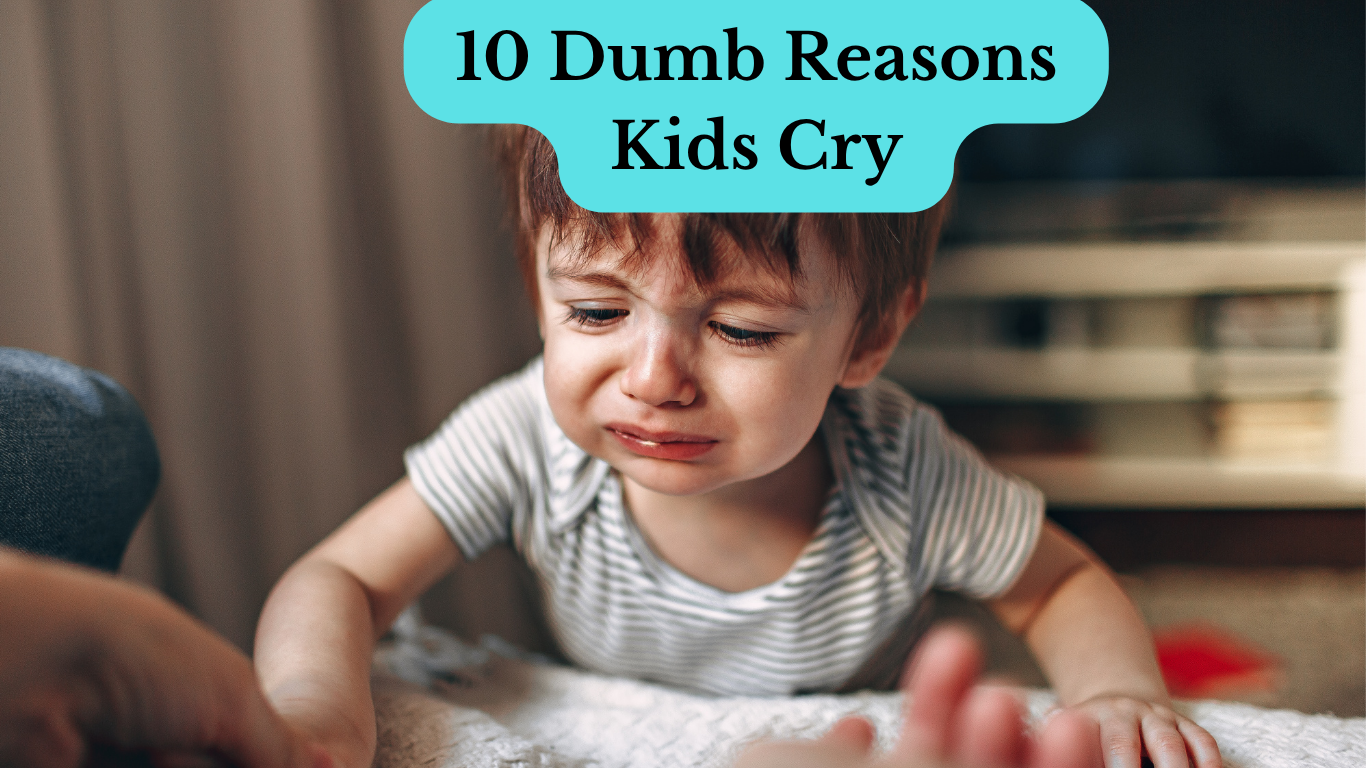
Have you ever been a parent, a caregiver, a teacher, or simply a nearby adult, witnessing a child dissolve into full-scale emotional crisis over something that — from the adult perspective — is so comprehensively not a crisis that the only available response is the specific combination of genuine concern and barely suppressed laughter that parenting reliably produces? Children cry. They cry with a commitment, a volume, and a creative relationship to cause-and-effect that adult emotional life simply cannot replicate. This blog celebrates the most magnificently disproportionate, most creatively misguided, and most genuinely funny reasons children have been observed crying — with the warm, affectionate recognition that every one of these children was experiencing something entirely real to them, which makes the whole thing simultaneously funnier and more endearing.
Table of Contents
1. The Dog Was Looking at Them
The crisis: Sustained, committed sobbing because the family dog made eye contact.
Not threatening eye contact. Not barking eye contact. Simply the dog, in its customary position on the sofa, directing its gaze in the child’s direction with the mild, benevolent attention that dogs deploy on everything in their vicinity. The dog was not doing anything. The dog was simply being a dog in proximity to a child who had decided, at this specific moment, that being looked at by the dog was unacceptable.
The parent’s attempt to explain that the dog looking at you is not, in the catalogue of available misfortunes, particularly significant, was received poorly. The dog, responding to the emotional climate of the room, continued to exist. The child continued to be aggrieved by this. Eventually some equilibrium was restored, and the dog went back to sleeping, which resolved the eye contact issue in a way that the parent’s explanation had not.
What makes this category of child crying so endearing is the dog’s utter innocence of any wrongdoing — its complete bewilderment at having become the villain of an emotional scene simply by existing in the usual way and looking in the usual direction. The dog did not choose this. The dog never chooses this. The dog is always surprised.
2. Their Toast Was Cut Into Squares When They Wanted Triangles
The geometric toast crisis is among the most well-documented entries in the parental annals of “I genuinely could not have anticipated this would be a problem,” and it has been experienced by a sufficient number of parents across a sufficient number of cultures that it has achieved the status of a near-universal childhood experience.
The toast, by any objective measure, is the same toast. It has the same nutritional content, the same flavour profile, the same structural integrity in either configuration. The butter distribution is comparable. The cutting was done with genuine care and reasonable skill. None of these facts are relevant. The shapes are wrong. The morning is ruined.
What makes the geometric toast crisis particularly interesting from a developmental psychology perspective is what it reveals about children’s very early and very serious engagement with preference and autonomy — the specific and genuine importance of things being the way they wanted them to be, whose violation is experienced as a meaningful injustice rather than a trivial inconvenience. The toast is not about the toast. The toast is about wanting the world to match the internal vision of how it should be — a feeling that, scaled to adult life, is entirely recognisable.
3. The Banana Was Peeled Wrong — or Right — or At All
The banana is the food most represented in the literature of children crying about food presentation, and it holds this position because it is also among the foods whose very existence seems most designed to generate child-specific grievances.
Scenario one: the banana was peeled from the top, and the child wanted to peel it themselves from the bottom. The banana has been irrevocably compromised. It is now not a banana that can be enjoyed — it is evidence of an injustice.
Scenario two: the banana was not peeled at all, and the child wanted it peeled. The banana is wrong.
Scenario three: the banana was broken — anywhere, in any amount, for any reason — and is therefore no longer a banana in any meaningful sense and cannot be consumed.
Scenario four: the banana is the right banana, peeled correctly, intact, presented appropriately, but it is not the banana that was wanted. There was a different banana. That banana was better. The loss of the other banana — which may or may not have existed — is the specific subject of the current emotional episode.
4. They Asked for Help and Then Got Help
The request-for-help crisis is a developmental classic whose timing is exquisitely frustrating and whose internal logic, once understood, is entirely coherent — the child asked for help with something, help was provided, and the provision of the help has now made the thing different from how they wanted it, which was for them to do it themselves, which they could not do, which is why they asked for help, which they did not want.
The shoe-tying version is perhaps the most universal. The child cannot tie their shoe. They communicate this, with increasing urgency. The parent ties their shoe. The child, whose shoe is now tied, is devastated. They wanted to tie it. The parent’s understanding that they had just requested this assistance is apparently irrelevant to the current emotional position, which is that the shoe should be untied so that they can tie it themselves, which they also cannot do.
What makes this crisis so specifically and efficiently frustrating for parents is the speed of the transition from the desperate need for help to the devastated rejection of the help provided — a transition that can occur in the time it takes to complete the assistance, leaving the parent holding a tied shoe and wondering where they went wrong.
5. The Sun Was in Their Eyes
The sun crisis occupies a special category of child crying because of its specific combination of the child’s genuine discomfort — the sun is, indeed, in their eyes, and this is an objectively irritating experience — and the complete absence of any available party to hold responsible for this state of affairs.
The sun is in their eyes. Someone must be responsible. Nobody is available who is responsible. This is the specific structure of the sun crisis — the genuine discomfort meeting the specific developmental stage of needing someone to be accountable for discomforts, encountering the meteorological reality that the sun does not operate in response to parental authority.
The parent’s attempt to explain atmospheric optics, the geometry of the Earth’s orbit, and the general non-responsiveness of celestial bodies to requests for adjustment is received with the specific frustration of someone who understands at some level that this explanation is correct and finds this fact additionally grievous. The sun continues to be in their eyes. The crying continues. Eventually a cloud, or a turn in the road, or a well-timed hat resolves the situation without any improvement in the child’s understanding of why none of this was anyone’s fault.
6. Their Sibling Was Breathing
The sibling-breathing crisis represents the specific and magnificent hostility of sibling relationships at their most creatively aggrieved — the identification of the most fundamental and least actionable biological process as the specific subject of a grievance that demands immediate parental intervention.
“They’re breathing on me.” Or: “They’re breathing too loud.” Or, most impressively, the version in which no proximity is alleged, no contact is claimed, no noise is specified — simply the awareness of the sibling’s ongoing biological existence in the shared space, communicated as a problem that requires solving.
The parent’s observation that breathing is both necessary and non-negotiable is received as the kind of technicality that should not be allowed to stand in the way of justice. The sibling, who may or may not be aware of the crisis their respiratory function has generated, continues to breathe with the casual unconcern of someone who has been through this before and expects to get through it again.
What the sibling-breathing crisis reveals, beneath its comedy, is the genuine emotional intensity of sibling relationships — the specific closeness and specific friction of people who share everything including space, parents, and the full weight of childhood in close quarters — expressed through the most absurd available channel.
7. The Cartoon Character They Did Not Like Appeared on Screen
The cartoon crisis has a specific and well-documented variant in which the child’s distress is not produced by something bad happening to a character they love — which would be, from an adult perspective, at least understandable — but by the mere appearance of a character they have decided they do not like, whose presence on the screen for even a brief moment has contaminated the viewing experience in ways that require immediate parental action.
The specific character in question varies — there is always a character — and the dislike of that character is genuine, deeply felt, and impervious to the observation that the character is fictional and therefore incapable of causing any actual harm. They are on the screen. They exist in the child’s viewing environment. This is not acceptable.
The parent’s attempt to fast-forward, change the channel, or otherwise remove the offending character from the visual field is complicated by the child’s simultaneous insistence on watching the thing from which the character must be removed — a logical position from the child’s perspective and a structurally impossible one from the parent’s.
8. A Grown-Up Sang Along With a Song
The sing-along crisis is both entirely understandable from the child’s developmental perspective and spectacularly funny in its delivery — the specific devastation of a child who has discovered that a parent knows the words to a song and has made the mistake of demonstrating this knowledge at a moment when the child was enjoying the song in a way that requires sole ownership of its experience.
“Stop singing it.” The parent stops. A moment passes. The song continues. The parent, whose capacity for restraint is apparently limited, hums the melody. This is worse than singing. The humming is precisely as bad as the singing, possibly worse, because the humming is the singing stripped of the courtesy of being fully committed to the transgression.
The sing-along crisis reveals something genuinely interesting about childhood’s relationship with music and ownership — the specific way that children attach to songs, performances, and experiences as theirs and experience sharing them as dilution rather than amplification. The parent who sings along is not, in the child’s emotional accounting, participating in a shared pleasure — they are trespassing on a private experience in a way that somehow diminishes the original thing.
9. The Wrong Parent Came to Get Them
The wrong-parent crisis is the one that most effectively communicates both the depth of children’s specific attachments and the specific impracticality of those attachments as a basis for managing family logistics — the child who wanted Mummy, got Daddy, and has decided that this substitution is categorically insufficient regardless of Daddy’s many genuine qualities.
Daddy is not wrong in any objective sense. Daddy is attentive, caring, and present. Daddy would like to help. The problem is not Daddy’s characteristics — it is Daddy’s identity, which is not Mummy. The preference for Mummy at this specific moment is absolute, and no amount of Daddy being genuinely excellent resolves the fundamental identity problem that Daddy’s presence represents.
What makes this crisis particularly affecting — beneath its comedy — is what it reveals about the depth and specificity of children’s attachments. The preference is not casual. It is not negotiable. It reflects a genuine and profound relational need that, in the moment, only one specific person can meet. This is a feeling that, scaled to adult experience, is entirely recognisable — the moments when only a specific person will do — expressed with the full uninhibited force of a small person who has not yet learned to manage it quietly.
10. Life Itself
The tenth and final entry is the most comprehensive — the crying that is not about anything specific, that did not begin with an identifiable trigger, that cannot be resolved by addressing any particular grievance because the grievance is not locatable, and that represents the general condition of being a small person in a large and overwhelming world that contains constant novelty, constant stimulation, and the continuous requirement to navigate experiences whose emotional weight exceeds the regulatory capacity available for managing them.
This is the tired cry. The hungry cry that does not know it is hungry. The overwhelmed cry. The “I don’t know why I’m crying but I am definitely crying” cry that every parent knows by its specific quality — different from the injury cry, different from the injustice cry, different from the want cry — the cry of someone who simply needs to cry and is doing so with complete commitment.
The parent who encounters this cry has no specific grievance to address, no injustice to remedy, no banana to correct — only the small person, the tears, and the specific job of being present for the experience of being small in a world that is large and sometimes simply too much, which is the most important job parenting contains.
Key Takeaways
The ten reasons in this blog — the dog’s gaze, the geometric toast, the existential banana, the help that was also not help, the sun’s inconvenient position, the sibling’s audacity of existing, the cartoon villain, the sing-along transgression, the wrong parent, and the general condition of childhood — together capture something genuinely true about the experience of being small.
Children cry at things that seem objectively small because nothing is small to them yet. They have not yet accumulated the experience that calibrates emotional response to objective scale, the perspective that distinguishes the genuinely significant from the temporarily frustrating, or the self-regulatory capacity that manages the gap between how things feel and how they are expressed. They are learning all of these things — through the very experiences that produce the crying — and the crying itself is part of the process.
Per developmental psychology research on emotional development, the child who is allowed to experience, express, and gradually learn to regulate genuine emotional responses — however apparently disproportionate those responses are to their triggers — is developing the emotional intelligence and regulatory capacity that adult functioning requires. The banana crisis is not a failure of parenting or childhood. It is the work of emotional development in progress.
The toast will be cut into triangles next time. The dog will be redirected. The banana will be presented with ceremony and handled with extreme care. And somewhere in all of it — in the tiredness and the laughter and the crying that is about nothing and everything simultaneously — is the specific, unrepeatable, occasionally hysterical privilege of being present for someone’s first years of learning what it feels like to be alive.