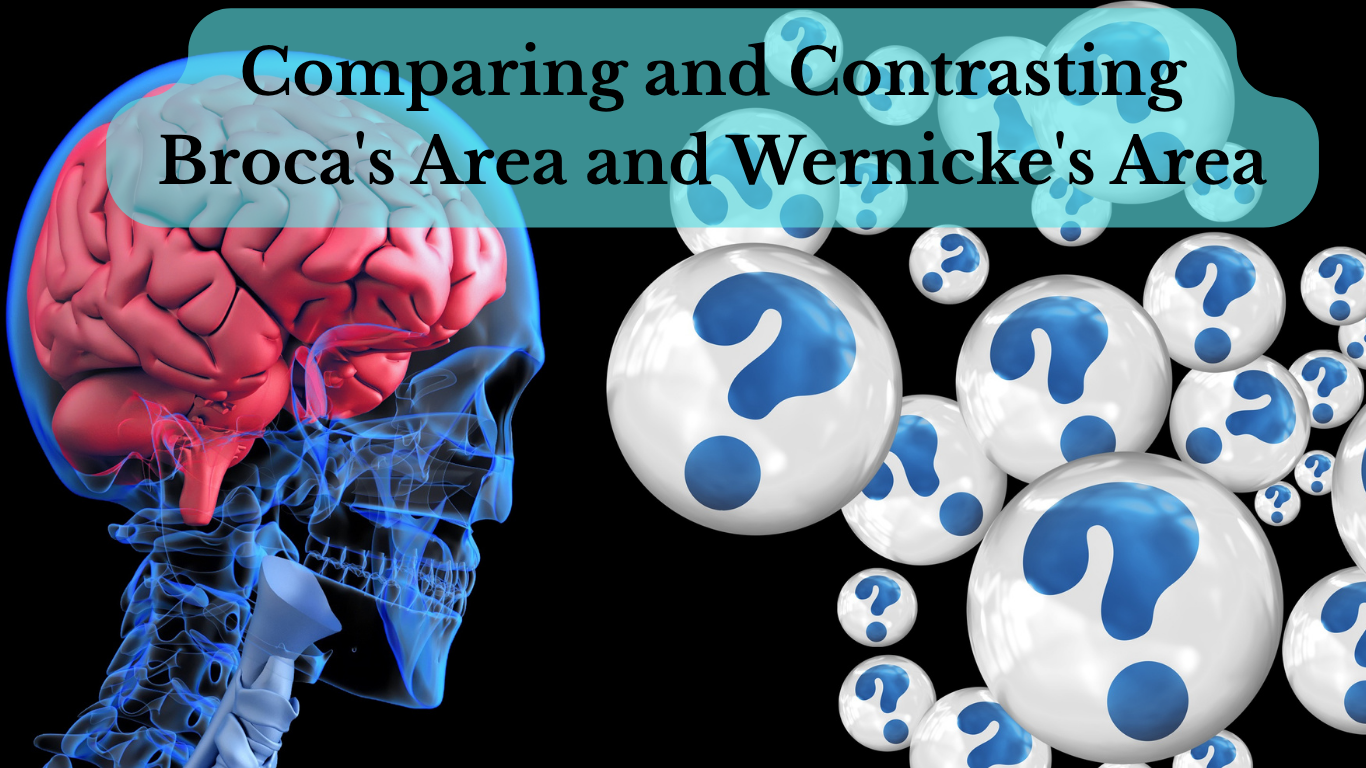
Have you ever wondered why a stroke affecting one small region of the brain can leave a person unable to produce fluent speech while their comprehension remains completely intact, while damage to a different region just a few centimetres away produces the opposite pattern – fluent, grammatically structured speech that makes no coherent sense at all? The relationship between Broca’s area and Wernicke’s area is one of the foundational case studies in the neuroscience of language — foundational because the nineteenth-century clinical observations that identified these regions established some of the earliest evidence that specific cognitive functions could be localised to specific brain structures, and genuinely instructive today because the comparison between them illustrates both how language is organised in the brain and how much that early, elegant model has since been refined. This blog examines the locations, functions, associated disorders, and historical significance of these two regions, along with the more nuanced understanding that contemporary neuroscience has developed.
Table of Contents
Location and Anatomical Position
Broca’s area is located in the posterior portion of the frontal lobe, specifically in the inferior frontal gyrus, typically in the left hemisphere for the vast majority of right-handed individuals and most left-handed individuals as well. It corresponds approximately to Brodmann areas 44 and 45. Its position adjacent to the motor cortex — particularly the region controlling the muscles of the face, tongue, jaw, and throat — is anatomically significant, reflecting its close functional relationship to the physical production of speech.
Wernicke’s area is located in the posterior portion of the superior temporal gyrus, typically also in the left hemisphere, corresponding approximately to Brodmann area 22. Its position is adjacent to the auditory cortex, reflecting its traditional association with the processing and comprehension of heard language. Wernicke’s area sits closer to the junction of the temporal, parietal, and occipital lobes — a region sometimes implicated in integrating auditory, visual, and somatosensory information relevant to language.
The two regions are connected by a bundle of white matter fibres called the arcuate fasciculus, whose integrity is critical to the classical model of how these regions are understood to work together.
Primary Function: Production Versus Comprehension
The most commonly taught distinction between the two areas is the classical production-versus-comprehension framework, established originally through nineteenth-century clinical observation and still useful as a starting point.
Broca’s area is traditionally associated with speech production — the planning and coordination of the motor sequences required to articulate words, and the grammatical and syntactic structuring of language. It is considered central to the ability to generate fluent, grammatically well-formed sentences and to coordinate the complex sequence of motor commands that speaking requires.
Wernicke’s area is traditionally associated with language comprehension — the processing of heard or read language into meaning. It is considered central to the ability to understand the semantic content of language, whether spoken or written, and to select appropriate words during the process of producing meaningful speech.
This functional distinction is the most commonly cited contrast between the two regions, and it remains a useful first-pass framework even though, as discussed further below, the reality is considerably more distributed and interactive than this clean separation suggests.
Associated Disorders: Broca’s Aphasia Versus Wernicke’s Aphasia
The clinical syndromes associated with damage to each region provide the clearest and most memorable illustration of their differing functions.
Broca’s aphasia (also called expressive or non-fluent aphasia) is characterised by:
- Slow, laboured, non-fluent speech production
- Short, fragmented sentences with simplified grammar (often called “telegraphic speech” — e.g., “Want… go… store” instead of a full sentence)
- Relatively preserved comprehension of language
- Frequent awareness and frustration on the part of the patient about their own difficulty, since they generally understand what they want to say but cannot produce it fluently
- Often accompanied by right-sided weakness or paralysis, since the region’s proximity to the motor cortex means strokes large enough to damage it frequently also damage adjacent motor areas
Wernicke’s aphasia (also called receptive or fluent aphasia) is characterised by:
- Fluent, grammatically structured speech that flows easily
- Speech content that is often meaningless, includes invented words (neologisms), or substitutes incorrect words (paraphasias)
- Significantly impaired comprehension of spoken and written language
- Often a lack of awareness that anything is wrong with their own speech (a phenomenon called anosognosia), since the same comprehension deficit that impairs understanding others’ speech also impairs the ability to monitor and recognise errors in their own
The contrast between these two syndromes is genuinely striking in clinical practice — the Broca’s aphasia patient who struggles desperately to produce a few correct words while fully understanding everything said to them, versus the Wernicke’s aphasia patient who speaks in an effortless stream of fluent nonsense while remaining largely unaware that anything is amiss.
Historical Discovery and Significance
Both regions were identified through similar methodology — careful clinical observation of patients with specific language deficits, followed by post-mortem examination of their brains to identify the location of damage.
Paul Broca, a French physician, identified the region in 1861 through his examination of a patient nicknamed “Tan” (his real name was Louis Victor Leborgne), who could understand language but could produce only the single syllable “tan” repeatedly. Post-mortem examination revealed a lesion in the posterior inferior frontal gyrus, which Broca identified as the seat of articulate speech.
Carl Wernicke, a German neurologist, identified the corresponding comprehension-related region in 1874, building on Broca’s work and identifying patients with the opposite pattern of deficit — fluent but meaningless speech with impaired comprehension — whose lesions were located in the posterior superior temporal gyrus.
Together, these discoveries were genuinely revolutionary for nineteenth-century neuroscience — they provided some of the first compelling evidence for the principle of cortical localisation, the idea that specific, complex cognitive functions could be mapped to specific brain regions rather than being distributed uniformly across the brain as some contemporary theories suggested. This work directly informed the Wernicke-Lichtheim model (later developed further as the “classical model” of language), which proposed that auditory word forms were processed in Wernicke’s area, transmitted via the arcuate fasciculus to Broca’s area, and then converted into motor speech output.
How They Work Together: The Classical Model
The traditional model describes language processing as a relatively sequential pathway:
- Spoken language is heard and initially processed in the auditory cortex
- The sound is processed for meaning in Wernicke’s area
- The semantic and lexical information is transmitted via the arcuate fasciculus to Broca’s area
- Broca’s area organises this information into a grammatically structured, motorically executable plan for speech
- The motor cortex executes the physical movements required for articulation
Damage to the arcuate fasciculus itself, disconnecting the two regions while leaving both intact, produces a third classical syndrome called conduction aphasia — characterised by fluent speech and largely intact comprehension, but a specific and pronounced difficulty repeating words or phrases spoken by someone else, since the connection required to relay heard language into a spoken repetition is disrupted.
The Contemporary Revision: A More Distributed Picture
While the classical model remains pedagogically useful and clinically relevant, contemporary neuroscience using functional MRI, diffusion tensor imaging, and more sophisticated lesion-mapping techniques has substantially revised this picture in several important ways.
Language is more distributed than the two-region model suggests. Modern neuroimaging research consistently shows that language processing engages a broader network of regions, including areas of the middle temporal gyrus, additional frontal regions beyond Broca’s area proper, the angular and supramarginal gyri, and even some right hemisphere contribution, particularly for prosody (the rhythm, stress, and intonation of speech) and pragmatic aspects of language use.
The functions of “Broca’s area” and “Wernicke’s area” are not as cleanly separated as production versus comprehension. Research has found that Broca’s area is involved in some aspects of comprehension, particularly the processing of complex syntax, and that Wernicke’s area contributes to aspects of production, particularly word selection and retrieval. The clean functional split taught in introductory courses is a useful simplification rather than a complete description.
The precise anatomical boundaries of both regions are debated. Some researchers have questioned whether the cortical area damaged in Broca’s original patient actually corresponds precisely to what is now labelled “Broca’s area” in modern atlases, and the exact boundaries of Wernicke’s area are similarly subject to ongoing debate and have varied across different research traditions and historical periods.
Aphasia syndromes in clinical practice are often less clean than the classical categories suggest. Many stroke patients present with mixed or atypical patterns that do not fit neatly into “pure” Broca’s or Wernicke’s aphasia, reflecting the reality that strokes rarely damage only one cleanly bounded region and that the underlying neural architecture of language is more interconnected than the classical model implies.
Summary Comparison
| Feature | Broca’s Area | Wernicke’s Area |
|---|---|---|
| Location | Posterior inferior frontal gyrus (frontal lobe) | Posterior superior temporal gyrus (temporal lobe) |
| Brodmann areas | 44, 45 | 22 |
| Primary function | Speech production, grammatical structuring | Language comprehension, semantic processing |
| Associated aphasia | Broca’s (non-fluent) aphasia | Wernicke’s (fluent) aphasia |
| Speech characteristics when damaged | Slow, effortful, fragmented, telegraphic | Fluent but often meaningless, with paraphasias |
| Comprehension when damaged | Largely preserved | Significantly impaired |
| Patient awareness of deficit | Usually aware, often frustrated | Often unaware (anosognosia) |
| Discovered by | Paul Broca (1861) | Carl Wernicke (1874) |
| Connecting structure | Arcuate fasciculus (connects to Wernicke’s area) | Arcuate fasciculus (connects to Broca’s area) |
Key Takeaways
Broca’s area and Wernicke’s area represent one of the foundational discoveries in the neuroscience of language — two distinct cortical regions, identified through careful clinical observation of patients with strikingly different and complementary language deficits, whose comparison established some of the earliest and most compelling evidence for functional localisation in the human brain. Their classical association with speech production and language comprehension respectively, and the corresponding aphasia syndromes that damage to each produces, remain genuinely useful frameworks for understanding both the clinical presentation of stroke-related language disorders and the broader history of neuroscience as a discipline.
The contemporary, more nuanced understanding — recognising that language engages a more widely distributed network, that the functional boundaries between these regions are less absolute than once believed, and that the clean clinical categories are simplifications of a messier biological reality — does not diminish the historical and continuing pedagogical value of the classical model. It simply reflects the normal progress of scientific understanding, in which an elegant early framework provides the essential scaffolding that more detailed subsequent research refines rather than discards.