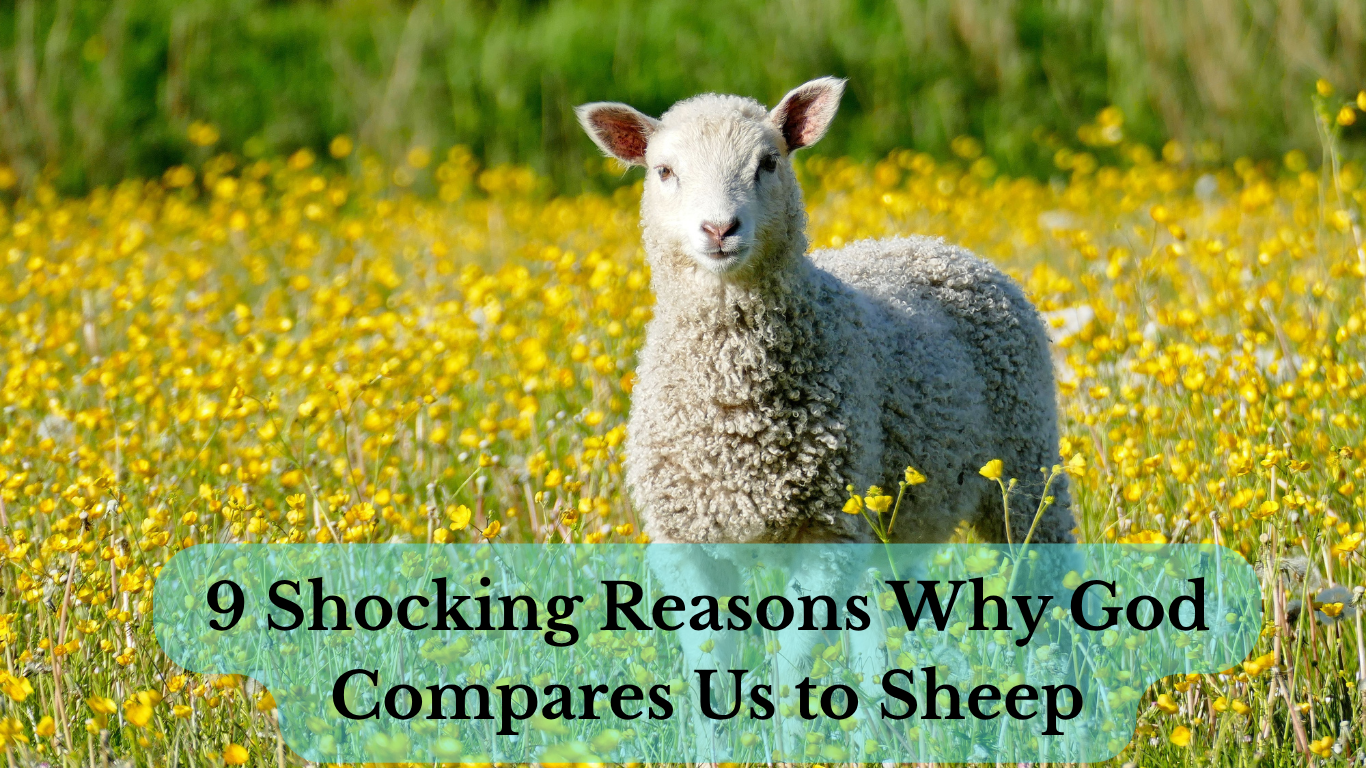
Have you ever paused to consider that one of the Bible’s most frequent and most beloved metaphors for human beings is also, from a zoological perspective, one of the least flattering comparisons available in the animal kingdom? God compares His people to sheep — not eagles, whose soaring majesty would be inspiring; not lions, whose strength would be impressive; not even industrious ants, whose organisation would be admirable — but sheep. And the more one understands about the actual nature and behaviour of sheep, the more the comparison reveals about the depth of theological honesty embedded in the metaphor. This blog examines 9 reasons why God compares us to sheep — and why each reason is simultaneously humbling, illuminating, and ultimately a source of profound comfort rather than embarrassment.
Table of Contents
The Shepherd-Sheep Metaphor in Scripture
Before examining the nine reasons, it is worth establishing the depth and frequency with which Scripture employs this metaphor – because it is not an incidental comparison but one of the Bible’s most sustained and most theologically significant images.
The shepherd-sheep relationship appears throughout both Testaments with remarkable consistency. “The Lord is my shepherd; I shall not want” (Psalm 23:1) is perhaps the most beloved and most memorised verse in all of Scripture—and it opens by establishing this foundational relational reality. Jesus describes himself as the Good Shepherd who lays down his life for the sheep (John 10:11), who knows his sheep by name (John 10:3), and who leaves the ninety-nine to find the one that is lost (Luke 15:4). The prophet Isaiah declares, “We all, like sheep, have gone astray; each of us has turned to our own way” (Isaiah 53:6). And the book of Revelation closes with the image of the Lamb – himself the Good Shepherd – leading his people to springs of living water (Revelation 7:17).
The consistency of this metaphor across the sweep of Scripture is not coincidental. It reflects a deliberate, sustained, and theologically precise comparison that rewards careful examination.
1. Sheep Are Utterly Dependent — And So Are We
Among the most fundamental zoological facts about sheep is their extraordinary degree of dependence on their shepherd. Unlike most animals that develop survival instincts and independence from their earliest weeks, sheep are uniquely, almost comprehensively, unable to manage without human care and direction. They cannot reliably find adequate food and water independently. They cannot protect themselves from predators. They cannot navigate back to safety when lost. They require the shepherd for virtually every dimension of their well-being.
This total dependence is precisely what makes the metaphor theologically accurate rather than merely poetic. The foundational claim of biblical faith is that human beings were created for dependence on God — not the dependence of weakness or inadequacy but the dependence of relationship, of creature upon Creator, of the beloved upon the One who loves. “Apart from me you can do nothing” (John 15:5) is not a limitation imposed upon us from outside—it is a description of our nature, made in the image of a relational God for a life of sustained communion with Him.
The specific comfort of the comparison is this: a shepherd who takes sheep does so knowing they are dependent. The acceptance is not conditional on their independence becoming complete. God’s shepherding of His people is offered precisely in the full awareness of their need – and the need itself is not an obstacle to the relationship but the context in which its depth is revealed.
2. Sheep Are Prone to Wandering — Without Realising They Have Gone Astray
Sheep have a remarkable capacity for drifting — moving from one patch of grass to the next, following immediate appetite rather than any awareness of direction or destination until they are profoundly and thoroughly lost without having made any single decisive turn away from home. The wandering sheep did not decide to become lost. It simply followed the next available bit of grass until it looked up and had no idea where it was.
Isaiah’s declaration captures this precisely — “We all, like sheep, have gone astray; each of us has turned to our own way” (Isaiah 53:6). The Hebrew construction suggests not a dramatic rebellion but a gradual, appetite-driven drift — the following of immediate desire until the distance from God has become significant without any single moment of dramatic departure being identifiable.
This specific quality of the sheep metaphor is among its most theologically honest applications. Human spiritual wandering rarely looks like dramatic apostasy. It looks like the gradual prioritisation of other things – comfort, distraction, ambition, pleasure, self-sufficiency – until the practice of faith has atrophied, the relationship with God has become distant, and the person who once walked closely with God finds themselves far away without a single moment they could point to as the turning point.
The Good Shepherd’s response to the wandering sheep is equally revealing. He does not wait for the sheep to find its own way back — he leaves the ninety-nine and searches for the one that is lost (Luke 15:4). The shepherd’s initiative in pursuit is the specific grace that the sheep’s wandering necessitates and that the metaphor is designed to illuminate.
3. Sheep Cannot Defend Themselves — And Neither Can We
Sheep are among the most defenceless large animals in nature. They have no meaningful offensive capability — no claws, no venom, no significant speed advantage over predators, no defensive horns in most breeds. Their primary defence mechanism is proximity to the shepherd and the flock — isolation is existential danger, and the sheep that stray from the shepherd’s presence become immediately and acutely vulnerable to every threat the environment contains.
The theological application is one of the most honestly humbling dimensions of the comparison. The spiritual vulnerability of human beings — to the specific forces that Scripture identifies as threats, including the enemy of souls, the world’s distorting values, and the pull of the flesh — is not a weakness that self-development or spiritual discipline can ultimately resolve independently. The safety of the sheep depends not on the sheep’s own capabilities but on the shepherd’s presence, vigilance, and power.
Per the imagery of Psalm 23, the shepherd’s rod and staff are not the sheep’s weapons but the shepherd’s instruments — the rod for protection against predators and the staff for guiding and steadying the sheep. The sheep’s protection is entirely derivative of the shepherd’s active engagement. “Even though I walk through the valley of the shadow of death, I will fear no evil, for you are with me; your rod and your staff, they comfort me” (Psalm 23:4). The comfort is not the sheep’s own strength but the shepherd’s presence.
4. Sheep Follow — But They Can Follow the Wrong Voice
Sheep are followers — they move in flocks, they follow the lead sheep, and they are susceptible to the directional influence of whatever voice or presence establishes itself as worthy of following. In a healthy flock with a faithful shepherd, this following instinct is the precise quality that makes the relationship work. In a situation where a threatening voice mimics the shepherd’s, or where the flock follows a lead sheep in the wrong direction, the following instinct becomes a source of danger rather than safety.
Jesus’s teaching in John 10 is built directly on this quality — “My sheep listen to my voice; I know them, and they follow me” (John 10:27). The specific distinction Jesus draws is between the voice of the Good Shepherd — whose sheep recognise and follow — and the voice of strangers and thieves, which the sheep of the true flock will not follow because they do not recognise it (John 10:5).
The theological implication is direct and important. The capacity for following is not the problem — it is the design. Human beings were made to follow, to be directed, to orient their lives around a voice and a presence beyond themselves. The spiritual danger is not the following instinct but its misdirection – toward voices that promise life and deliver destruction, toward the leading of cultural consensus that has departed from God’s design, and toward the false shepherds that every generation produces.
The specific remedy is not the development of radical independence — the sheep that decides to follow nothing is not safer than the sheep following the Good Shepherd; it is simply lost alone. The remedy is the cultivation of discernment — the developing capacity to recognise the true Shepherd’s voice so reliably that counterfeit voices are identified for what they are.
5. Sheep Require Still Waters — They Are Easily Overwhelmed
A well-documented characteristic of sheep that has significant theological resonance is their relationship with water. Sheep will not drink from fast-moving, turbulent water — the rushing of a stream frightens them, and the wool they carry makes them susceptible to being pulled under if they enter moving water and become saturated. They require the shepherd to lead them to still waters — the quiet pools and gentle streams where drinking is safe and the experience is restorative rather than threatening.
Psalm 23:2 captures this precisely — “He leads me beside still waters”. The specific provision of still water rather than simply water reflects the shepherd’s intimate knowledge of the sheep’s specific needs and vulnerabilities – not just what is required but what is required in a form the sheep can safely receive.
The theological application speaks to the human need for the specific form of spiritual nourishment that our nature can receive. The overwhelming torrent of spiritual information, the noise of competing voices, the rapid pace of contemporary life — these are not the conditions in which the human soul most readily receives the nourishment it needs. The Good Shepherd leads to the still waters — the quiet places, the unhurried moments, the practices of silence and prayer and sabbath — where the soul can actually drink.
6. Sheep Have No Sense of Direction — They Need to Be Guided
Sheep have a notoriously poor sense of direction. Unlike some animals with strong homing instincts, sheep that become separated from their flock or their shepherd have minimal capacity for independent navigation back to safety. They do not naturally orient toward home – they orient toward immediate stimuli, following what is immediately appealing without any reliable internal compass pointing toward where they need to be.
“I am the way and the truth and the life” (John 14:6) addresses precisely this need – the provision of the directional guidance that the sheep cannot generate from within. Proverbs 3:5-6 — “Trust in the Lord with all your heart and lean not on your own understanding; in all your ways submit to him, and he will make your paths straight” — acknowledges both the insufficiency of autonomous navigation and the provision available through dependence on the Shepherd’s direction.
The specific humility this dimension of the metaphor requires is the acknowledgement that the sense of confident self-direction that modern culture most prizes is, in the spiritual domain, one of the conditions most likely to produce lostness. The sheep that is most confident of its own navigation capacity is often furthest from home.
7. Sheep Are Prone to Casting — They Need Someone to Restore Them
One of the most striking and least known facts about sheep is the phenomenon of a sheep becoming cast—falling onto its back in a hollow or depression and being unable to right itself without help. A cast sheep – particularly one with a full fleece – can die within hours if not restored to its feet, because the gases that build up in the rumen can prevent breathing and reduce circulation. A cast sheep does not need food or water or protection in that moment — it needs someone to come and lift it to its feet.
The shepherd’s regular task of walking among the flock is partly the search for cast sheep — the ones who have fallen and cannot rise without assistance.
Psalm 23:3 uses the word ‘restore’ – ‘He restores my soul‘ – and the specific image of restoration in the shepherd’s context is precisely this lifting of the cast sheep. The theological application is one of the most personally comforting dimensions of the metaphor. There are seasons in human spiritual experience — of depression, of discouragement, of spiritual defeat, and of the accumulated weight of failure or grief — in which the person simply cannot lift themselves. They are not capable of self-restoration. They need the Shepherd to come to them in their helplessness and lift them.
The Good Shepherd’s promise is that He does exactly this — not after the lost sheep has made some preliminary effort to restore itself, not after it has demonstrated sufficient worthiness of assistance, but simply in response to the condition of the sheep who cannot rise on its own.
8. Sheep Are Valuable to the Shepherd — Far Beyond What They Might Expect
A sheep contemplating its own value in isolation would have a limited basis for confidence. It is not the most capable animal. It is not the most self-sufficient. It is not the most impressive. Its primary contribution to the shepherd is the wool it produces and, in some traditions, the lamb it bears – neither of which the sheep produces through deliberate choice or remarkable skill.
And yet the shepherd’s valuation of the sheep consistently exceeds what the sheep’s self-assessment might predict. The shepherd who leaves the ninety-nine to find the one lost sheep (Luke 15:4) is doing something economically irrational — the risk to the ninety-nine, the effort of the search, and the value of a single sheep do not justify the calculation by market logic. The shepherd’s pursuit reflects not market value but relationship value — the worth that comes not from what the sheep produces but from the relationship the shepherd has with each individual sheep.
Jesus’s description of the Good Shepherd is radical in precisely this dimension — “He calls his own sheep by name” (John 10:3). Each sheep is individually known, individually named, and individually pursued. The flock is not an aggregate — it is a collection of individuals, each of whom the Shepherd knows specifically.
The theological comfort of this dimension of the metaphor is one of the most fundamental in all of Scripture — you are known by name, pursued individually, valued beyond what market logic would suggest, and cared for not because of what you produce but because of who the Shepherd is.
9. Sheep Ultimately Need a Shepherd Who Is Willing to Die for Them
The final and most theologically profound reason God compares us to sheep is that the comparison reaches its climax not in the sheep’s inadequacy but in the Shepherd’s sacrifice. “I am the good shepherd. The good shepherd lays down his life for the sheep” (John 10:11).
A hired hand, Jesus explains, sees the wolf coming and abandons the sheep because he is not the shepherd and the sheep are not his own (John 10:12–13). The Good Shepherd does not flee — He stands between the predator and the sheep, and He does so at ultimate cost. The sheep’s need is greater than any shepherd could meet except through self-giving love.
Isaiah 53 — the passage whose sixth verse declares, “We all, like sheep, have gone astray” — goes on to describe the Servant who bears the iniquity that the wandering produced: “He was led like a lamb to the slaughter, and as a sheep before her shearers is silent, so he did not open his mouth” (Isaiah 53:7). The sheep metaphor reaches its most extraordinary moment when the Shepherd becomes the Lamb — when the one who pursues the lost becomes the one who pays the price for their lostness.
The comparison to sheep, understood fully, is not humiliating. It is the context in which the love of God becomes most visible — because what kind of love would leave the ninety-nine and come after the one? What kind of love would lay down its life for the sheep? The sheep’s helplessness, wandering, vulnerability, and dependence are not obstacles to that love — they are precisely the conditions that revealed its depth.
Key Takeaways
The nine reasons God compares us to sheep — our utter dependence, our tendency to wander without awareness, our defencelessness, our susceptibility to following wrong voices, our need for still waters, our lack of direction, our tendency to fall and be unable to rise, our value to the Shepherd beyond our own estimation, and our need for a Shepherd willing to die for us — are not nine separate embarrassments. There are nine dimensions of a single, integrated truth about the human condition and the divine response to it.
Per the testimony of believers across every century of the church’s life, the sheep metaphor is ultimately not humiliating but liberating—because it honestly names the conditions of human need and simultaneously points to the Shepherd whose nature is precisely suited to meeting that need. The sheep’s weaknesses are not problems that disqualify them from the shepherd’s care — they are the reasons the shepherd’s care is offered.
We are sheep. And the Good Shepherd knows it completely, loves us anyway, and has given everything to ensure that not one of His sheep is ultimately lost. In that reality, the comparison to sheep becomes not an insult but an invitation — to stop pretending otherwise, to receive the care that is being offered, and to follow the voice that calls each of us by name.