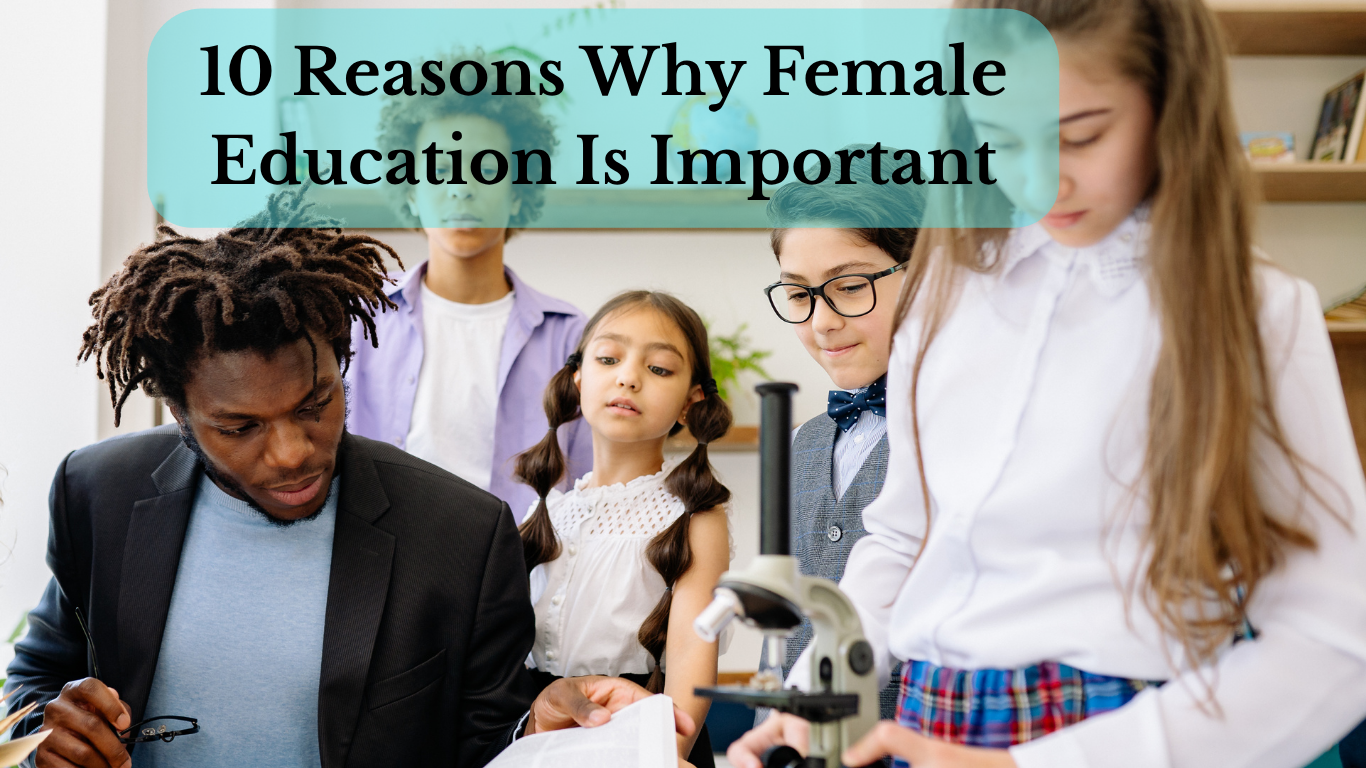
Have you ever considered the specific and well-documented ripple effect that a single girl’s access to education produces – not only in her own life trajectory but also in the health of her future children, the economic prospects of her community, and the broader trajectory of the society she is part of – and recognised that few investments available to humanity carry the documented, multiplying returns that female education consistently demonstrates? Female education remains one of the most extensively researched and most consistently validated levers for human development available — researched because the gap between male and female educational access has been a persistent global reality whose closure development economists and policymakers have studied intensively and validated because the evidence for its transformative effects across health, economic, and social outcomes is among the most robust in development research. This blog examines 10 evidence-based reasons why female education matters profoundly — for individuals, families, communities, and nations.
Table of Contents
1. It Significantly Improves Maternal and Child Health Outcomes
The first and among the most extensively documented reasons female education matters is its powerful and consistent association with improved health outcomes for women and their children.
Per research published by UNESCO and the World Bank, increased years of maternal education are associated with significantly reduced rates of maternal mortality, reduced infant and child mortality, and improved child nutrition outcomes — with some analyses finding that each additional year of a mother’s education is associated with a measurable reduction in under-five mortality. The mechanisms include educated mothers’ greater capacity to access and understand health information, increased likelihood of seeking skilled care during pregnancy and childbirth, better understanding of nutrition and disease prevention, and generally greater autonomy in household health decision-making.
Per UNICEF research, children of educated mothers are significantly more likely to be immunised, more likely to survive past age five, and more likely to be adequately nourished than children of mothers with no formal education – a pattern documented consistently across diverse countries and contexts, suggesting the relationship reflects genuine causal mechanisms rather than being purely an artefact of the other advantages (wealth, urban residence) that often correlate with maternal education.
2. It Delays Marriage and Reduces Adolescent Pregnancy
The second reason is the well-documented relationship between girls’ continued education and delayed marriage and childbearing — a relationship with significant downstream effects on health, economic independence, and life trajectory.
Per research from UNICEF and the Population Council, girls who remain in secondary education are significantly less likely to marry before age 18 and significantly less likely to become pregnant during adolescence compared to girls who leave school early. Each additional year of secondary education is associated with a measurable reduction in the likelihood of child marriage in the populations studied. This matters because early marriage and adolescent pregnancy are associated with significantly elevated risks of maternal mortality and morbidity (adolescent bodies are at higher risk for pregnancy complications), reduced educational and economic prospects, and increased likelihood of intimate partner violence in several studied populations.
The relationship operates partly through a simple mechanism — girls in school have less exposure to marriage pressure and pregnancy risk during the years they remain enrolled — but also through the changed aspirations, social networks, and sense of alternative life pathways that sustained education provides.
3. It Substantially Increases Lifetime Earning Potential
The third reason is the direct and well-established economic return that education provides to the individual woman across her lifetime — a return that compounds with each additional year of schooling completed.
Per World Bank research on returns to education, each additional year of education is associated with an average increase in earnings, with the effect documented across both developing and developed economies, though the magnitude varies by context and level of education. For women specifically, secondary and tertiary education completion is associated with substantially higher formal labour force participation and substantially higher earnings within that participation compared to women with only primary education or no formal education.
This economic return matters not only for the individual woman’s financial independence and security but also for the household and community economic effects that follow — educated women who enter the workforce contribute to household income diversification, reduce household economic vulnerability to single-earner risk, and contribute tax revenue and economic productivity at the community and national level.
4. It Reduces Poverty Across Generations
The fourth reason is the specific intergenerational poverty reduction effect that female education produces — educated mothers raise children who are themselves significantly more likely to access education and escape poverty, creating a multiplying effect across generations.
Per research on intergenerational education transmission, children of educated mothers are significantly more likely to attend school themselves and to complete more years of education than children of mothers without education—with the maternal education effect on children’s schooling generally found to be stronger than the equivalent paternal education effect in much of the research literature, particularly for daughters’ educational attainment. This intergenerational transmission means that investment in girls’ education today produces compounding returns across multiple subsequent generations rather than a one-time benefit limited to the educated individual.
Per development economics research, this multiplying effect is among the reasons female education is frequently identified as one of the most cost-effective development interventions available — the returns are not contained to the individual but ripple forward through her children and, per some research, her children’s children.
5. It Increases Women’s Decision-Making Power and Autonomy
The fifth reason is the documented relationship between female education and increased autonomy and decision-making power within the household and broader community.
Per research on women’s empowerment and education, educated women demonstrate significantly greater participation in household financial decisions, greater control over their own healthcare decisions, and greater autonomy in decisions about their children’s education and welfare compared to women with less or no formal education. This increased decision-making power is associated, in turn, with household resource allocation that more consistently prioritises children’s health, nutrition, and education – per research on household economics, women across many studied contexts demonstrate a greater propensity than men to direct household resources toward children’s welfare when they have genuine decision-making power over those resources.
The autonomy effect also extends to women’s capacity to make decisions about their own lives — including decisions about marriage timing, family size, and whether and when to enter the workforce — that research consistently associates with improved wellbeing outcomes for the women themselves.
6. It Contributes Significantly to National Economic Growth
The sixth reason shifts from the individual and household level to the macroeconomic – the documented relationship between female education levels and national economic growth and productivity.
Per World Bank and McKinsey Global Institute research, closing gender gaps in education and subsequently in labour force participation is associated with substantial potential increases in GDP across countries with current gender gaps — with some analyses estimating that gender parity in labour markets could add trillions of dollars to global GDP. The mechanisms include the straightforward expansion of the productive workforce when educated women enter formal employment, the increased human capital and skill base available to national economies, and the innovation and productivity gains associated with more diverse and more fully utilised talent pools.
Per economic research on education and growth more broadly, female education specifically has been identified in multiple cross-country analyses as having particularly strong associations with subsequent economic growth, potentially reflecting the historically larger gap between female educational potential and female educational attainment in many economies – meaning there has been more “unrealised potential” whose activation through education access produces correspondingly larger growth effects.
7. It Reduces Rates of Gender-Based Violence
The seventh reason is the documented, though complex, relationship between female education and reduced experience of gender-based and intimate partner violence.
Per research from the World Health Organization and multiple country-level studies, women with secondary or higher education generally report lower rates of intimate partner violence than women with no formal education, with the relationship attributed to multiple mechanisms including increased economic independence (reducing financial dependence that can trap women in abusive relationships), increased social networks and support systems developed through educational environments, later marriage age (reducing exposure to the power imbalances associated with very early marriage), and greater awareness of rights and available support resources.
The honest qualification is that this relationship is genuinely complex and not uniform across all contexts — some research finds more mixed or context-dependent results, and the relationship between women’s increased education and status can, in some specific circumstances and cultural contexts, produce backlash effects from partners experiencing the change as a threat to traditional power dynamics. The general pattern across the bulk of the global evidence favours education as protective, but the relationship is not simple or guaranteed in every context.
8. It Improves Family Nutrition and Food Security
The eighth reason is the specific and well-documented relationship between maternal education and household nutritional outcomes, extending the health benefits discussed earlier into the specific domain of food security and nutrition.
Per research from the International Food Policy Research Institute, maternal education is one of the most consistently identified predictors of child nutritional status across global studies, with educated mothers significantly more likely to provide adequate dietary diversity, more likely to understand and act on nutritional information, and more likely to recognise and respond appropriately to signs of malnutrition or illness in their children. This effect has been documented as operating independently of household income in several studies — meaning that maternal education improves nutritional outcomes even after accounting for the household’s economic resources, suggesting the education itself, not merely the income it enables, contributes directly to better nutritional decision-making and care practices.
9. It Builds More Resilient and Adaptive Communities
The ninth reason addresses the community-level resilience effects associated with higher female education levels, particularly relevant to communities facing climate change, economic shocks, or other significant disruptions.
Per development and climate resilience research, communities with higher levels of female education demonstrate greater adaptive capacity in response to environmental and economic shocks — including more diversified household income strategies (educated women’s greater labour force participation provides income diversification beyond agriculture or a single household earner), more effective uptake of new agricultural techniques and health information during crises, and generally more effective community-level information dissemination and collective response coordination. Some research on disaster and climate resilience specifically identifies female education levels as a measurable predictor of community recovery speed and effectiveness following significant shocks.
10. It Expands Representation and Diverse Perspectives in Leadership and Public Life
The tenth reason addresses the broader social and political effects of female education — its role in expanding the pool of women equipped to participate in leadership, governance, and public decision-making, with documented effects on the quality and inclusiveness of resulting institutions and policy.
Per political science research on women’s representation, female education is one of the most consistently identified prerequisites for women’s participation in formal political leadership, professional leadership, and civic decision-making roles – educated women are significantly more likely to run for office, hold professional leadership positions, and participate actively in civic and community governance structures. Per research on the effects of women’s political representation, jurisdictions and institutions with greater female representation in decision-making roles show documented differences in policy priorities, including in many studied contexts a greater emphasis on health, education, and family welfare policy areas, suggesting that expanding the pool of educated women eligible for these roles has downstream effects on the breadth and inclusiveness of issues addressed in public decision-making.
The Compounding Effect — Why Female Education Is Often Called a “Multiplier”
Having examined ten distinct reasons, the most important synthesis is the way these effects compound rather than operate independently — which is why development economists frequently describe female education as having a uniquely high “multiplier effect” compared to many other development interventions.
The woman who receives secondary education is simultaneously more likely to delay marriage (#2), earn more over her lifetime (#3), make autonomous health and household decisions (#5), raise healthier and better-nourished children (#1, #8) who themselves are more likely to be educated (#4) — and each of these effects reinforces the others across her own lifetime and across the generations that follow her. This is the specific mechanism behind the frequently cited claim that female education is among the highest-return development investments available — not because any single effect is uniquely large, but because the effects compound across health, economic, and social dimensions simultaneously and persist across generations.
Key Takeaways
The ten reasons examined in this blog — improved maternal and child health, delayed marriage and reduced adolescent pregnancy, increased lifetime earnings, intergenerational poverty reduction, increased autonomy and decision-making power, national economic growth, reduced gender-based violence, improved family nutrition, community resilience, and expanded leadership representation — together represent some of the most extensively researched and most consistently validated findings in development economics and public health research.
Per the consistent finding of decades of development research across diverse global contexts, few interventions available to policymakers, communities, and families demonstrate returns as broad, as compounding, and as well-evidenced as investment in girls’ and women’s education.
The evidence here spans health systems, economies, and generations — but its foundation is simple: when a girl has genuine access to education, the benefits do not stop with her. They extend to the children she will raise, the community she will contribute to, and the future that her education makes measurably more possible.