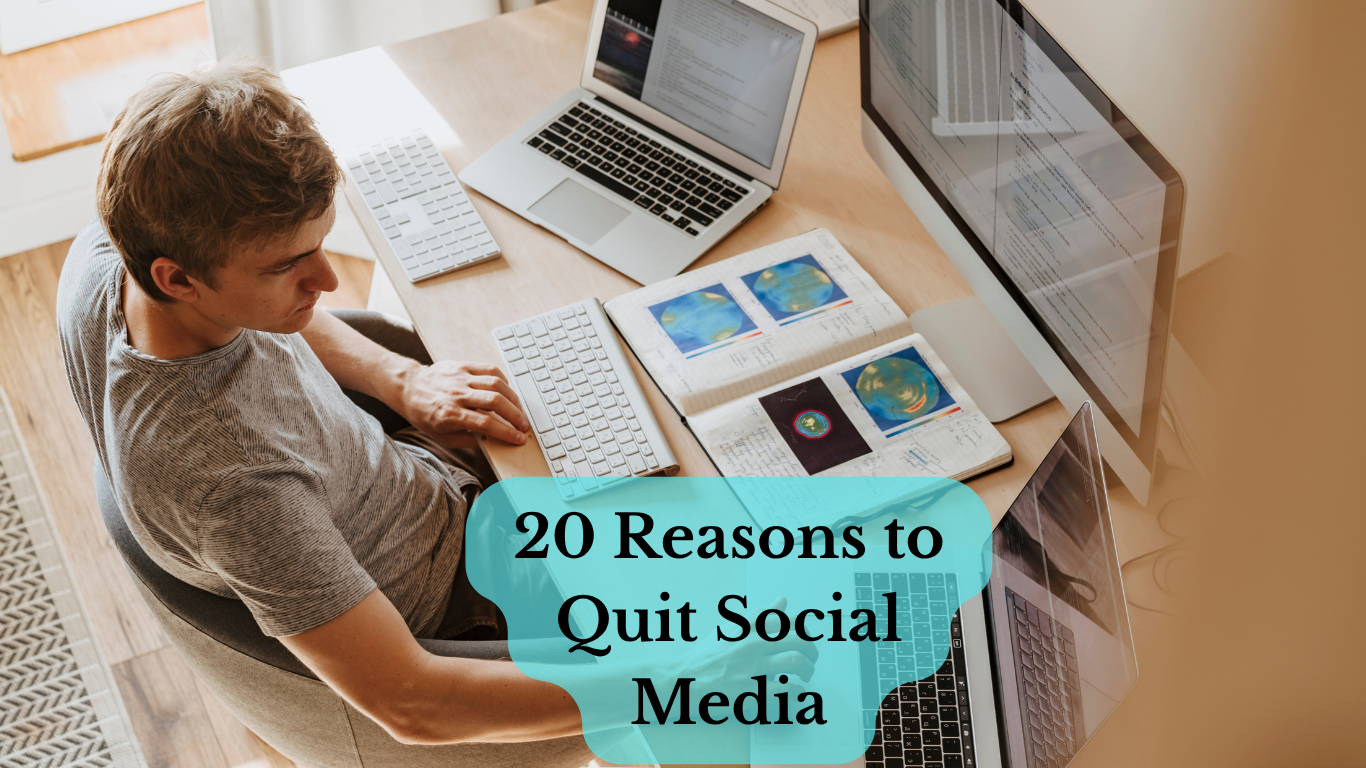
Have you ever deleted a social media app in a moment of clarity, felt a profound sense of relief for approximately forty-eight hours, and then quietly reinstalled it “just to check something” — only to find yourself still scrolling forty minutes later with no memory of how you got there? You are not alone, and that specific experience captures something important about the relationship most people have with social media today. This blog examines 20 honest, well-evidenced, and genuinely compelling reasons why quitting social media — or at the very least, dramatically reducing its presence in your life — may be one of the most beneficial decisions you can make for your mental health, relationships, productivity, and sense of self.
Table of Contents
1. It Is Deliberately Designed to Be Addictive
This is the reason that reframes every other reason on this list — and it deserves to be stated plainly at the outset. Social media platforms are not neutral tools that happen to be popular. They are products engineered by teams of world-class behavioural psychologists, neuroscientists, and user experience designers whose explicit professional objective is to maximise the amount of time you spend on the platform.
Variable reward schedules — the same psychological mechanism that makes slot machines compelling — are built into every pull-to-refresh interaction, every notification badge, and every like counter. The dopamine response triggered by social validation is real, measurable, and deliberately engineered. Per testimony from former Facebook and Google engineers who helped build these systems — including Tristan Harris, whose work inspired the documentary The Social Dilemma — the addictive architecture of social media is not an accidental by-product but an intentional design feature. You are not failing at self-discipline when you can’t put your phone down. You are up against a system specifically engineered to defeat self-discipline.
2. It Distorts Your Perception of Reality
Social media presents a version of the world that is comprehensively curated, strategically filtered, and systematically skewed toward extremes. The content that performs best — that gets shared, liked, and commented on — is content that triggers strong emotional responses, primarily outrage, envy, fear, and desire. Content that is nuanced, ordinary, or emotionally neutral performs poorly and is algorithmically deprioritised.
The result is a constructed reality in which everyone else’s life appears more exciting, more beautiful, more successful, and more socially rich than your own — while the world at large appears more dangerous, more polarised, and more dysfunctional than it actually is. Per research on social comparison and digital media, heavy social media users consistently overestimate how happy, wealthy, and socially active their peers are — and underestimate the normalcy of their own experience. Living inside a distorted reality, continuously and without awareness, has measurable consequences for both individual wellbeing and social cohesion.
3. It Is Damaging Your Mental Health
The evidence linking heavy social media use to poor mental health outcomes is now sufficiently large and consistent to have moved from academic debate into mainstream medical concern. Per a meta-analysis of studies involving over 35,000 participants published in JAMA Pediatrics, social media use is significantly associated with increased rates of depression, anxiety, loneliness, and low self-esteem — with the strongest effects documented in adolescent girls but measurable across all age groups and demographics.
The mechanisms are multiple — social comparison, cyberbullying, sleep disruption, displacement of face-to-face interaction, and the psychological cost of continuous self-presentation all contribute. What is particularly concerning is the dose-response relationship — the more time spent on social media, the worse the mental health outcomes, with the effect reversing measurably when use is reduced or eliminated. In a landmark experimental study, participants who deactivated Facebook for four weeks reported significantly higher life satisfaction, lower depression, and greater engagement with real-world activities than a control group who continued using the platform normally.
4. It Is Consuming Time You Will Never Get Back
The average person spends approximately two hours and twenty-seven minutes per day on social media, per global digital usage reports. Over the course of a year, that amounts to approximately 37 full days — more than five complete working weeks — spent scrolling, liking, comparing, and consuming content that produces no lasting value, develops no lasting skill, and contributes nothing to the goals, relationships, or experiences that matter most to you.
Over a decade, the figure becomes truly confronting — over a year of waking life surrendered to an activity chosen not by genuine preference but by algorithmic capture. The question worth sitting with honestly is not “am I spending too much time on social media?” but “what would I do with 37 days a year if I had them back?” The answer to that question is almost certainly more interesting than the next post in your feed.
5. It Is Making Deep Focus Impossible
The capacity for sustained, uninterrupted, deep cognitive engagement — what author Cal Newport calls “deep work” — is one of the most economically and personally valuable skills available in the modern world. It is also one of the skills most directly undermined by habitual social media use.
Per neuroscience research on attention and digital interruption, checking social media — even briefly — fragments attention in ways that persist long after the phone is put down. The brain, habituated to rapid context-switching and the micro-stimulation of scrolling, becomes progressively less capable of sustaining the single-minded focus required for complex work, serious reading, creative output, and meaningful conversation. Per a study from the University of California Irvine, it takes an average of 23 minutes to fully regain concentration after a digital interruption — meaning that frequent social media checking effectively eliminates deep focus from large portions of the working day.
6. It Is Replacing Real Relationships With Synthetic Ones
There is a meaningful and consequential difference between a relationship and a social media connection — and the distinction matters more than the platforms would like you to believe. A social media connection involves following someone’s curated public presentation, occasionally reacting to their content, and maintaining the impression of closeness without the substance of it. A real relationship involves vulnerability, reciprocity, conflict, repair, shared physical experience, and the kind of knowledge of another person that only comes through sustained and honest engagement.
Per research on loneliness and digital connection, people with large social media followings and high engagement metrics report equivalent or greater levels of loneliness than those with minimal social media presence — because the platform creates the feeling of connection without delivering the substance of it. The time spent maintaining digital relationships is, in many cases, time directly displaced from the face-to-face relationships that actually sustain human wellbeing.
7. It Is Fuelling Anxiety About Things Outside Your Control
Social media delivers a continuous, algorithmically curated stream of the world’s most distressing, outrage-generating, and anxiety-inducing content — selected and amplified precisely because distress and outrage produce the highest engagement metrics. Climate catastrophe, political collapse, economic instability, social injustice, health crises, and interpersonal conflict are all served to you in an unrelenting feed that creates the impression of a world in continuous emergency.
Per research on news consumption and anxiety, the format of social media news delivery — continuous, contextless, and emotionally amplified — produces significantly higher anxiety than equivalent information consumed through traditional journalism formats. The problem is not staying informed. The problem is a delivery mechanism that prioritises emotional arousal over informational value — keeping you anxious, engaged, and scrolling rather than informed, grounded, and able to act.
8. It Is Eroding Your Privacy Systematically
Every interaction on social media — every like, share, pause, scroll, search, and click — is logged, analysed, sold, and used to build an increasingly precise behavioural and psychological profile of you as an individual. This data is used to sell you products, influence your political views, predict your behaviour, and — as documented in the Cambridge Analytica scandal — potentially manipulate democratic processes at scale.
Per digital privacy research, the average social media user has no practical understanding of the volume, specificity, or commercial and political uses of the data being collected about them. The platforms are free to use precisely because the user is not the customer — the user is the product. Quitting social media does not restore privacy entirely, but it dramatically reduces the most comprehensive and intimate form of corporate surveillance most people voluntarily subject themselves to.
9. It Is Distorting Your Politics and Hardening Division
Social media algorithms are optimised for engagement — and the content that generates the highest engagement in political contexts is content that triggers outrage, confirms existing beliefs, and portrays the opposing side as not merely wrong but malevolent. The result is a political information environment specifically designed to radicalise, polarise, and entrench — not because the platforms are politically motivated, but because division is algorithmically profitable.
Per research on political polarisation and social media use, heavy social media users hold more extreme political views, are less willing to engage with opposing perspectives, and are more likely to attribute bad faith to political opponents than light users or non-users — even when controlling for pre-existing political beliefs. The platforms do not create political disagreement, but they systematically amplify and harden it in ways that make democratic discourse and civil compromise measurably more difficult.
10. It Is Undermining Your Self-Image
Social media is a comparison engine — and the comparisons it facilitates are comprehensively unfair. You are comparing your interior experience, including your doubts, insecurities, failures, and ordinary moments, with other people’s exterior presentation, which is curated, filtered, selectively shared, and strategically timed for maximum favourable impression.
The result is a persistent and structurally unwinnable comparison that damages self-image not through a single dramatic event but through the cumulative weight of thousands of small, barely conscious moments of perceived inadequacy. Per research on upward social comparison and self-esteem, this effect is most pronounced and most damaging for appearance-based comparisons — with Instagram use specifically linked to higher rates of body dysmorphia, disordered eating, and cosmetic surgery interest among both adolescent and adult users.
11. It Is Disrupting Your Sleep
The relationship between social media use and sleep disruption is direct, well-documented, and operating through multiple simultaneous mechanisms. The blue light emitted by phone screens suppresses melatonin production, delaying sleep onset. The psychological stimulation of social media content — emotionally engaging, socially activating, and algorithmically designed to keep attention — raises arousal levels incompatible with the relaxation required for sleep initiation. The social anxiety generated by posts, comments, and unresolved digital interactions follows users into the bedroom and occupies mental space that should be transitioning toward rest.
Per sleep research from the Royal Society for Public Health, 91% of young people aged sixteen to twenty-four use social media in the hour before bed, and those who do report significantly higher rates of insomnia, anxiety at bedtime, and daytime fatigue than those who do not. The simple act of removing social media from the bedroom — or eliminating it from the hour before sleep — produces measurable improvements in sleep quality within days.
12. It Is Shortening Your Attention Span
The short-form, rapid-fire content format that social media has normalised — from Twitter’s character limits to TikTok’s fifteen-second videos to Instagram’s scrollable grid — is progressively recalibrating the human brain’s tolerance for slow, sustained, unrewarding cognitive effort. The brain, habituated to constant novelty and immediate gratification, becomes increasingly reluctant to engage with content, tasks, or conversations that require patience, persistence, and delayed reward.
Per cognitive research on media consumption and attention, heavy social media users demonstrate measurably shorter attention spans, lower tolerance for ambiguity, reduced capacity for sustained reading, and greater difficulty engaging with complex arguments than light users. These effects are not permanent — attention capacity recovers with reduced digital stimulation — but they are real, progressive, and consequential for every domain of life that requires sustained mental effort.
13. It Is Monetising Your Insecurity
Social media platforms generate revenue primarily through advertising — and the most effective advertising is advertising that exploits insecurity. The algorithmic delivery of beauty content, luxury lifestyle content, fitness content, and aspirational consumption content is not incidental to the business model. It is central to it. Creating and sustaining a sense of inadequacy — about your appearance, your home, your career, your lifestyle, your relationships — is the mechanism by which the attention economy converts your psychological vulnerability into commercial revenue.
Per marketing research on digital advertising effectiveness, ads delivered in the context of social comparison content perform significantly better than equivalent ads delivered in neutral contexts — because insecurity activates the purchasing impulse in ways that contentment does not. You are not a user of social media. You are the raw material from which insecurity is manufactured and sold back to advertisers. That transaction deserves to be seen clearly.
14. It Is Creating a Culture of Performative Living
Social media has introduced a new and psychologically costly dimension to human experience — the compulsion to document, share, and seek validation for every significant moment of life. Meals are photographed before they are eaten. Holidays are curated for the feed before they are fully experienced. Milestones are announced publicly before they are privately absorbed. Grief, joy, and achievement are increasingly processed through the filter of how they will appear to an audience rather than how they are actually felt.
Per psychological research on self-presentation and experience quality, the act of documenting an experience for social media measurably reduces the depth of engagement with that experience — a phenomenon researchers have described as the photo-taking impairment effect. Life lived for an audience, rather than for itself, is a diminished life — and social media has made the audience a constant, intrusive presence in moments that previously belonged entirely to the person living them.
15. It Is Exposing You to Cyberbullying and Online Harassment
The disinhibition effect of online interaction — the well-documented tendency for people to say things digitally that they would never say face-to-face — creates a social environment on social media that is significantly more hostile, contemptuous, and personally attacking than equivalent offline social contexts. Cyberbullying, pile-ons, targeted harassment, unsolicited criticism, and the casual cruelty of anonymous comment sections are not peripheral features of social media. They are predictable products of an environment that removes accountability, rewards provocation, and amplifies conflict.
Per research from the Cyberbullying Research Center, over 40% of social media users have experienced some form of online harassment — with rates significantly higher among women, minority communities, and public figures. The psychological consequences of cyberbullying are comparable to those of face-to-face bullying, including elevated rates of anxiety, depression, and in severe cases, suicidal ideation. An environment with a 40% harassment rate would be considered unacceptable in any physical social context. Online, it has been normalised.
16. It Is Weakening Your Ability to Be Alone
One of the most underappreciated consequences of constant social media connectivity is the progressive erosion of the capacity for solitude — the ability to be alone with your own thoughts, without distraction, stimulation, or the management of social presentation. Solitude is not loneliness. It is a psychologically essential state that enables self-reflection, creative thinking, emotional processing, and the development of a stable sense of identity that does not depend on external validation.
Per research by psychologist Ester Buchholz and subsequent scholars on solitude and development, the capacity for productive solitude is associated with greater creativity, stronger emotional regulation, clearer personal values, and more authentic social relationships. Social media — by filling every available moment of potential solitude with content, connection, and stimulation — progressively atrophies this capacity, producing individuals who are increasingly uncomfortable with their own company and dependent on continuous external input to regulate their emotional state.
17. It Is Spreading Misinformation at Unprecedented Scale
Social media has created a misinformation distribution system of extraordinary speed and reach — one in which false information travels faster, further, and more persuasively than accurate information, because false information is disproportionately designed to trigger emotional responses that drive sharing behaviour. Per research published in Science, false news stories on social media spread six times faster than true ones and reach significantly larger audiences before correction — a finding that applies across political content, health information, and general news.
The personal consequences of navigating a misinformation-saturated information environment include distorted beliefs about health, politics, and social reality — beliefs formed not through deliberate reasoning but through repeated algorithmic exposure to emotionally compelling falsehoods. Quitting social media does not solve the misinformation problem, but it dramatically reduces your personal exposure to its most virulent distribution mechanism.
18. It Is Preventing You From Being Present
The phone on the table between two people having dinner is not a neutral object. Per research on the iPhone effect — documented by psychologist Shalini Misra — the mere visible presence of a smartphone during a face-to-face conversation measurably reduces the quality of that conversation, the depth of connection felt by both participants, and the empathy expressed by both parties — even when the phone is never touched. The anticipation of digital interruption, the background awareness of unread notifications, and the habitual impulse to check collectively compromise the quality of presence in every real-world interaction they accompany.
Presence — full, undivided, genuinely attentive presence — is one of the most valuable gifts one human being can offer another. Social media, by maintaining a constant competing claim on attention, makes genuine presence progressively more difficult to offer and to receive.
19. It Is Making You Politically Manipulable
Beyond the polarisation effect already discussed, social media creates specific vulnerabilities to deliberate political manipulation that deserve separate acknowledgement. State-sponsored disinformation campaigns, coordinated inauthentic behaviour networks, algorithmic amplification of divisive content, and micro-targeted political advertising based on detailed psychological profiles all operate through social media platforms with a precision and scale that traditional propaganda never achieved.
Per documented investigations into the 2016 US election, the Brexit referendum, and multiple subsequent electoral processes globally, social media platforms were used as primary vehicles for foreign interference, domestic manipulation, and the deliberate amplification of social division. The individual social media user is not a passive victim of these campaigns — they are an active distribution node, sharing and amplifying content whose origin and intent they frequently cannot verify. Removing yourself from the platform removes you from the manipulation infrastructure.
20. Life Is Genuinely Better Without It
Beyond all the specific, evidence-based arguments on this list, there is a final reason that is simultaneously the simplest and the most compelling — the direct, personal testimony of people who have quit social media and found that their lives improved in ways they did not fully anticipate.
More time. Clearer thinking. Better sleep. Stronger real-world relationships. Reduced anxiety about things outside their control. A more stable and internally referenced sense of identity. Greater presence in their own lives. The ability to be bored — and to discover what genuine rest, genuine curiosity, and genuine creativity feel like when they are not continuously displaced by algorithmic stimulation.
Per survey data on social media abstinence, the majority of people who significantly reduce or eliminate social media use report net positive effects on wellbeing within two to four weeks — even among those who expected to miss it significantly. The life waiting on the other side of the screen is not smaller than the one inside it. For most people, it is considerably larger.
Key Takeaways
The twenty reasons examined in this blog are not an argument that social media is entirely without value — it has genuine utility for communication, community building, creative distribution, and social connection that deserves honest acknowledgement. The argument is more specific and more urgent than that — that the current form of social media, as designed and deployed by profit-driven platforms optimised for engagement rather than wellbeing, extracts more from most people than it returns, and that the costs are borne disproportionately by the most vulnerable users.
The decision to quit, reduce, or fundamentally restructure your relationship with social media is not a small or easy one in a world where it has become infrastructural to social and professional life. But it is a decision that an increasing number of thoughtful, informed people are making — and reporting, consistently, that the quality of attention, relationship, rest, and self-knowledge available on the other side was worth the discomfort of the transition.
Per digital wellbeing research, the most effective approach is not cold-turkey elimination but intentional redesign — removing apps from your phone, turning off all notifications, designating specific limited times for access, and filling the recovered time with activities that deliver genuine rather than synthetic fulfilment. Start with one week. Notice what changes. The evidence, and the experience of those who have gone before you, suggests that what changes will surprise you.
The scroll will always be there. Your life, in the meantime, is happening right now.