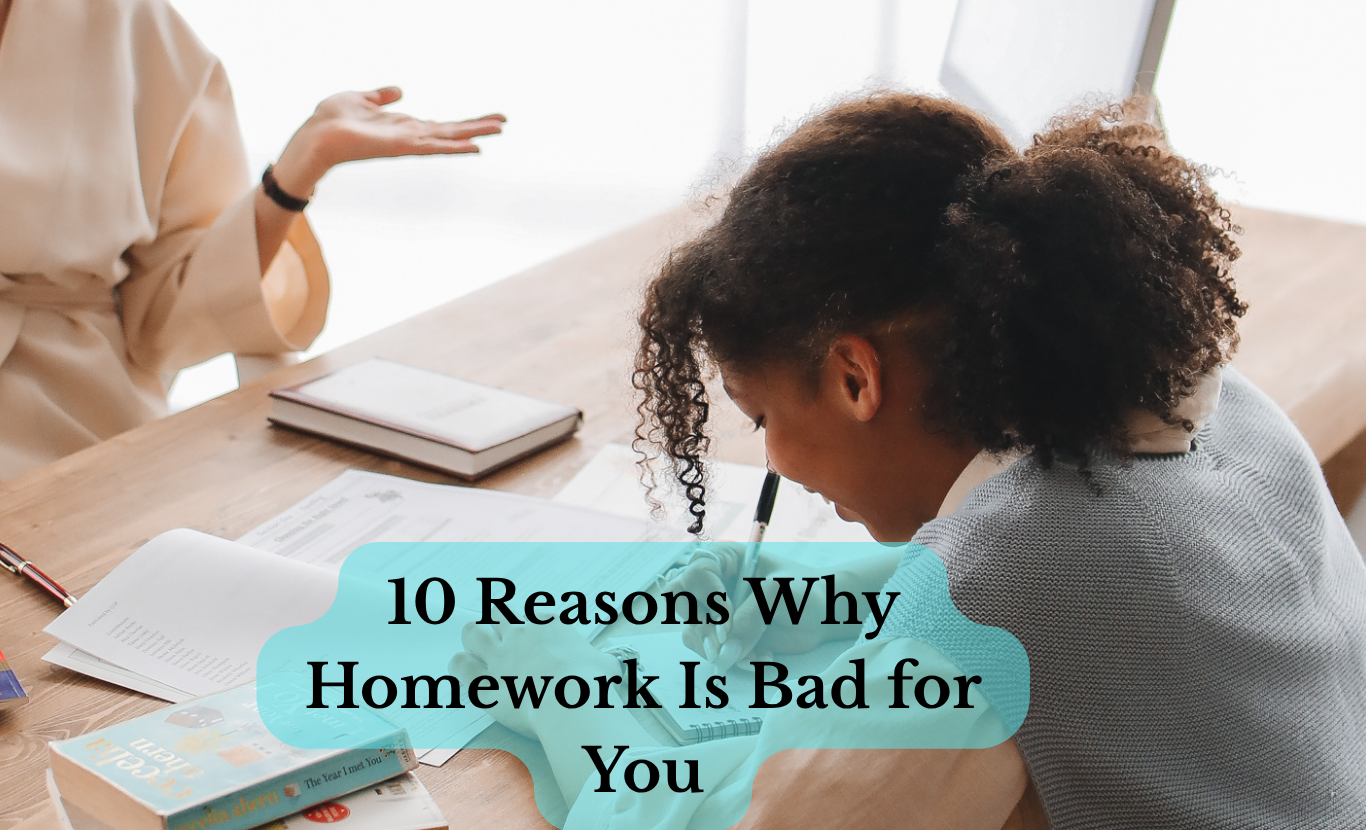
Have you ever sat at a kitchen table at 10 p.m., surrounded by worksheets, textbooks, and the quiet desperation of a student who has already spent seven hours in school and still has two more hours of work ahead? If that image feels familiar — as a student, a parent, or someone who simply remembers — then you already understand, instinctively, the argument this blog is about to make. Homework is one of education’s most accepted and least examined institutions. This blog examines 10 honest, well-evidenced reasons why homework, particularly in its current form and volume, may be doing more harm than the marks it produces are worth.
Note: This blog presents arguments questioning the value of homework as part of an informed educational debate. Research on homework is genuinely mixed, and context — age, subject, volume, and quality — matters enormously in evaluating its effects.
1. The Research Supporting Homework Is Weaker Than Most People Realise
Before examining the specific harms, it is worth establishing something that surprises most people when they first encounter it — the research base supporting the academic value of homework is significantly weaker and more contested than the universal institutional acceptance of homework would suggest.
Per the work of education researcher Harris Cooper — whose meta-analyses of homework research represent the most comprehensive review of the evidence base — the relationship between homework and academic achievement is positive but modest at secondary level and negligible to non-existent at primary level. For students under the age of ten, Cooper’s research found essentially no consistent correlation between homework completion and improved academic outcomes.
This finding — that the practice consuming hours of children’s and adolescents’ evenings may not be producing the learning gains used to justify it — is the essential context within which every other reason on this list should be read. The burden of proof for a practice with significant documented costs rests with those advocating for its continuation — and that proof is considerably thinner than homework’s institutional permanence suggests.
2. It Produces Stress, Anxiety, and Mental Health Consequences
The mental health consequences of homework — particularly for students in high-pressure academic environments — are among the most consistently documented and most practically significant findings in the research literature on homework’s effects.
Per a landmark study conducted by Stanford University researchers examining homework load and student wellbeing, students in high-achieving schools who completed more than three hours of homework per night reported significantly elevated rates of stress, physical health problems, and reduced time for activities essential to healthy adolescent development. “I feel like homework is the primary source of stress in my life” was a sentiment expressed consistently across the study’s qualitative data — not occasionally, not by a minority, but as a dominant theme.
The physiological consequences of chronic homework-induced stress are real and cumulative — elevated cortisol, disrupted sleep, suppressed immune function, and the long-term neurological consequences of sustained adolescent stress documented in developmental psychology research. The student sitting at 10 p.m. with two hours of work remaining is not merely tired. They are physiologically stressed in ways that compound across every school night of every school year.
3. It Cuts Into Sleep — With Documented Academic and Health Consequences
Sleep and academic performance are among the most robustly linked variables in educational research — and homework is one of the most consistent drivers of adolescent sleep deprivation. The relationship is direct and well-documented: homework extends into the evening hours, delays sleep onset, reduces total sleep duration, and impairs the restorative sleep quality that adolescent neurological development specifically requires.
Per the American Academy of Pediatrics, teenagers require between 8 and 10 hours of sleep per night for optimal health and cognitive function — a recommendation that is practically incompatible with the homework loads assigned in many secondary schools, combined with the school start times, extracurricular commitments, and part-time employment that characterise the typical adolescent schedule.
The academic irony is profound and rarely acknowledged — homework assigned to improve academic performance degrades the sleep quality that is one of the strongest predictors of the very cognitive performance it is designed to enhance. Memory consolidation, problem-solving capacity, attention, and emotional regulation all depend on adequate sleep. An assignment that costs a student an hour of sleep may produce a net negative academic outcome even when it is completed competently.
4. It Deepens Educational Inequality
Homework assumes a level of home environment support that is not equally available to all students — and in doing so, it functions as a mechanism that systematically advantages already-advantaged students and compounds the disadvantage of those already struggling.
Consider what completing homework effectively requires. A quiet, dedicated workspace. Access to reference materials, textbooks, or internet connectivity. An adult available to provide assistance with difficult concepts. Freedom from competing responsibilities — younger siblings to care for, household work to contribute, part-time employment to maintain. These resources are not uniformly distributed, and their unequal availability means that the same homework assignment represents a fundamentally different experience — and produces fundamentally different outcomes — depending on the circumstances in which it is completed.
Per research on homework completion and socioeconomic status, students from low-income households complete homework at lower rates, report more difficulty completing it without assistance, and demonstrate less benefit from homework completion than their more affluent peers — not because of differences in ability or motivation, but because the home environment cannot provide the support the homework assumes.
When a school practice systematically rewards students for the advantages their families provide rather than for their own academic effort and understanding, it is not measuring learning — it is measuring socioeconomic privilege.
5. It Eliminates Time for Play, Rest, and Healthy Development
Childhood and adolescence are not merely preparatory phases for adult productivity — they are developmental periods with their own essential requirements, and those requirements include unstructured time for play, physical activity, creative exploration, social connection, and rest. These are not luxuries supplementary to development. They are the conditions in which development occurs.
Per research on child and adolescent development, unstructured play is specifically associated with the development of creativity, executive function, social competence, emotional regulation, and intrinsic motivation — capacities that structured academic tasks, including homework, do not develop equivalently. Physical activity, independently, is one of the strongest predictors of cognitive performance, emotional wellbeing, and academic motivation documented in developmental research.
A school day that runs from 8 a.m. to 3 p.m., followed by two to three hours of homework, leaves a student with minimal time for any of these developmental necessities — and the cumulative developmental cost of that deprivation is borne over years, not days. What homework displaces matters as much as what homework produces.
6. It Damages the Relationship Between Students and Learning
One of the least-discussed but most consequential potential harms of excessive homework is its effect on students’ intrinsic motivation — their genuine curiosity, their appetite for learning, and their sense of education as something worth engaging with rather than enduring.
Intrinsic motivation — the internal drive to learn for its own sake — is one of the strongest predictors of long-term academic success and lifelong learning engagement documented in educational psychology. It is also fragile, and it is specifically damaged by conditions that make learning feel coercive, exhausting, and detached from genuine interest.
Per self-determination theory research by Deci and Ryan — foundational in educational motivation literature — conditions that undermine autonomy, generate sustained negative affect around academic tasks, and associate learning with obligation rather than curiosity consistently reduce intrinsic motivation. Excessive homework, assigned without regard for student interest or genuine pedagogical purpose, creates precisely these conditions.
The student who loved reading at age eight and resents it at fourteen has not changed — the conditions around reading have. Homework is frequently a significant contributor to that change.
7. It Creates Family Conflict and Household Stress
The homework battle — the nightly negotiation, argument, or standoff between a tired student and a frustrated parent attempting to enforce completion of work the student resents and the parent cannot always help with — is a documented source of household stress that affects not just the individual student but the entire family system.
Per research on homework and family dynamics, homework-related conflict is among the most consistently reported sources of parent-child tension in households with school-age children — with the conflict most intense, most frequent, and most damaging in households where the child is already struggling academically and the parent is least equipped to provide academic support.
The consequences of this conflict extend beyond the immediate stress of a difficult evening. Sustained homework-related conflict damages the parent-child relationship in measurable ways, reduces the positive associations parents and children share around education, and creates a home atmosphere that is tense rather than restorative during the evening hours that should be among a family’s most connected.
8. It Does Not Teach the Skills It Claims to Develop
A frequently cited justification for homework — particularly among secondary school educators — is that it develops independent learning skills, self-discipline, time management, and personal responsibility. These are genuinely valuable capacities. The question worth asking is whether homework, as typically assigned and completed, actually develops them.
Per research on homework completion behaviour, the majority of students complete homework under conditions of obligation and time pressure that are specifically incompatible with the development of independent, self-directed learning. Homework completed hurriedly, assisted by parents, copied from peers, or submitted for completion marks rather than quality of understanding does not build the capacities its advocates claim — it rehearses compliance while creating the impression of learning without the substance.
The skills that homework is supposed to develop — autonomy, self-regulation, intrinsic motivation, and genuine independent inquiry — are more reliably produced by conditions that give students genuine agency over their learning, genuine interest in the task, and genuine stakes beyond a completion grade. Most homework assignments provide none of these conditions.
9. It Widens the Gap Between High and Low Achievers
The relationship between homework and the achievement gap is bidirectional and concerning. Students who are already performing well academically tend to complete homework more effectively, receive more assistance when they need it, and benefit more from the reinforcement that homework is intended to provide. Students who are already struggling tend to find homework harder, receive less assistance, complete it less reliably, and experience it primarily as a source of shame, failure, and negative feedback.
The result is that homework — intended as a tool for improving academic performance — frequently functions as a mechanism that reinforces existing achievement differentials rather than reducing them. The students most in need of the support that genuine learning consolidation could provide are the least likely to experience homework as that kind of support.
Per educational equity research, homework completion rates are among the strongest predictors of grade outcomes in systems where homework carries significant grade weight — which means that the grading system compounds the socioeconomic and ability differentials that homework completion reflects, producing academic records that measure homework completion capacity as much as genuine academic understanding.
10. Teachers Cannot Verify Whether Learning Has Actually Occurred
The fundamental pedagogical problem with homework — the one that underlies every other concern on this list — is the absence of the conditions in which genuine learning and genuine assessment can occur. In a classroom, a teacher can observe a student’s thinking in real time, identify misconceptions as they form, provide immediate corrective feedback, adjust instruction in response to demonstrated understanding, and distinguish genuine comprehension from performed compliance.
None of these conditions apply to homework. The teacher receives a completed product — or does not — without any capacity to verify the process by which it was produced, the understanding it reflects, or whether the student who submitted it learned anything in the process of completing it.
Per research on formative assessment and learning outcomes, the feedback loop between teacher and student is one of the most powerful determinants of academic progress available in education. Homework systematically severs that feedback loop — replacing the teacher’s direct observation of learning with an artefact that may reflect parental assistance, peer copying, online solutions, or varying degrees of genuine engagement that the submitted product cannot distinguish between.
An assessment practice that cannot reliably distinguish understanding from copying, genuine learning from completed compliance, or independent thinking from borrowed answers is not serving the educational purpose it claims to serve.
Key Takeaways
The ten reasons examined in this blog do not constitute an argument that homework should be abolished entirely — context, age, subject, volume, and quality all matter in evaluating its effects, and well-designed, purposeful, appropriately limited homework can have genuine educational value. What they constitute is an argument that homework’s current form — its volume, its universality, its assumption of equal home support, its disconnection from genuine learning feedback — warrants far more critical examination than educational systems typically give it.
Per the growing body of research on homework, workload, and student wellbeing — including influential work by Alfie Kohn, Harris Cooper, and Denise Pope — the most educationally and developmentally sound approach is not maximum homework but purposeful homework — assigned with a specific and genuine learning objective, calibrated to student age and capacity, designed to be completable without adult assistance, and evaluated for the quality of thinking it reflects rather than merely its completion.
The question every teacher, parent, and policymaker should be asking is not “how much homework should students have?” but “what specific learning is this homework producing that could not be better achieved another way?” When the honest answer is “I am not sure,” the case for assigning it becomes considerably harder to make.