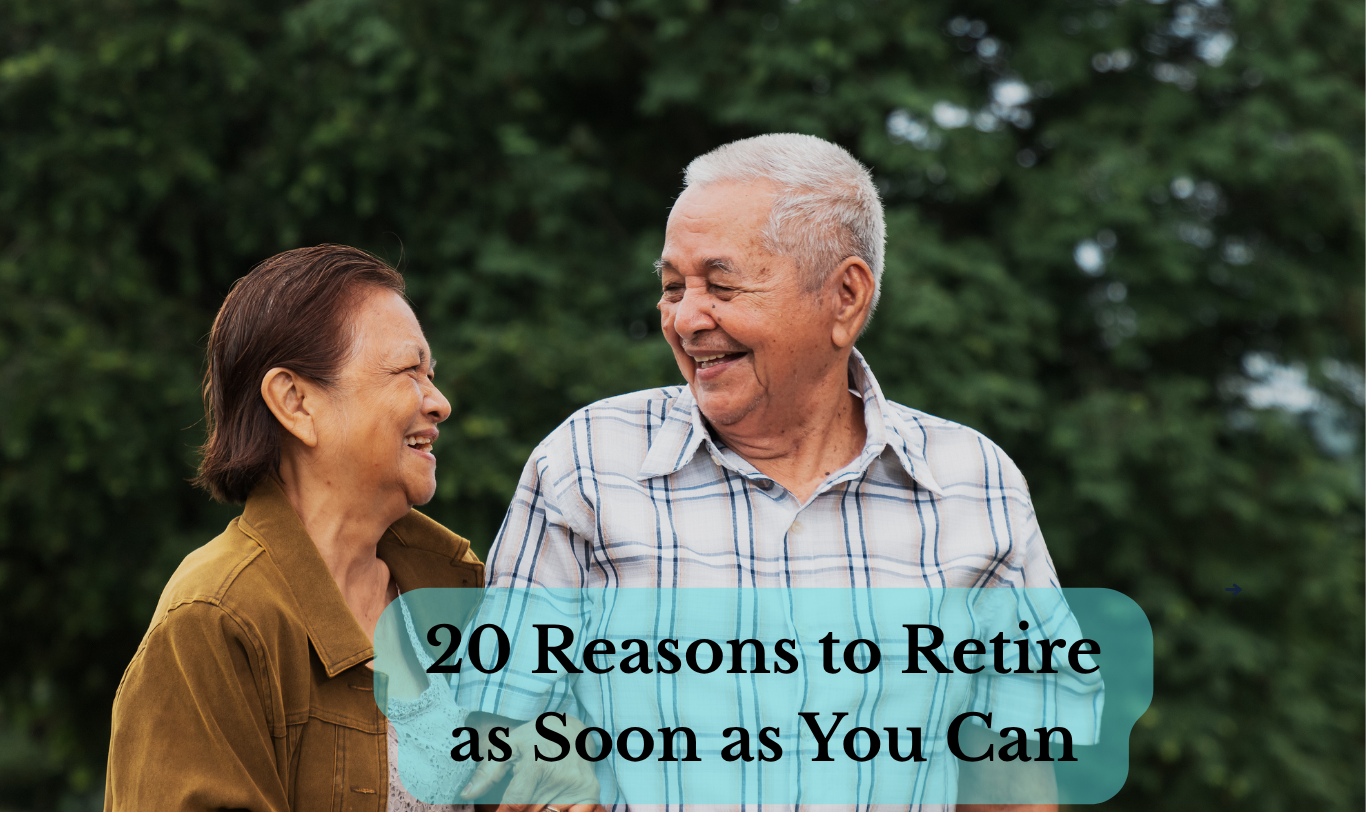
Have you ever sat at your desk on a perfectly beautiful Tuesday afternoon, watching the sunlight move across the floor while you answered emails that felt entirely disconnected from anything that genuinely mattered to you — and thought, “there has to be more to life than this”? That thought is not ingratitude or laziness. It is a deeply human recognition that time is finite, that what you do with it matters enormously, and that the conventional timeline of working until the traditional retirement age is a social construct rather than a biological inevitability. This blog examines 20 genuine, compelling, and honestly considered reasons why retiring as soon as you responsibly can may be one of the most intelligent decisions you ever make for your health, your relationships, your creativity, and the quality of your remaining years.
Table of Contents
1. Time Is the One Resource You Cannot Earn Back
Every other resource in human life — money, energy, relationships, skills, and knowledge — can be rebuilt, replenished, or recovered after a period of depletion. Time cannot. Every year spent in a career beyond the point where it genuinely fulfils you is a year that belonged to the finite supply of your life and was spent in a particular way that cannot be undone.
Per research on temporal discounting and life satisfaction, people consistently underestimate how much they will value time over money in later life — and overestimate how much additional income beyond a certain threshold will improve their wellbeing. The psychological literature on this is extensive and consistent: above a certain income level, more money produces diminishing returns on happiness, while more time produces increasing ones.
2. Your Health Is Better Protected Earlier Than Later
The relationship between prolonged occupational stress and physical health is among the most robustly documented in medical research. Chronic workplace stress is associated with elevated cardiovascular risk, suppressed immune function, higher rates of type 2 diabetes, accelerated cognitive decline, and measurably shortened lifespan — per research published in leading medical journals including The Lancet and the British Medical Journal.
The earlier retirement occurs — relative to the accumulation of these chronic stress-related health effects — the greater the potential for health recovery, maintenance, and the enjoyment of physical capacity while it remains relatively intact. Retiring at sixty-two with the health to hike, travel, and physically engage with the world is categorically different from retiring at seventy with the accumulated health consequences of eight additional years of occupational stress.
3. Relationships Deserve More Than Your Leftover Energy
The people who matter most to you — your partner, your children, your parents, your closest friends — are currently receiving whatever remains of your time and energy after work has taken its share. For most people in demanding careers, that remainder is modest. The hours available for genuine connection are squeezed into evenings compromised by tiredness, weekends competing with errands and recovery, and holidays that are never quite long enough to fully decompress.
Per research on relationship quality and time investment, the depth and satisfaction of intimate relationships is strongly correlated with the quality of undistracted time partners invest in each other — not the quantity of moments shared in the same household while mentally elsewhere. Retirement offers the conditions for the kind of sustained, unhurried, genuinely present relational investment that working life structurally prevents.
4. You May Have More Retirement Years Than You Think — Use Them Well
Many people operating on traditional retirement timelines reach retirement age with their health already compromised by the decades that preceded it — and find that the retirement they planned for, with its travel, its activity, and its adventure, is partially foreclosed by the physical realities of a body that has been running on stress, insufficient sleep, and deferred maintenance for thirty years.
The concept of the retirement window — the period of retirement in which a person has both the financial resources and the physical capacity to do what they planned — is considerably narrower than most pre-retirees appreciate. Per actuarial and health data, the years between sixty and seventy-five represent the window of greatest retirement vitality for most people — and every year of earlier retirement that falls within that window is a year of qualitatively better retirement.
5. Stress Accumulates — and the Damage Compounds
Occupational stress is not merely an unpleasant experience to be managed. It is a physiological state that produces cumulative biological damage over time — through sustained cortisol elevation, chronic inflammation, telomere shortening, and the disruption of the sleep, immune, and cardiovascular systems that stress hormones govern.
Per research on allostatic load — the cumulative biological cost of chronic stress exposure — individuals with high occupational stress over sustained periods demonstrate measurably accelerated biological ageing, higher rates of chronic disease, and shorter healthy life expectancy than those with lower occupational stress. The body keeps score of every difficult year at work in ways that extend well beyond the subjective experience of feeling stressed.
6. You Have Interests That Deserve Your Best Hours
Most working people have creative interests, intellectual pursuits, physical hobbies, and personal projects that have spent years waiting patiently in the margins of a life dominated by professional obligations. The novel that has been “almost started” for a decade. The instrument gathering dust in the corner. The language half-learned on a discontinued app. The garden that gets attention only on bank holidays.
These interests are not trivial. Per research on engagement, meaning, and psychological wellbeing, regular participation in personally meaningful creative and intellectual activities is among the strongest predictors of life satisfaction, cognitive vitality, and emotional resilience in later life. Retirement is not the end of productive engagement — it is the beginning of productive engagement on your own terms, with your own priorities, in the hours when your energy is highest rather than depleted.
7. The FIRE Movement Proves It Is Possible
The Financial Independence, Retire Early movement — a global community of individuals who have pursued aggressive savings, investment, and expense reduction strategies to achieve financial independence decades before traditional retirement age — has demonstrated at scale that early retirement is not exclusively available to the very wealthy or the extraordinarily lucky.
People from middle-income backgrounds, ordinary careers, and unremarkable inheritances have achieved financial independence in their thirties, forties, and early fifties by making deliberate choices about consumption, savings rate, and investment strategy. The mathematical foundation is the 4% rule — the finding that a portfolio of invested assets can sustain annual withdrawals of 4% indefinitely, based on historical market returns — which means that retirement is achievable once savings reach approximately twenty-five times annual expenses.
This is not a get-rich-quick proposition. It is a decade-long, discipline-requiring, genuinely achievable planning framework that has changed the retirement timeline of hundreds of thousands of people globally.
8. Your Children Are Young for a Remarkably Short Time
For parents, the years of a child’s active, present, physically-at-home childhood are astonishingly brief — and the working years overlap almost perfectly with them. The child who needs a present, engaged, genuinely available parent at six will be moving toward independence at sixteen and out of the house entirely at twenty-two. The window of maximally impactful parental presence is not the retirement years — it is now.
Per research on parenting quality and child outcomes, parental presence, availability, and genuine engagement during childhood and adolescence produce measurably better educational, emotional, and relational outcomes than equivalent material provision accompanied by parental absence. The most irreplaceable thing you can give your children is not a larger inheritance — it is more of yourself, during the years when they most need it.
9. Retirement Protects Against Cognitive Decline When Engaged Actively
The fear that retirement leads to cognitive decline — the “use it or lose it” concern that keeping the mind active through work is necessary for neurological health — is a genuine consideration worth addressing directly. The research, however, is more nuanced than the fear suggests.
Per longitudinal research on retirement, cognitive decline, and lifestyle factors, retirement that is accompanied by active engagement — in learning, creative pursuits, social connection, physical activity, and intellectually stimulating activities chosen voluntarily — is associated with better cognitive outcomes than continued stressful employment. It is not the presence of work that protects cognitive function — it is the presence of engaged, stimulating, purposeful activity. Retirement does not eliminate those activities. It liberates them from the competition of mandatory professional obligations.
10. You Have Already Contributed — Sufficiently and Honourably
There is a cultural narrative — particularly powerful in societies where professional identity and personal identity are deeply merged — that suggests the ethical obligation to contribute professionally does not have an endpoint. That a person who could continue working but chooses not to is somehow taking something from the collective that they have not fully earned.
This narrative deserves examination. A person who has worked for three, four, or five decades, paid taxes, contributed to the economy, raised children, built relationships, and participated in community life has honoured every reasonable social contract. The choice to stop — to redirect the remaining years of a finite life toward personal flourishing, family, and the pursuits that bring genuine meaning — is not selfishness. It is the natural and deserved fruit of a working life honourably completed.
11. Commuting Is Stealing Your Life in Small, Daily Increments
The average commute time for workers in developed nations is approximately 27 minutes each way, per global commuting data — which translates to roughly 225 hours per year of life spent in transit, in conditions that research consistently identifies as among the most reliably misery-producing experiences in daily life.
Per the research of Nobel laureate Daniel Kahneman on daily emotional experience, commuting ranks consistently among the activities producing the lowest moment-to-moment happiness in people’s daily routines — lower than housework, childcare, and most forms of work itself. Over a career, the cumulative hours spent commuting represent weeks and months of life spent in a demonstrably unpleasant state. Retirement eliminates this entirely.
12. The Best Travel Happens When You Have Time, Not Just Money
The retirement dream of travel is a near-universal aspiration — but travel at its most enriching is not primarily a function of budget. It is a function of time. The difference between a ten-day holiday constrained by work calendars and school terms, and the freedom to spend three months in a country you are genuinely exploring — learning its language, its rhythms, its people — is not a difference of money. It is a difference of time.
Early retirees consistently report that the quality of travel in retirement — its depth, its spontaneity, its capacity for genuine cultural immersion — is qualitatively different from the holiday travel of working life. You do not need to be rich to experience the world more fully. You need to be free.
13. Work Culture Is Not Always Good for Human Beings
Contemporary work culture — with its always-on connectivity, its performative busyness, its conflation of professional identity with personal worth, and its implicit message that productivity is the primary measure of a human being’s value — is not a neutral environment. It actively shapes how people think about themselves, their time, and their relationships in ways that are not always healthy.
Per research on work culture and identity, individuals who have spent decades in high-demand professional environments frequently report significant difficulty separating their sense of self-worth from their professional productivity — a condition that makes genuine rest, play, and non-productive engagement psychologically difficult even when time becomes available. The earlier a person disengages from this cultural conditioning, the more fully they can develop an identity and a sense of value grounded in something more whole than professional output.
14. You Have Permission to Prioritise Yourself
The concept of prioritising one’s own wellbeing — one’s health, one’s rest, one’s joy, one’s genuine flourishing — is one that many high-achieving, responsibility-oriented people find genuinely difficult to act on without permission from an external source. Retirement offers that permission in the most institutionally legitimate form available.
When the professional obligations that have provided the structure and justification for self-deprivation are removed, the invitation to prioritise genuine wellbeing becomes not merely available but structurally supported. The person who has spent decades prioritising the needs of employers, clients, colleagues, and institutions has, by any measure, earned the right to spend the remaining years prioritising themselves.
15. Grandparenting Is One of Life’s Greatest Joys — And It Requires Presence
For those who become grandparents, the relationship with grandchildren is among the most consistently cited sources of late-life joy, meaning, and vitality reported by older adults. It is also a relationship that is maximally enriched by the thing retirement uniquely provides — time.
The grandparent who is present, available, unhurried, and genuinely engaged in a grandchild’s life offers something qualitatively different from the one who visits occasionally on compressed holiday schedules. That presence — consistent, generous, and genuinely invested — is one of the most meaningful gifts that the freedom of retirement makes possible.
16. Financial Independence Changes How You Work — Even Before You Stop
One of the less-discussed benefits of pursuing early retirement is the transformation in professional autonomy that financial independence produces even before actual retirement occurs. A person who could retire — who has the financial resources to stop — but chooses to continue working does so from a position of genuine freedom rather than necessity.
That freedom changes the relationship with work fundamentally. The ability to decline unreasonable requests, leave a toxic environment, take extended leave, or simply say “no” without existential financial anxiety produces a quality of working life — and a dignity in that working life — that financial dependence on employment cannot provide. Building toward early retirement improves not just the post-retirement years but the pre-retirement ones.
17. Volunteering and Community Contribution Await Your Time and Skills
The skills, experience, networks, and capacities that a person develops across a professional lifetime have significant value to communities, organisations, and causes that desperately need them — and that cannot compete financially with the professional marketplace for access to them.
The retired professional who volunteers their expertise to a non-profit, mentors young people in their field, contributes to community organisations, or engages in civic life with the full depth of their accumulated experience is making a contribution to the social fabric that employment obligations prevented. Retirement is not an exit from contribution — it is a redirection of contribution toward purposes chosen by the contributor rather than assigned by an employer.
18. Your Mornings Deserve to Be Yours
The quality of a morning — its pace, its content, and the psychological state it produces — shapes the entire day that follows in ways that are both individually felt and physiologically documented. The morning that begins with an alarm, a rushed commute, and the immediate pressure of professional obligations is a fundamentally different physiological and psychological experience from the morning that begins with whatever pace, whatever activity, and whatever intention its owner chooses.
Per research on morning routines and daily wellbeing, the quality and personal ownership of morning time is among the most significant predictors of daily mood, energy, and cognitive performance. Retirement returns the morning — one of the most resource-rich and psychologically generative parts of the day — to its rightful owner.
19. The People You Love Are Not Going to Live Forever
This is the reason that arrives most quietly and carries the most weight. Parents age. Friends face illness. The people whose company has given your life its texture and warmth are operating on their own finite timelines — and the hours available to spend genuinely in their presence, without the competing obligations of professional life, are more limited than most people in mid-career allow themselves to fully acknowledge.
The retirement decision, for many people, arrives most urgently not as a response to their own needs but as a recognition that the people they love need them present — not professionally distracted, not available only on weekends, not too tired for the long conversations — but genuinely, unhurriedly, fully there.
The years available to sit with the people you love, in the unhurried way that love deserves, are not unlimited. Retiring sooner rather than later is, for many people, a decision made in the name of love as much as freedom.
20. The Life You Are Waiting to Live Is Not Guaranteed to Come
Perhaps the most honest and most important reason to retire as soon as you responsibly can is the one that the conventional deferred-life plan never fully confronts — the life you are waiting for is not guaranteed.
The retirement in which you will travel extensively requires functional health. The grandchildren you will spend quality time with require that your children have children while you still have energy. The creative projects you will finally pursue require the cognitive vitality that is most abundant in the years you are currently spending at a desk. The people you will reconnect with in retirement require that they are still here when retirement arrives.
None of these are guaranteed. Health changes without warning. Time moves faster than the mid-career optimist fully believes. The person who defers the good life indefinitely on the assumption that it will be available on demand has made an optimistic bet that reality does not always honour.
Retire as soon as you responsibly can — not because work is without value, but because the life that waits beyond it deserves more than your leftover years.
Key Takeaways
The twenty reasons in this blog are not an argument against work — work, when it is meaningful, purposeful, and conducted in conditions that support human flourishing, is genuinely valuable and genuinely fulfilling. They are an argument against the unexamined assumption that the longer you work, the better off you are — and in favour of the deliberate, financially prepared, and personally meaningful decision to stop working on your own terms, at the earliest point that genuine financial security makes possible.
Per research on retirement satisfaction and life quality, the retirees who report the highest wellbeing are not those who worked the longest but those who retired with intention — with a clear sense of what they were moving toward rather than simply what they were leaving behind, with financial security sufficient to support their chosen lifestyle, and with the relationships, interests, and sense of purpose that make the freedom of retirement genuinely productive rather than simply empty.
The question worth asking is not “can I afford to retire?” — though that question matters enormously and must be answered seriously. The question worth asking first is “what is the cost of not retiring — in health, in relationships, in time, and in the unlived life that is accumulating interest while you wait?” That calculation, done honestly, changes the conversation.