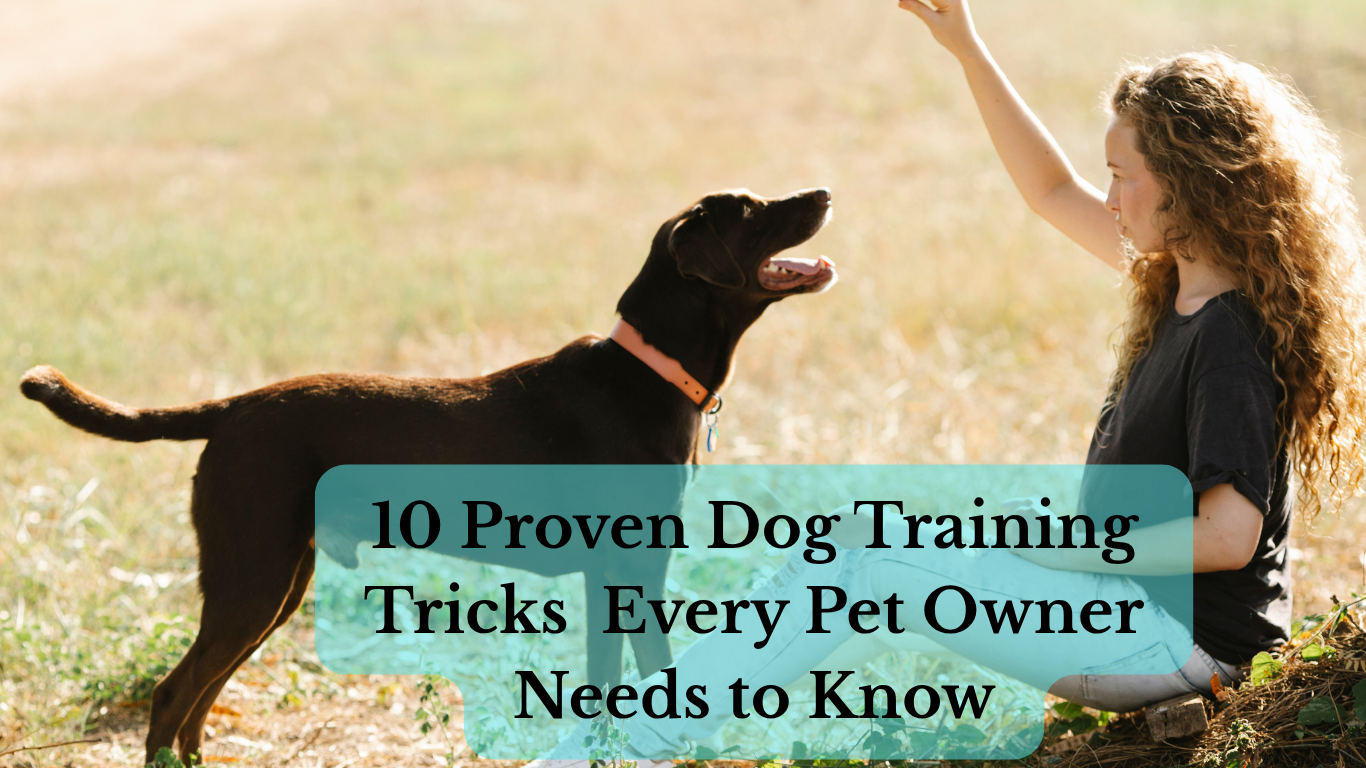
Have you ever watched someone else’s dog sit calmly, come immediately when called, and walk politely on a lead — while your own beloved animal is simultaneously eating a shoe, ignoring every instruction, and looking at you with what can only be described as cheerful indifference? Dog training can feel like a mystery from the outside, but the science behind it is remarkably consistent and genuinely accessible to every pet owner willing to invest the time and the patience. This blog examines 10 proven dog training tricks that work across breeds, ages, and temperaments — and the principles behind why they work.
Table of Contents
Before You Begin: The Principles That Make Everything Work
Understanding why dog training works is as important as knowing what to do. Every technique in this blog is grounded in the same foundational science — positive reinforcement — the principle that behaviours followed by pleasant consequences are more likely to be repeated.
Dogs do not learn through punishment, dominance, or the kind of dramatic alpha-establishment that older training traditions promoted. Per research from the American Veterinary Society of Animal Behaviour, training methods based on positive reinforcement produce faster learning, stronger retention, lower anxiety, and better owner-dog relationships than aversive or punishment-based approaches. Understanding this changes everything about how you approach the training process.
Three additional principles apply across every technique that follows. Timing matters — the reward must arrive within two seconds of the desired behaviour for the dog to connect the two. Consistency is non-negotiable — every member of the household must use the same commands, the same rewards, and the same expectations. Short sessions work better than long ones — five to ten minutes of focused training, two to three times per day, produces better results than a single exhausting hour.
1. Sit — The Foundation of Everything
Sit is the first command most dogs learn and the most practically useful one they will ever know. It is the foundation upon which almost every other behaviour is built — because a dog that is sitting cannot simultaneously be jumping, running, or engaging in any of the dozen inconvenient behaviours that the average dog considers optional.
How to teach it: Hold a small, high-value treat close to your dog’s nose. Slowly move your hand upward, allowing their head to follow the treat and their bottom to lower naturally toward the ground. The moment their bottom touches the floor, say “sit” clearly, reward immediately with the treat, and offer warm verbal praise. Repeat in short sessions until the behaviour is reliable with the verbal cue alone.
The key mistake most owners make is saying “sit” before the behaviour rather than as it occurs — which teaches the dog that “sit” is the sound that precedes an interesting hand movement rather than the name of the action itself. Say the word as the bottom hits the ground, and the association forms correctly.
2. Stay — Building Impulse Control
Stay is not merely a convenient command — it is an exercise in impulse control that builds the self-regulation your dog needs in dozens of real-world situations. A dog with a reliable stay can be kept safely at a distance from an open front door, held calmly while guests arrive, and managed safely in situations where uncontrolled movement could create risk.
How to teach it: Ask your dog to sit. Open your palm toward them in a stop gesture and say “stay” in a calm, firm tone. Take one step backward. If they remain in position for two seconds, return, reward, and praise. Gradually increase the distance and duration over multiple sessions — never asking for more than the dog can reliably achieve before adding challenge.
The critical principle here is never reward a dog that has broken the stay by returning to them and rewarding anyway. This teaches them that breaking the stay is the behaviour that earns the reward. Always return to the dog, reset the position, and try again at a shorter distance or duration before gradually rebuilding.
3. Come — The Recall That Could Save Their Life
The recall — teaching your dog to come to you reliably when called — is the single most important safety behaviour a dog can learn. A reliable recall is what brings a dog back from a road, away from a dangerous animal encounter, or out of a situation escalating toward harm. It is, without exaggeration, a command that could save your dog’s life.
How to teach it: Begin in a small, distraction-free environment. Crouch down to the dog’s level, open your arms, say their name followed by “come” in a warm, enthusiastic tone, and reward with the highest-value treat available — something reserved specifically for recall training — the moment they reach you. Never call your dog to you for anything they find unpleasant — baths, nail clipping, being put in a crate — because this teaches them that “come” predicts something they want to avoid. Keep the recall command permanently associated with the best possible outcome.
Never punish a dog that takes a long time to come. From the dog’s perspective, they eventually did what was asked. Punishing a slow recall teaches them that arriving is dangerous — the opposite of what training requires.
4. Leave It — Preventing Dangerous Behaviour
Leave it is one of the most practically life-saving commands in any dog’s repertoire — the instruction to disengage from something they are interested in, whether it is a dropped medication, a piece of toxic food, a small animal, or a hazard on a walk. A reliable leave it response requires genuine impulse control and consistent training investment.
How to teach it: Place a low-value treat in your closed fist. Present your closed fist to the dog. They will sniff, lick, and paw at it — wait until they pull back even slightly, say “leave it” clearly, and reward them immediately from your other hand with a higher-value treat. The principle is that disengaging from the interesting thing produces something better — a reward association that generalises over time to real-world situations.
Progress gradually from a closed fist to a treat on the floor covered by your foot, to an uncovered treat on the floor, to objects on walks. Each stage requires solid reliability before advancing.
5. Down — Calm Position for Calm Behaviour
Down — asking a dog to lie down on command — is a physically and psychologically calming position that is useful in restaurants, veterinary waiting rooms, during meals, and any situation where you need a dog to settle and remain quiet for an extended period. A dog in a down position is a dog in a physiologically calmer state — the position itself promotes relaxation.
How to teach it: Ask your dog to sit. Hold a treat at their nose and slowly move it straight down toward the floor between their front paws. As they follow the treat downward and their elbows touch the ground, say “down” and reward immediately. Some dogs find this position more vulnerable than sit and resist it initially — patience, very short sessions, and exceptionally high-value rewards address most reluctance.
Do not confuse “down” with “off” — using the same word for both “lie down” and “get off the furniture” creates confusion that undermines both commands. Choose distinct words for distinct behaviours and apply them consistently.
6. Loose Lead Walking — The Walk Nobody Dreads
The pulled, lurching, arm-wrenching walk is one of the most common and most solvable dog ownership frustrations — and it is solved not through strength or correction equipment but through consistent, patient loose lead training that teaches the dog that staying beside you is far more rewarding than pulling ahead.
How to teach it: Begin in a low-distraction environment. Hold the lead in one hand and high-value treats in the other, positioned at your hip. The moment the lead goes taut, stop completely — do not move forward. The instant the dog returns to your side and the lead relaxes, reward and resume walking. The principle is straightforward — pulling produces nothing. Walking beside you produces forward movement and intermittent treats.
The most important element of loose lead training is consistency across every walk. A dog who learns that pulling works on thirty percent of walks will pull on one hundred percent of them — because intermittent reinforcement of an unwanted behaviour is one of the most powerful ways to make it persistent.
7. Place or Bed — The Behaviour That Creates Peace
Place — teaching a dog to go to a specific mat, bed, or designated spot and remain there on command — is one of the most practically useful behaviours for household management. A dog that reliably goes to their place on command can be redirected away from a front door during arrivals, settled during mealtimes, managed during children’s play, and given a clear, consistent signal that it is time to be calm.
How to teach it: Lead your dog to their mat and lure them onto it with a treat. The moment all four paws are on the mat, say “place” or “bed” and reward generously. Build duration gradually — rewarding calm, sustained position on the mat before releasing them with a clear release word like “okay” or “free.” Progress to sending them from increasing distances and eventually from different rooms.
The mat itself becomes a conditioned cue for calm behaviour over time — dogs generalise the relaxation associated with the place command to the object itself, making the mat a portable tool for managing behaviour in new environments.
8. No Jump — Boundaries That Everyone Enforces
Jumping up is one of the most consistently reported dog behaviour frustrations among owners — and one of the most consistently self-reinforced, because most people respond to a jumping dog by pushing them down, making eye contact, or saying “no” — all of which the dog experiences as engagement and therefore reward.
How to teach it: The most effective approach is complete removal of all reward for jumping. Turn away the moment all four paws leave the ground. Cross your arms, avert your gaze, and offer zero attention — no eye contact, no speech, no physical contact. The moment all four paws return to the ground, immediately turn back, crouch to the dog’s level, and reward with attention, praise, and treats. Every person who interacts with the dog must apply this protocol consistently — one family member who responds to jumping with enthusiastic engagement will undermine the training of everyone else.
Teaching an incompatible behaviour — asking the dog to sit as a greeting behaviour, rewarded consistently every time — accelerates the process by giving the dog an alternative action that reliably produces the attention they are seeking.
9. Name Recognition — The Gateway to All Communication
Name recognition — teaching your dog to reliably orient toward you when their name is spoken — is the gateway behaviour through which all other training is accessed. A dog that does not respond to their name cannot be directed, recalled, or managed through verbal instruction in any meaningful way.
How to teach it: Say the dog’s name once in a clear, warm tone. The moment they orient toward you — even a brief flicker of attention — reward immediately and enthusiastically. Practice in multiple low-distraction environments before building to situations with competing stimuli. Never use the dog’s name in frustration, in punishment, or in a tone that predicts something unpleasant — the name should carry an exclusively positive association that makes turning toward you the automatic response.
A critical refinement many owners overlook is not repeating the name. Saying “Max, Max, MAX” teaches the dog that “Max” is background noise until the third repetition. Say it once, wait for the response, and reward — building the expectation that a single utterance of their name requires and produces immediate attention.
10. Crate Training — Security, Not Punishment
Crate training is perhaps the most misunderstood of all the techniques in this blog — often resisted by owners who perceive it as confinement or punishment, and consequently denied to dogs who would genuinely benefit from having a secure, personal space that is entirely their own.
Dogs are den animals by nature — they instinctively seek enclosed, secure spaces for rest and safety. A properly introduced crate is not a cage. It is a bedroom — a safe, predictable space where a dog can rest without stimulation, recover from overstimulation, and feel genuinely secure.
How to introduce it: Begin with the crate door open and make the interior maximally appealing — comfortable bedding, a chew toy, and treats scattered inside. Allow the dog to explore freely without pressure. Feed meals just inside the door, then progressively further inside over several days. Only begin closing the door — briefly at first — once the dog is entering voluntarily and relaxed. Build duration gradually, always ensuring the dog is calm before closing and calm before releasing — never releasing a dog that is whining or pawing, as this teaches them that vocalisation produces release.
Per veterinary behavioural research, dogs with access to a properly introduced crate demonstrate lower separation anxiety, faster house-training progress, and calmer behaviour in novel and stressful environments than those without a designated safe space.
Key Takeaways
Dog training is not about dominance, punishment, or breaking a dog’s spirit into compliance. It is about building a shared language — a reliable set of signals through which you can communicate expectations and your dog can communicate understanding — grounded in trust, consistency, and the science of positive reinforcement. The ten techniques in this blog provide the foundation of that language, applicable across every breed, every age, and every temperament with patience and consistency.
Per research on human-animal bond and training outcomes, dogs whose owners invest in positive reinforcement training demonstrate not only better behaviour but measurably stronger attachment, lower cortisol levels, and greater capacity for learning new behaviours throughout their lives. The training investment pays dividends in every walk, every greeting, every meal, and every moment of shared daily life.
Start with one technique. Practice in short, frequent sessions. Celebrate every small success. And remember that your dog is not being difficult — they are simply waiting to understand what you want, in a language you both have to build together.