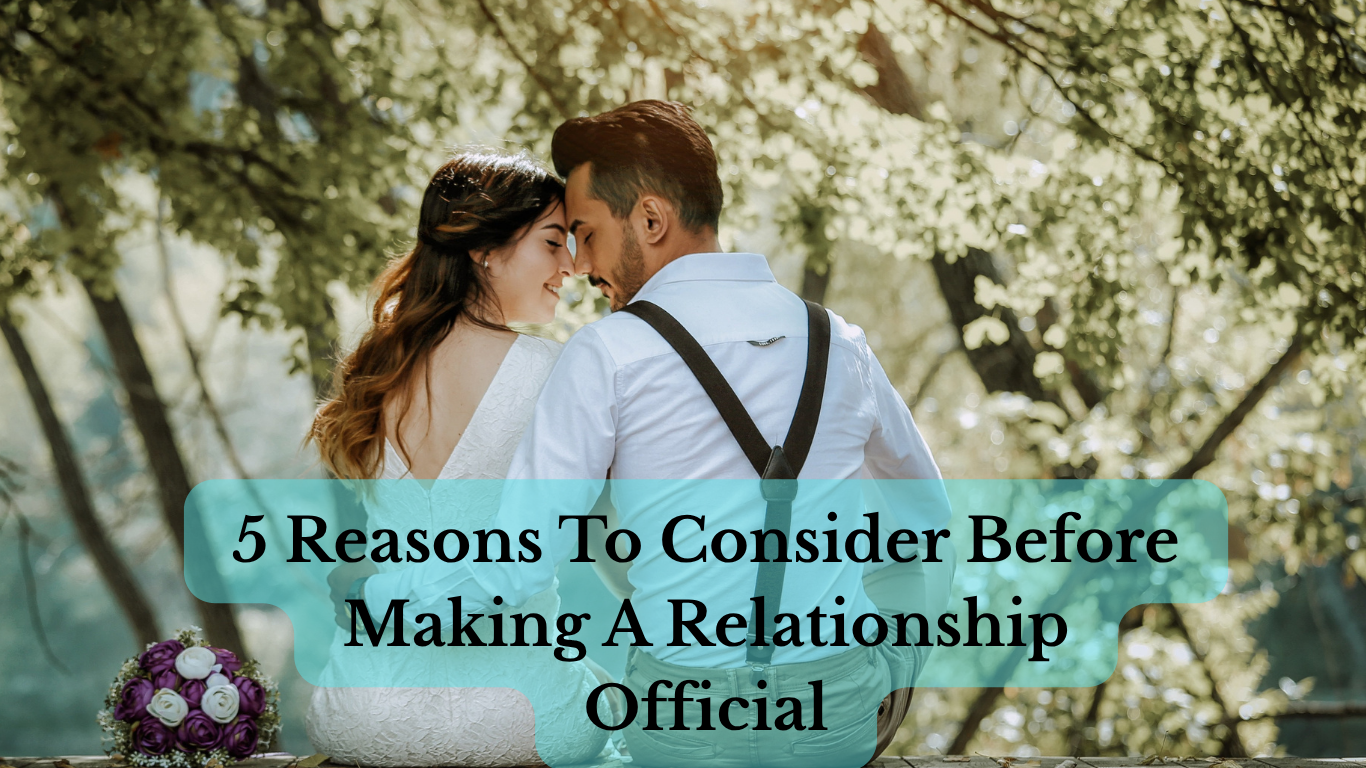
Have you ever found yourself in that particular in-between space of a relationship — past the first few dates, past the early uncertainty, somewhere in the warm middle ground where things feel good and the question of “what are we actually doing here?” has begun to hover, unasked, over every shared evening? That moment — when the possibility of making things official begins to feel both exciting and terrifying in equal measure — is one of the most significant transition points in any romantic relationship. This blog examines the most important, honest, and genuinely useful things to consider before making a relationship official — because the conversation that precedes the commitment shapes everything that follows it.
Table of Contents
What “Making It Official” Actually Means
Before examining what to consider, it is worth pausing on what making a relationship official actually involves — because the phrase means different things to different people, and the assumption that both parties share the same understanding of what they are agreeing to is one of the most common and most consequential sources of early relationship disappointment.
For some people, making it official means exclusivity — an agreement that neither party is romantically or sexually involved with anyone else. For others, it means public acknowledgement — being introduced as a partner, appearing together in social media, being known to each other’s friends and family as a couple. For others still, it carries a deeper implication of intentionality — a shared acknowledgement that this relationship is being pursued with genuine long-term possibility in mind rather than casual enjoyment of the present.
The conversation about making things official is most valuable when it includes, rather than assumes, a shared definition of what official means for both people. That clarity, established early, prevents the misaligned expectations that cause genuine harm later.
1. Are Your Core Values Genuinely Compatible?
Values compatibility is the foundation beneath every other dimension of relationship compatibility — and yet it is frequently the last thing couples examine, because the early stages of romantic connection are so dominated by chemistry, excitement, and the generous interpretation of everything the other person says and does.
Core values — the deep, non-negotiable convictions that govern how a person lives, what they prioritise, how they treat others, and what they ultimately want from life — are not the same as shared interests or compatible personalities. Two people can enjoy the same films, laugh at the same things, and feel deeply comfortable together while holding fundamentally different values about family, money, faith, ambition, honesty, and the role of relationship in a full life.
The relevant questions are not comfortable but they are essential. Do you share a fundamental orientation toward honesty, or do you have different thresholds for what constitutes acceptable social or relational dishonesty? Do your values around family — whether to have children, how to raise them, the role of extended family in your lives — align at the level that matters? Do you share enough common ground on faith, spirituality, or philosophical worldview that the differences are enriching rather than eroding?
Per research on relationship longevity and satisfaction, values alignment — particularly on the issues of family formation, financial philosophy, and life priorities — is one of the strongest predictors of long-term relationship success. Chemistry fades and compatibility deepens with time. What you are left with, after the excitement of early relationship has settled, is largely determined by whether your values point in the same direction.
2. Have You Seen Each Other in Enough Contexts?
Early relationship is a curated experience. Both people are presenting their most appealing, most considered, most socially gracious selves — not through deliberate deception but through the natural human tendency toward positive self-presentation in contexts of romantic aspiration. The question worth asking before making things official is whether you have seen enough of the uncurated version of each other to make a genuine rather than a projected assessment.
The uncurated version of a person is visible in specific contexts that early relationship tends to avoid or minimise. How does this person behave under genuine stress — not the performative stress of a difficult day described over dinner, but the actual stress response when something goes meaningfully wrong? How do they treat people who have no social power over them — service workers, people who make mistakes, strangers in minor conflict situations? How do they handle disappointment — when plans change, when they do not get what they wanted, when a situation is genuinely unfair? How do they behave with their family — because the family of origin is the most revealing context for understanding a person’s relational history and habitual patterns?
You do not need years to gather this information, but you do need more than a series of carefully planned dates in controlled environments. Travelling together, navigating a minor crisis, spending time in each other’s domestic environments, and meeting each other’s families and close friends are the experiences that provide this information — and the relationship that has not yet generated them deserves a degree of epistemic humility before being formalised.
3. Is the Pace of the Relationship Driven by Genuine Readiness or External Pressure?
The decision to make a relationship official is most sound when it emerges organically from the genuine readiness of both people — from a shared sense that the relationship has developed the depth, trust, and mutual knowledge that a commitment deserves. It is least sound when it is driven by external pressures that have nothing to do with the actual state of the relationship.
External pressures on relationship timing are varied and powerful. Social comparison — watching peers in committed relationships and feeling the pull to formalise your own situation to match — is one of the most common. Family expectation — the question asked at gatherings about the status of the relationship, creating pressure to resolve the ambiguity with a label — is another. The practical convenience of commitment — the desire to secure the relationship against the uncertainty of the non-exclusive stage — is a third. And the cultural narrative that relationships should follow a specific timeline, with clear milestones at predictable intervals, exerts a background pressure that most people underestimate.
Per research on relationship satisfaction and commitment quality, relationships made official in response to genuine mutual readiness demonstrate significantly stronger long-term stability and satisfaction than those formalised in response to external timing pressure. A relationship that is not yet ready to be official is not necessarily a relationship that will never be ready. The question worth sitting with is whether the readiness is genuinely present or whether the timing is being driven by something other than the relationship itself.
4. Have You Had Any Difficult Conversations — and Survived Them Well?
The quality of a relationship under pressure is a more reliable indicator of its long-term viability than its quality under the favourable conditions of early romance. Before making things official, it is genuinely worth assessing whether you have had any conversations that required honesty, vulnerability, or the navigation of genuine disagreement — and how both people handled them.
Relationships that have not yet encountered any friction are relationships whose conflict resolution capacity is entirely untested. The early stages of courtship are characterised by a natural suppression of potentially difficult topics — both people instinctively avoid what might jeopardise the connection they are building, and the result is a relationship that feels easy because it has not yet been asked to be anything else.
A relationship in which you have navigated at least some genuine difficulty — a misunderstanding resolved honestly, a difference of opinion discussed without it becoming a source of damage, a moment of vulnerability met with care rather than judgment — has demonstrated something real. It has shown you not just who this person is when things are good but who they are when things require effort. That demonstration is worth more than months of harmonious early dating.
The specific things to observe in difficult conversations include whether both people feel heard or whether one person consistently dominates or deflects, whether repair is made genuinely or superficially, whether honesty is met with openness or defensiveness, and whether both people emerge from difficulty with the relationship feeling stronger rather than more fragile.
5. Do Your Long-Term Visions for Life Point in Compatible Directions?
Making a relationship official is, implicitly, a declaration of interest in exploring whether this person could be a long-term partner — and that interest makes long-term vision compatibility a relevant consideration at a level it was not during casual dating. The questions that feel premature to ask on a third date become entirely appropriate before formalising a commitment — because the commitment invites the long-term in a way that casual connection does not.
Long-term vision encompasses geography — where each person imagines building their life, and how flexible or fixed those imaginations are. It encompasses family formation — whether and when children are wanted, and what parenting would look like. It encompasses career ambition and lifestyle — the relationship between work and personal life, financial priorities, and the kind of daily existence each person is genuinely trying to create. And it encompasses the fundamentals of how each person imagines a long-term partnership functioning — the roles, the expectations, the distribution of domestic and financial responsibility.
These are not conversations to be resolved before making a relationship official — they are conversations to be begun. The difference between a relationship with genuine long-term potential and one that will eventually founder on irreconcilable visions is not the absence of difference but the quality of how difference is navigated. Beginning those conversations before the commitment rather than after is not pessimistic — it is the most practically loving thing either person can do for the relationship’s actual future.
6. Are You Making This Decision From a Place of Security or Anxiety?
Perhaps the most personally honest and most psychologically important question on this list — the motivation driving the desire to formalise the relationship deserves examination with more candour than the romantic context typically invites.
People make relationships official for a range of motivations, some of which serve the relationship and some of which serve a need that the relationship is being recruited to meet. Genuine desire for commitment — the wish to honour something real by naming it and protecting it — is the motivation that most serves the relationship. Anxiety-based commitment — the desire to resolve the uncertainty of the non-exclusive stage, to secure against the fear of losing someone, or to fill a void of loneliness or self-worth — is a motivation that frequently produces a commitment made to manage a feeling rather than to honour a relationship.
Per attachment theory research on relationship patterns, individuals with anxious attachment styles are significantly more likely to seek premature commitment — to push for official status before the relationship has developed the genuine foundation that commitment should reflect — as a strategy for managing relational anxiety rather than as a response to genuine relational readiness. The commitment that follows may temporarily reduce the anxiety, but it does not address its source — and the anxiety tends to resurface, in a different form, within the now-official relationship.
The most useful question is not just “do I want this relationship to be official?” but “why do I want it to be official, right now, at this pace?” The answer to the second question tells you considerably more about the quality of the first.
7. What Does Your Support Network Think — and How Much Does That Matter?
The people who know you best — your closest friends, your family, the people who have witnessed you in relationships before and who love you with the kind of honesty that affection produces — often see things about your romantic situations that your own emotional involvement makes difficult to perceive clearly. Their perspective is not authoritative, and the decision to make a relationship official is ultimately yours to make on the basis of your own experience and judgment. But it is worth knowing what the people closest to you think — and genuinely hearing it rather than simply seeking validation.
The friend who expresses a concern — about the pace, about something they have observed in the person you are dating, about a pattern they recognise from previous relationships — is not necessarily right. But they may be seeing something that your investment in the relationship has made difficult to see, and the honest consideration of their perspective is a form of relational due diligence that the excitement of early relationship makes easy to skip.
Per research on social support and relationship outcomes, individuals who make major relationship decisions in genuine dialogue with their closest trusted relationships — rather than in isolation from them or in deliberate avoidance of potentially challenging perspectives — demonstrate better long-term decision quality and higher relationship satisfaction. The people who love you are not obstacles to your romantic decisions. They are, at their best, some of the most valuable information sources available to you.
8. How Do You Each Communicate When It Actually Matters?
Communication quality in a relationship is not primarily visible in how well two people talk when everything is comfortable. It is visible in how honestly, how clearly, and how generously they communicate when something uncomfortable needs to be said — a boundary, a need, a concern, a feeling that risks creating conflict or vulnerability.
Before making a relationship official, it is worth honestly assessing the communication patterns that have already established themselves in the connection. Is there genuine reciprocity — does each person share, listen, and respond with equivalent openness? Are there topics that have been implicitly identified as off-limits — not through explicit agreement but through the unspoken social dynamics of early relationship? Does either person have a pattern of withdrawing, deflecting, or becoming defensive when communication moves into difficult territory?
The communication patterns established in the early stages of a relationship tend to persist and intensify rather than naturally improve after commitment. A relationship that already has a pattern of avoiding difficult conversations will not develop greater honesty simply because it has been made official — the commitment may actually reduce the incentive for honest communication by reducing the fear of the relationship ending.
The quality of communication in the pre-official stage is one of the best available predictors of the quality of communication in the official one. Pay attention to it with the same rigour you would apply to any other important evidence.
Key Takeaways
Making a relationship official is not merely a social formality or a label applied to an existing situation. It is a genuine threshold — a mutual acknowledgement that both people are choosing this relationship with intentionality, are prepared to invest in its development, and are interested in exploring where it might genuinely go. That threshold deserves the consideration it rarely receives in the moment of romantic excitement that typically surrounds it.
The considerations in this blog — values compatibility, contextual knowledge of each other, genuine readiness versus external pressure, tested conflict capacity, long-term vision alignment, motivation quality, support network perspective, and communication patterns — are not a checklist to be completed before permission to proceed is granted. They are a framework for the kind of honest self-examination and mutual conversation that makes the commitment, when it is made, genuinely worth making.
Per research on relationship quality and long-term satisfaction, the couples who report the highest relationship satisfaction and the greatest resilience through difficulty are almost universally those who entered commitment with clear eyes — who knew what they were choosing, had examined their motivations honestly, and had begun the difficult conversations before the commitment rather than deferring them indefinitely after it.
Make it official when the relationship is ready — not when the calendar says it should be, not when the social pressure becomes uncomfortable, and not when the anxiety of uncertainty becomes easier to manage through commitment than through patience. Make it official because what you have built together is genuinely worth naming, protecting, and choosing again every day that follows.