Have you ever watched two children balance perfectly on a seesaw — one heavier child sitting closer to the centre, the other lighter child sitting further out, the whole thing hovering in that satisfying state of equilibrium that seems to almost defy the apparent imbalance between them — and thought that something genuinely elegant in the physics of the situation deserves a better explanation than it usually receives? The seesaw is not merely a piece of playground equipment. It is one of the most intuitive and most perfectly realised examples of a first-class lever in the physical world — a mechanical system whose arrangement embodies the defining principles of lever mechanics with a clarity that no other common object quite matches. This blog examines precisely why the seesaw is closest in arrangement to a first-class lever and what that arrangement reveals about one of the most fundamental principles in all of physics.
Table of Contents
Understanding Levers — The Foundation
Before examining why the seesaw exemplifies a first-class lever, it is essential to understand what a lever is, what its fundamental components are, and why the classification of levers into three classes is physically meaningful rather than merely taxonomic.
A lever is one of the six classical simple machines — a rigid bar or beam that rotates around a fixed point called the fulcrum when a force is applied to it. The purpose of a lever is to transmit and transform force — to allow a smaller input force applied over a greater distance to produce a larger output force over a smaller distance, or alternatively, to produce greater speed and range of motion at the cost of increased input force.
Every lever, regardless of its specific form, contains three essential elements whose relative positions define both its class and its mechanical behaviour.
The fulcrum — also called the pivot — is the fixed point around which the lever rotates. It does not move during the lever’s operation; it is the axis of rotation that makes the lever’s mechanical advantage possible.
The effort — also called the input force or the load force in some conventions — is the force applied to the lever to produce the desired effect. It is what the person or system operating the lever contributes to the mechanical system.
The load — also called the resistance or the output force — is the force that the lever acts against. It is the weight being lifted, the resistance being overcome, or the output the lever is designed to produce.
The relative positions of these three elements — fulcrum, effort, and load — determine which class of lever a given mechanism represents, and those positional relationships directly determine the lever’s mechanical properties.
The Three Classes of Levers — Distinguished by Arrangement
The classification of levers into three classes is entirely determined by the positional arrangement of the three elements — fulcrum, effort, and load — relative to each other along the lever’s length. Understanding all three classes contextualises what makes the first class arrangement distinctive and why the seesaw exemplifies it.
First-Class Lever — Fulcrum Between Effort and Load
In a first-class lever, the fulcrum is positioned between the effort and the load. The person applying force pushes or pulls on one side of the fulcrum, and the load is positioned on the other side. Both the effort and the load act on opposite sides of the fulcrum, and the lever rotates around the fulcrum between them.
This arrangement is the one most people instinctively imagine when they think of a lever in the classical sense – because it is the arrangement that Archimedes famously described when he declared, “Give me a place to stand, and I shall move the Earth.” The crowbar being used to pry open a crate, with the fulcrum at the edge of the crate between the pushing hand and the load being lifted, is a first-class lever. Scissors, in which each blade is a first-class lever with the pivot between the cutting force and the resistance of the material being cut, are first-class levers. The human head balanced on the neck — with the neck vertebrae as the fulcrum between the facial muscles pulling forward at the front and the weight of the skull behind — is a biological first-class lever.
The defining physical characteristic of the first-class lever is that effort and load are on opposite sides of the fulcrum. This means that when the effort end goes down, the load end goes up — the two ends of the lever move in opposite directions relative to the fulcrum. This opposing motion is a direct consequence of the fulcrum-between-effort-and-load arrangement.
Second-Class Lever — Load Between Fulcrum and Effort
In a second-class lever, the load is positioned between the fulcrum and the effort. The fulcrum is at one end, the effort is applied at the other end, and the load is situated somewhere between them along the lever’s length.
A wheelbarrow is the classic example — the wheel is the fulcrum at the front, the handles where force is applied are at the back, and the load sits in the barrow between them. A nutcracker is another example – the hinge is the fulcrum, the hands apply effort at the handles, and the nut to be cracked sits between them. A door, hinged at one side and pushed or pulled at the other, with the door’s weight distributed along its surface, has properties consistent with a second-class lever.
Second class levers always produce a mechanical advantage greater than one — they always amplify the input force, because the effort arm (from effort to fulcrum) is always longer than the load arm (from load to fulcrum). They cannot produce a reversal of force direction — both effort and load act on the same side of the fulcrum.
Third Class Lever — Effort Between Fulcrum and Load
In a third-class lever, the effort is applied between the fulcrum and the load. The fulcrum is at one end, the load is at the other end, and the effort is applied somewhere in between.
The human forearm is the most commonly cited example — the elbow joint is the fulcrum, the biceps muscle applies effort to the forearm bone between the elbow and the hand, and the hand holds the load at the far end. A fishing rod, tweezers, and a broom are further examples. Third-class levers always sacrifice mechanical advantage — they produce a mechanical disadvantage, requiring more effort than the load — in exchange for increased speed and range of motion at the load end.
Why the Seesaw Is the Closest Arrangement to a First-Class Lever
With the three classes of levers clearly understood, the specific case for the seesaw as the closest arrangement to a first-class lever can be made with precision – examining each physical characteristic of the first-class lever arrangement and demonstrating how the seesaw embodies it.
The Fulcrum Is Centrally Located Between the Two Effort-Load Positions
The most fundamental defining characteristic of a first-class lever is the positioning of the fulcrum between the effort and the load — and the seesaw realises this arrangement with a physical explicitness that is unmatched by most other first-class levers in everyday life.
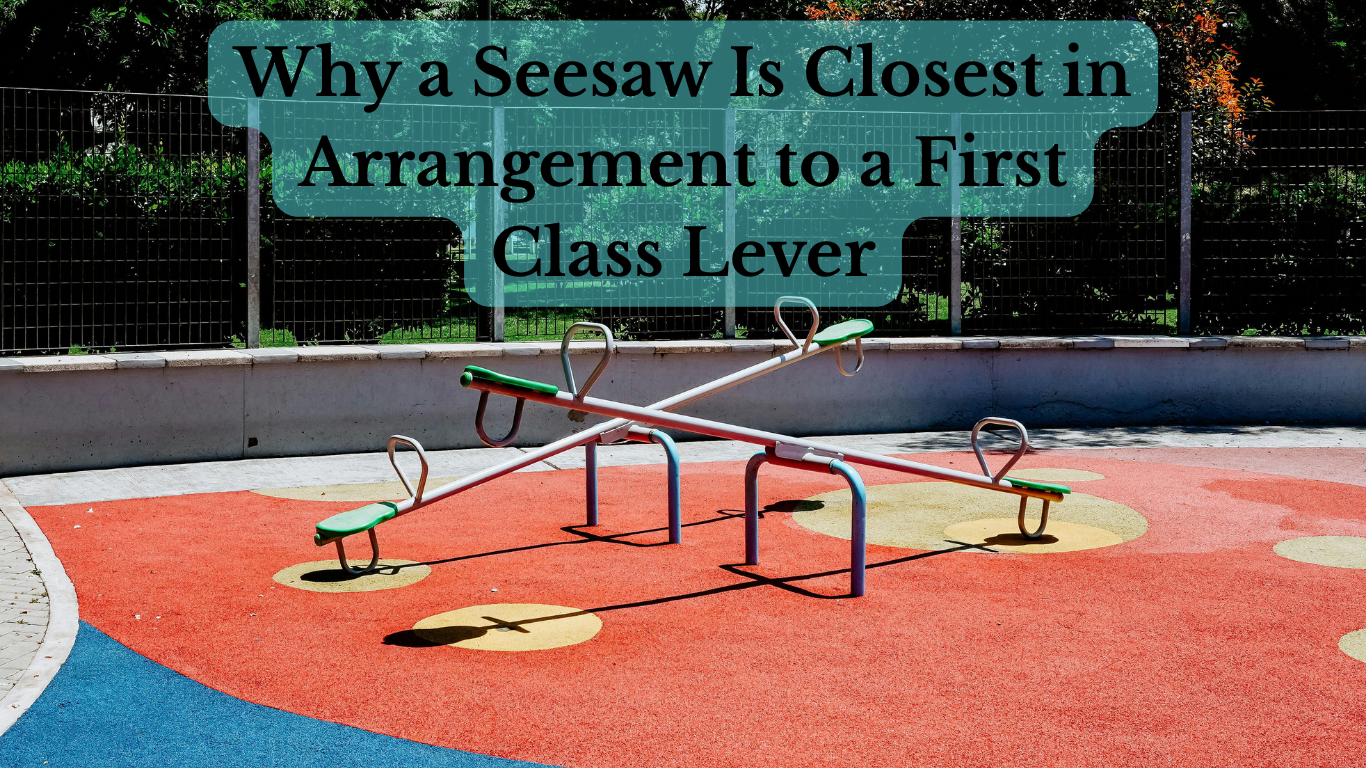
In a seesaw, the central pivot — the triangular support structure on which the plank rests and rotates — is positioned at the midpoint of the plank, with equal lengths of the plank extending to either side. This central pivot is the fulcrum — the fixed point around which the entire system rotates. The child on one end provides the effort, and the child on the other end constitutes the load — or, more precisely, each child is simultaneously both effort and load for the other, which is one of the seesaw’s most elegant mechanical properties.
The spatial arrangement could not more clearly embody the first-class lever’s defining geometry — the fulcrum between effort and load, with effort and load on opposite sides of the pivot. In a crowbar, the fulcrum is positioned at the edge of the object being pried, but the lengths on either side are typically unequal, and the arrangement may not be immediately geometrically obvious. In scissors, each blade is a first-class lever, but the compound nature of the tool and the cutting motion may obscure the underlying geometry. In the seesaw, the arrangement is visible, explicit, and spatially clear — making it the most pedagogically transparent first-class lever available in common experience.
Both Sides of the Lever Rotate in Opposite Directions Around the Fulcrum
The second defining mechanical property of a first-class lever — that the effort and load ends move in opposite directions relative to the fulcrum — is demonstrated by the seesaw with unmistakable physical clarity.
When one child on a seesaw goes down, the other goes up. This is not incidental to the seesaw’s design — it is the direct mechanical consequence of the first-class lever arrangement, in which effort and load are on opposite sides of a central fulcrum. The downward motion of one end of the plank necessarily produces the upward motion of the other end, because the plank rotates around the central pivot rather than moving in a single direction.
This opposing motion is the most visually distinctive feature of the seesaw and the most directly illustrative of first-class lever mechanics. In a second-class lever like a wheelbarrow, the effort end and the load move in the same general direction — the operator lifts the handles and the wheelbarrow’s contents rise with them. In a third-class lever like a fishing rod, the effort and the load again move in the same direction — the hand holding the rod moves and the rod’s tip follows. Only in the first-class lever — and therefore only in the seesaw — does the application of force on one side of the fulcrum produce motion in the opposite direction on the other side.
This is why the seesaw is so immediately and intuitively recognisable as a lever to anyone who observes it — because the opposing motion of its two ends is the most visually legible expression of the first-class lever’s fundamental mechanical property.
The Mechanical Advantage Is Determined by the Ratio of Effort Arm to Load Arm
The seesaw also perfectly illustrates one of the most practically important principles of first-class lever mechanics — the relationship between the lengths of the effort arm and load arm and the mechanical advantage the lever provides.
The effort arm is the distance from the point of effort application to the fulcrum. The load arm is the distance from the fulcrum to the point at which the load acts. The mechanical advantage of a lever is the ratio of the effort arm to the load arm — and it determines how much the lever amplifies or diminishes the applied force.
In a seesaw with the pivot at the exact centre — as in a standard playground seesaw — the effort arm and the load arm are equal in length, producing a mechanical advantage of exactly one. This means that the seesaw neither amplifies nor diminishes force — a child who weighs twice as much as their companion will push their end to the ground regardless of position, unless the imbalance is addressed.
The practical adjustment made in real seesaw use — the heavier child sitting closer to the centre, the lighter child sitting further out — is a direct application of the first-class lever principle. By moving the heavier child closer to the fulcrum, the load arm is shortened. By moving the lighter child further from the fulcrum, the effort arm is lengthened. When the torques on each side — the product of force and arm length — are equalised, the seesaw achieves equilibrium. This elegant demonstration of torque equilibrium is one of the seesaw’s most powerful pedagogical contributions.
Per the fundamental lever equation — Effort × Effort Arm = Load × Load Arm — equilibrium is achieved when these products are equal, regardless of whether the forces themselves are equal. The seesaw makes this principle physically tangible and visually accessible in a way that few other mechanical demonstrations can match.
The Seesaw Compared to Other First-Class Lever Examples
To fully appreciate why the seesaw is closest in arrangement to a first-class lever — rather than simply saying it is a first-class lever — it is worth comparing it with other examples of first-class levers and examining why the seesaw’s embodiment of the arrangement is uniquely clear.
| Lever Example | Fulcrum Position | Effort-Load Opposition | Arrangement Visibility |
|---|---|---|---|
| Seesaw | Centrally located, explicit | Directly visible — opposing vertical motion | Maximum — immediately apparent |
| Crowbar | At the prying edge | Present but not always visually obvious | Moderate — requires understanding the application |
| Scissors | At the central pivot | Present in the blade motion | Moderate — compound nature may obscure |
| Human head on neck | At the neck vertebra | Present but not intuitively obvious | Low — non-obvious biological lever |
| Balance scale | At the central pivot | Directly visible — opposing pan motion | High — similar to seesaw in clarity |
The seesaw and the balance scale share the highest arrangement visibility among common first-class lever examples — but the balance scale is a measurement instrument rather than a mechanism for work, and its application to human use is significantly narrower than the seesaw’s. The seesaw is simultaneously the most accessible, the most physically explicit, and the most commonly experienced first-class lever in everyday life — making it uniquely suitable as both an example and an educational tool.
The reason the question is framed as the seesaw being closest in arrangement rather than simply being a first-class lever is the important nuance that the seesaw is not merely a first-class lever — it is a first-class lever whose physical form is specifically and explicitly designed around the defining arrangement of the first-class lever. Most first-class levers — the crowbar, the scissors, and the human head — are first-class levers whose arrangement is incidental to their primary function. The seesaw is a first-class lever whose arrangement is its function — whose entire design is structured around the central fulcrum, the opposing effort and load positions, and the rotating motion that results. In this sense, it is not merely an example of a first-class lever but an embodiment of the first-class lever’s defining arrangement.
The Physics of Balance — Torque and the Seesaw
The seesaw’s status as the closest arrangement to a first-class lever is further reinforced by the elegance with which it demonstrates the physics of torque — the rotational force that determines the behaviour of all lever systems.
Torque is the rotational equivalent of linear force — it is the tendency of a force to cause rotation around a fixed point, and it is calculated as the product of the force applied and the perpendicular distance from the fulcrum to the line of the force. In the seesaw, the torque on each side of the fulcrum is the product of the child’s weight and their distance from the centre pivot.
The condition for the seesaw to balance – for neither side to rotate – is that the torques on each side are equal in magnitude. This is the physical expression of the lever principle that Archimedes formulated and that Newton’s laws of rotational mechanics formalised — and the seesaw makes it directly, physically, and intuitively tangible.
A child who weighs 40 kilograms sitting 2 metres from the pivot generates a torque of 80 kilogram-metres on their side. For the seesaw to balance, a child on the other side must generate an equal torque — which a 20-kilogram child can achieve by sitting 4 metres from the pivot. The mathematics is simple; the physical demonstration is profound; and the arrangement that makes it possible is precisely the arrangement that defines a first-class lever — the central fulcrum between effort and load, with each side rotating in the opposite direction of the other.
Per physics education research on mechanical principles and pedagogical effectiveness, the seesaw is consistently identified as the most effective physical demonstration of first-class lever principles available in common experience — because its arrangement makes every relevant physical principle simultaneously visible, tangible, and adjustable. Students who understand the seesaw understand first-class levers.
Key Takeaways
The seesaw is closest in arrangement to a first-class lever because it embodies, with unmatched physical explicitness and pedagogical clarity, every defining characteristic of the first-class lever arrangement — the central fulcrum positioned between the effort and the load, the opposing motion of the two ends around that central pivot, the determination of mechanical advantage by the ratio of effort arm to load arm, and the torque equilibrium that produces balance. No other common example of a first-class lever makes these principles simultaneously as visible, as tangible, as adjustable, and as intuitively understandable as the seesaw does.
Per the foundational principles of classical mechanics, the lever is among the most elegant of all simple machines — a device that transforms force through the geometry of its arrangement rather than through any chemical, electrical, or thermal process. And the first-class lever is the lever arrangement that most fully expresses this transformative capacity — allowing effort and load to oppose each other across a central fulcrum in the balanced, rotating, mechanically principled way that Archimedes recognised as foundational to all physical work.
The seesaw is not merely a playground toy that happens to be a first-class lever. It is the first-class lever made manifest in its most physically transparent and most pedagogically powerful form — a machine that teaches the principles of its own operation to every child who sits on it, whether or not they have ever heard the word ‘lever’ or know what a fulcrum is.
The next time you watch a seesaw in motion — one end rising as the other falls, children adjusting their positions to find the balance point, the central pivot holding everything together — you are watching one of the oldest and most fundamental principles in physics being demonstrated with a clarity that no classroom diagram quite captures. That is not an accident of design. It is the design.