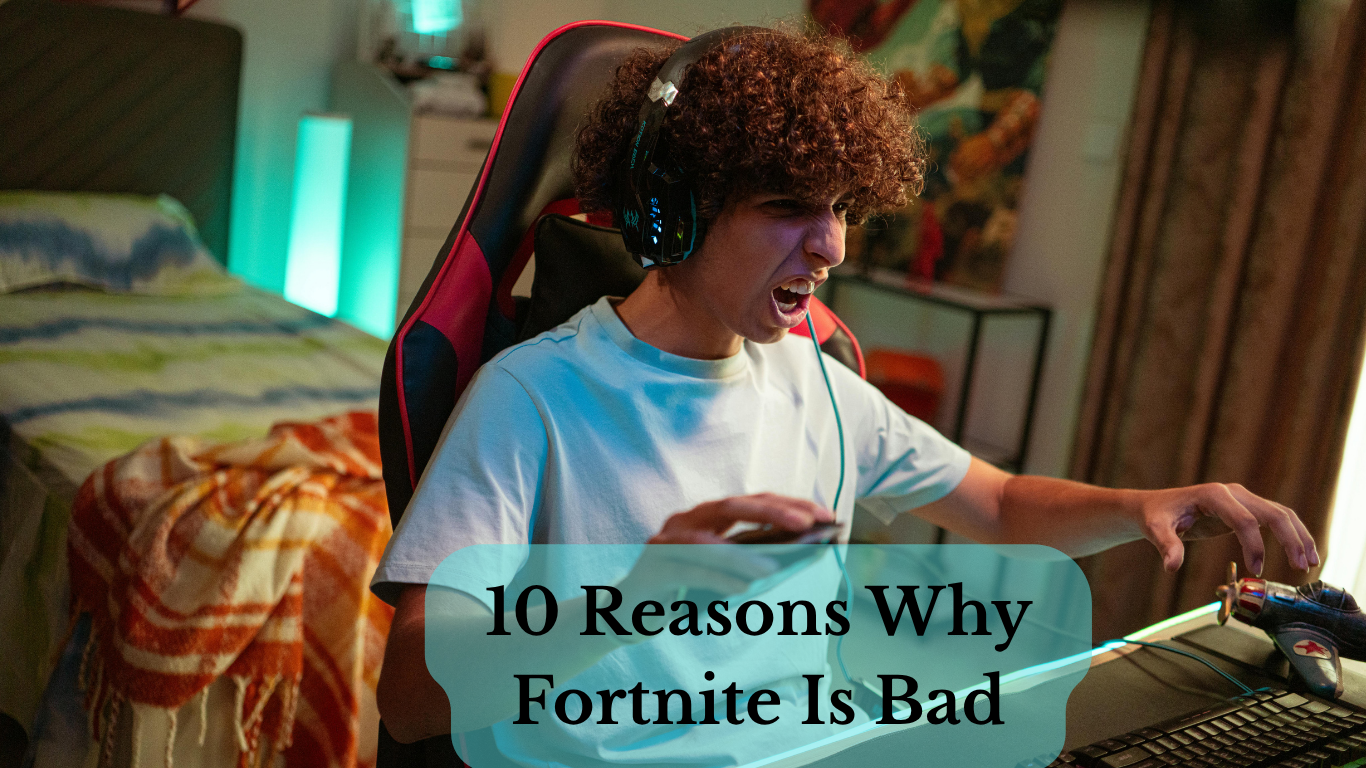
Have you ever watched a child — or perhaps a teenager, or perhaps a fully grown adult who should theoretically know better — disappear into Fortnite for what was announced as “just one more game” and emerge three hours later slightly glazed, mildly irritable, and with a vocabulary that has been enriched exclusively by gaming terminology whose utility in daily life is limited? Fortnite — Epic Games’ battle royale phenomenon that has captured the attention of hundreds of millions of players since its 2017 launch — is simultaneously one of the most successful, most innovative, and most genuinely concerning video games in the history of the medium. This blog examines 10 genuine, evidence-informed reasons why Fortnite raises legitimate concerns — presented honestly and without the moral panic that gaming criticism sometimes produces, but also without the dismissiveness that can prevent genuine concerns from being taken seriously.
Note: This blog examines legitimate concerns about Fortnite that are supported by research and expert opinion. It does not argue that Fortnite is uniquely evil among all entertainment options or that all players are equally affected by all concerns. Individual experiences vary significantly, and many players engage with the game without experiencing the harms described.
Table of Contents
1. Deliberately Engineered Addictive Design — Not Accidental Engagement
The most significant concern about Fortnite is not that it is fun — being fun is not a problem — but that it is specifically and deliberately engineered to maximise the difficulty of stopping play, using mechanisms whose psychological effects are well-understood and whose application to entertainment has been extensively documented as producing compulsive engagement patterns.
Fortnite employs the full toolkit of behavioural psychology engagement design. Variable reward schedules — the same mechanism that makes slot machines compelling — underlie the loot system, where the unpredictable timing and content of rewards produce the dopamine-driven anticipation response that sustains engagement more effectively than predictable rewards. The battle pass progression system creates a series of escalating near-completion states — the player who is four challenges away from the next tier is more compelled to play than one who just completed a tier, a specific application of the endowment effect and loss aversion to gaming engagement. The seasonal content structure — limited-time items, events, and cosmetics that disappear permanently — creates FOMO-driven urgency that pressures players to maintain engagement to avoid missing content that will not return.
Per research on game design and compulsive play, these mechanisms do not merely make games more enjoyable — they specifically target the self-regulatory capacities that would otherwise allow players to choose when to stop. The research of Andrew Przybylski and colleagues at the Oxford Internet Institute distinguishes between motivated engagement and compulsive engagement — the former being the deliberate choice to invest in an enjoyable activity and the latter being the continuation of behaviour despite the intention to stop. The specific design features described above are those most consistently associated with compulsive rather than motivated engagement.
2. Sleep Disruption — The Hidden Health Cost of Late-Night Gaming
The second major concern is the specific and consistently documented impact of Fortnite — and competitive gaming more broadly — on sleep duration, sleep quality, and the cascading health consequences that sleep disruption produces.
The mechanics of sleep disruption in Fortnite players operate through multiple simultaneous pathways. The fundamental engagement challenge — knowing when to stop — is amplified by the nature of battle royale gameplay, where the investment of 20 minutes in a game that ends in the final moments creates the specific frustration that motivates “one more game” patterns. The blue light emission of gaming screens suppresses melatonin production, delaying sleep onset when gaming occurs in the evening. The physiological arousal of competitive gameplay — elevated heart rate, heightened attentiveness, and the stress response of competitive performance — delays the transition to the parasympathetic state that sleep requires.
Per research on gaming and adolescent sleep, children and adolescents who report significant gaming time — and Fortnite’s primary demographic is precisely this group — demonstrate significantly shorter sleep duration, later sleep onset, and poorer sleep quality than age-matched non-gamers or moderate gamers. Per sleep research on adolescent health, the chronic sleep restriction that late-night gaming produces has consequences that extend across cognitive performance, emotional regulation, immune function, and the metabolic health dimensions whose disruption by sleep deprivation has been extensively documented.
The specific Fortnite-related sleep concern is amplified by the game’s update schedule and event timing — major events, limited-time modes, and seasonal conclusions are frequently timed at late evening hours in North American time zones, creating specific incentives for sleep sacrifice at exactly the moments when sleep protection is most important.
3. The Microtransaction Model — Psychological Pressure on Young Players
The third concern is the specific financial model that Fortnite operates under — free-to-play with extensive in-game purchase opportunities — and the documented psychological mechanisms through which this model extracts revenue from players, including children and adolescents whose capacity for the financial self-regulation this model demands is developmentally incomplete.
Fortnite’s V-Bucks currency system — the in-game currency purchased with real money at an exchange rate that obscures the real-world value of purchases — is a well-documented mechanism for reducing the psychological friction of spending. Per research on virtual currency and spending behaviour, the conversion of real money to virtual currency reduces the psychological salience of the expenditure — the player spending 800 V-Bucks for a cosmetic item is less immediately aware of having spent approximately $8 than they would be if the transaction were denominated directly in their national currency.
The specific targeting of cosmetic purchases at social status and identity – Fortnite skins signal peer status in the game’s social environment, and the wearing of rare or season-exclusive skins carries genuine social currency in the communities of young players – creates social pressure to spend that is particularly powerful for children and adolescents whose peer status concerns are developmentally heightened. Per research on social identity and gaming purchases, the relationship between cosmetic ownership and social standing within gaming communities creates genuine social pressure that parents and children frequently underestimate when assessing the game’s financial demands.
Per consumer protection research on loot boxes and gaming monetisation, several national regulatory authorities — including the Belgian Gaming Commission and the Netherlands Gaming Authority — have classified certain gaming monetisation mechanisms as gambling, and the broader regulation of in-game purchases targeting minors is an active area of policy development in multiple jurisdictions.
4. Academic Performance Disruption — Time Displacement and Cognitive Effects
The fourth concern is the documented association between heavy Fortnite engagement and academic performance outcomes — an association that operates through time displacement, sleep disruption, and the specific cognitive effects of sustained high-engagement gaming.
The time displacement mechanism is the most straightforward — time spent gaming is time not spent on homework, reading, sleep, physical activity, and the other activities that support academic development. Per research on adolescent time use and academic outcomes, the students who maintain the highest academic performance are consistently those who manage their discretionary time most effectively — and the specific engagement properties of Fortnite that make stopping difficult create a time displacement dynamic that is more severe than most other leisure activities produce.
The cognitive effects of heavy gaming on academic performance are more complex and less settled in the research literature — some research finds positive associations between gaming and specific cognitive skills, including spatial reasoning, processing speed, and multitasking, while other research finds negative associations between heavy gaming and the sustained attention, reading comprehension, and deliberate practice that academic performance requires. The current balance of evidence suggests that moderate gaming does not harm academic performance, while heavy gaming — particularly patterns involving late-night play and sleep sacrifice — is associated with academic performance decrements that are mediated partly by sleep disruption.
Per teacher and school counsellor reports on gaming-related academic disruption, Fortnite specifically has been identified as a significant disruption — with homework incompletion, class fatigue, and in-school discussion of gaming content consuming educational time and energy in ways that other gaming titles have not produced to the same degree.
5. Toxic Online Behaviour and Exposure to Harmful Social Environments
The fifth concern is the social environment of Fortnite’s online play — the exposure of players, including young children, to the verbal aggression, harassment, sexual language, and socially toxic behaviour patterns that characterise many competitive online gaming environments.
Fortnite’s voice chat and text communication systems — accessible to any player, including the youngest — expose players to the full range of online gaming culture, including its most problematic dimensions. Per research on online gaming environments and toxic behaviour, competitive gaming environments have among the highest rates of hostile, aggressive, and sexually explicit communication of any online social context — driven by the combination of competitive stakes, anonymity, and the specific disinhibition that these conditions produce.
For the young children who represent a significant component of Fortnite’s player base — the game’s cartoon aesthetic and cultural ubiquity have made it attractive to children considerably younger than its 12+ age rating — the exposure to adult competitive gaming culture through voice chat represents a genuine developmental concern. Per child psychology research on exposure to aggressive and sexually explicit language, the normalisation of hostile communication patterns in social environments has measurable effects on children’s own communication patterns and their expectations about how social interactions are conducted.
The specific dynamics of competitive gaming toxicity — the blame, the insults, and the harassment that follow poor performance — also create a social environment whose effects on self-esteem and psychological well-being deserve consideration, particularly for younger players whose sense of competence and social belonging is still being formed.
6. Physical Health Consequences of Sedentary Gaming Patterns
The sixth concern is the physical health consequences of the sedentary behaviour patterns that sustained Fortnite engagement promotes — whose effects compound across the hours, days, and years of habitual play that engaged players accumulate.
Per research on sedentary behaviour and health outcomes, prolonged sitting — the primary physical posture of gaming — is associated with elevated risks of cardiovascular disease, type 2 diabetes, obesity, and metabolic syndrome, independent of total physical activity levels. The specific concern for children and adolescents is the displacement of the vigorous physical activity that healthy development requires by the seated, static engagement of gaming — with consequences for the physical fitness development, motor skill acquisition, and metabolic health trajectory that the developmental period determines.
The specific musculoskeletal consequences of sustained gaming posture — neck and upper back pain from forward head position, repetitive strain in the hands and wrists, and eye strain from sustained near-focus attention — are documented occupational health concerns that translate directly to the gaming context. Per physiotherapy research on gaming-related musculoskeletal issues, the incidence of gaming-related physical complaints in heavy gaming populations is significant and increasing as gaming time increases.
The specific Fortnite concern is the game’s engagement properties — whose difficulty of stopping extends gaming sessions beyond the duration at which breaks would normally interrupt sedentary behaviour — combined with the late-night play patterns that replace sleep-associated physical restoration with continued sedentary gaming.
7. Mental Health Associations — Anxiety, Depression, and Emotional Dysregulation
The seventh concern is the associations between heavy Fortnite engagement and mental health outcomes — whose directionality and causality remain debated in the research literature but whose co-occurrence is sufficiently consistent to warrant serious attention.
Per research on gaming disorder and mental health, individuals who meet criteria for problematic gaming demonstrate elevated rates of depression, anxiety, social anxiety, and attention-related difficulties compared to non-problematic gamers — with the relationship between mental health challenges and heavy gaming being bidirectional in most models. Pre-existing depression and anxiety may increase vulnerability to compulsive gaming as an avoidance behaviour; compulsive gaming may exacerbate depression and anxiety through sleep disruption, social displacement, and the shame and loss of control associated with compulsive behaviour patterns.
The specific emotional dysregulation associated with Fortnite — the frustration, anger, and distress that accompany competitive loss in a game specifically designed to produce near-miss experiences — is a dimension of gaming-related mental health concern that clinical reports have highlighted. Per child and adolescent psychiatrist reports on gaming-related presentations, emotional explosions following gaming losses, difficulty regulating the transition from gaming to other activities, and the use of gaming as the primary emotional regulation strategy are among the most commonly reported clinical concerns associated with heavy Fortnite engagement.
Per research on emotional regulation development in adolescence, the reliance on any single activity — including gaming — as the primary emotional regulation strategy prevents the development of the broader emotional regulation repertoire that healthy adult functioning requires.
8. Social Development Displacement — Real Relationships vs. Virtual Ones
The eighth concern is the potential displacement of the real-world social development experiences — the face-to-face friendships, the physical social environments, and the unmediated human interactions — that healthy social and emotional development requires, by the virtual social experiences that gaming provides.
Fortnite is genuinely social — players coordinate with teammates, communicate in real time, and develop genuine friendships through shared gaming experiences. The social dimension of Fortnite is among its most significant positive features and should not be dismissed. The concern is not that gaming friendships are invalid but that they are insufficient substitutes for the full range of social experiences that healthy development requires — and that the balance between gaming-mediated and in-person social interaction matters for the social competencies that are developed through each.
Per developmental psychology research on social development and face-to-face interaction, the specific skills developed through unmediated physical social interaction — reading facial expressions and body language, managing physical proximity and touch, and navigating the full sensory complexity of in-person relationships — are not equivalent to those developed through voice-chat-mediated gaming interaction. For children and adolescents in critical social development periods, the displacement of face-to-face social time by gaming time may create gaps in these specific social competencies.
The specific social developmental concern is heaviest for children whose Fortnite engagement has reduced physical play, in-person social activity, and the unstructured social time in which the most important social developmental learning occurs.
9. Inappropriate Content and Age Rating Concerns
The ninth concern is the gap between Fortnite’s official age rating and its actual player base — a gap that results in the exposure of players considerably younger than the game’s intended audience to content and social environments for which they are developmentally unprepared.
Fortnite is rated 12+ by the Pan European Game Information system and T for Teen by the Entertainment Software Rating Board – ratings that reflect the game’s violence, even in its relatively cartoonish stylised form, and its competitive online social environment. Per parental research on children’s gaming habits, the actual Fortnite player base includes a substantial proportion of children well below the age 12 threshold — drawn by the game’s cultural ubiquity, its cartoon aesthetic, and the peer pressure of friends whose parents have also permitted access.
The specific content concerns for younger players include the violence of the game’s core mechanic — the explicit objective of killing all other players, even in stylised form, is the game’s fundamental purpose — and the exposure to the competitive online social environment described above. Per child development research on age-appropriate media content, the effects of violent competitive content on younger children differ meaningfully from the effects on the older adolescent audience the rating system targets.
The wider cultural concern is the normalisation — through Fortnite’s extraordinary cultural reach — of a battle royale game whose core mechanic is competitive homicide as a default childhood entertainment context that parents, educators, and children themselves have accepted without the level of reflection that its specific content characteristics might otherwise prompt.
10. The Opportunity Cost — What Is Not Being Done During Gaming Time
The tenth and final concern is the broadest and, in some respects, the most important — the opportunity cost of the hours invested in Fortnite and the experiences, skills, relationships, and development that are not occurring in those hours.
Every hour spent in Fortnite is an hour not spent on an alternative activity — and the alternatives foregone by children and adolescents who spend significant portions of their discretionary time gaming include activities whose developmental return substantially exceeds what gaming provides. Physical activity that develops fitness, motor skills, and the physical confidence that sports participation builds. Reading that develops vocabulary, empathy, and the capacity for sustained focused attention that academic and professional success requires. Creative activities — music, art, writing, building — that develop the expressive and technical skills that screen-based entertainment does not. Unstructured outdoor play that develops the independence, risk-tolerance, and self-directed activity that childhood exploration provides.
Per research on adolescent time use and developmental outcomes, the activities that most consistently predict positive long-term outcomes — academic achievement, professional success, psychological wellbeing, and social functioning — are precisely the activities most commonly displaced by heavy gaming engagement. The research does not suggest that gaming produces these negative outcomes directly — it suggests that gaming’s displacement of the activities that produce positive outcomes has measurable consequences that accumulate over the developmental years when those activities matter most.
The opportunity cost argument is not a claim that Fortnite provides zero value — it provides genuine entertainment, social connection, and specific cognitive challenges. It is a claim that the ratio of developmental return to time investment in heavy gaming is substantially lower than the equivalent ratio for the activities most commonly displaced by it.
Key Takeaways
The ten concerns examined in this blog — deliberately engineered addictive design, sleep disruption, psychological pressure through microtransactions, academic performance disruption, toxic social environments, physical health consequences, mental health associations, social development displacement, age rating and content concerns, and developmental opportunity cost — together represent a serious and evidence-grounded assessment of the legitimate concerns that Fortnite raises.
The honest framing of these concerns is not that Fortnite is uniquely evil or that all players are equally harmed. It is that the game’s specific design features — its engagement engineering, its monetisation psychology, its competitive social dynamics, and its cultural ubiquity among children significantly younger than its intended audience — create conditions that make the harms described more likely for more players than most entertainment options produce.
Per research on healthy gaming habits and the broader context of children’s and adolescents’ media use, the appropriate response to these concerns is not prohibition — which the research does not support and which parental experience consistently demonstrates is counterproductive — but informed, engaged parental management of gaming time, content, and social environment, combined with the cultivation of the alternative activities and relationships that provide the developmental foundation from which healthy gaming engagement is possible.
Fortnite is not going away. Its design is not becoming less engineered. The players are not becoming older or more developmentally equipped to manage its specific challenges independently. The appropriate response is the informed, attentive, and genuinely curious engagement of the adults responsible for the children who play it — not panic, not prohibition, but the clear-eyed understanding of what the game is actually doing and why it matters.