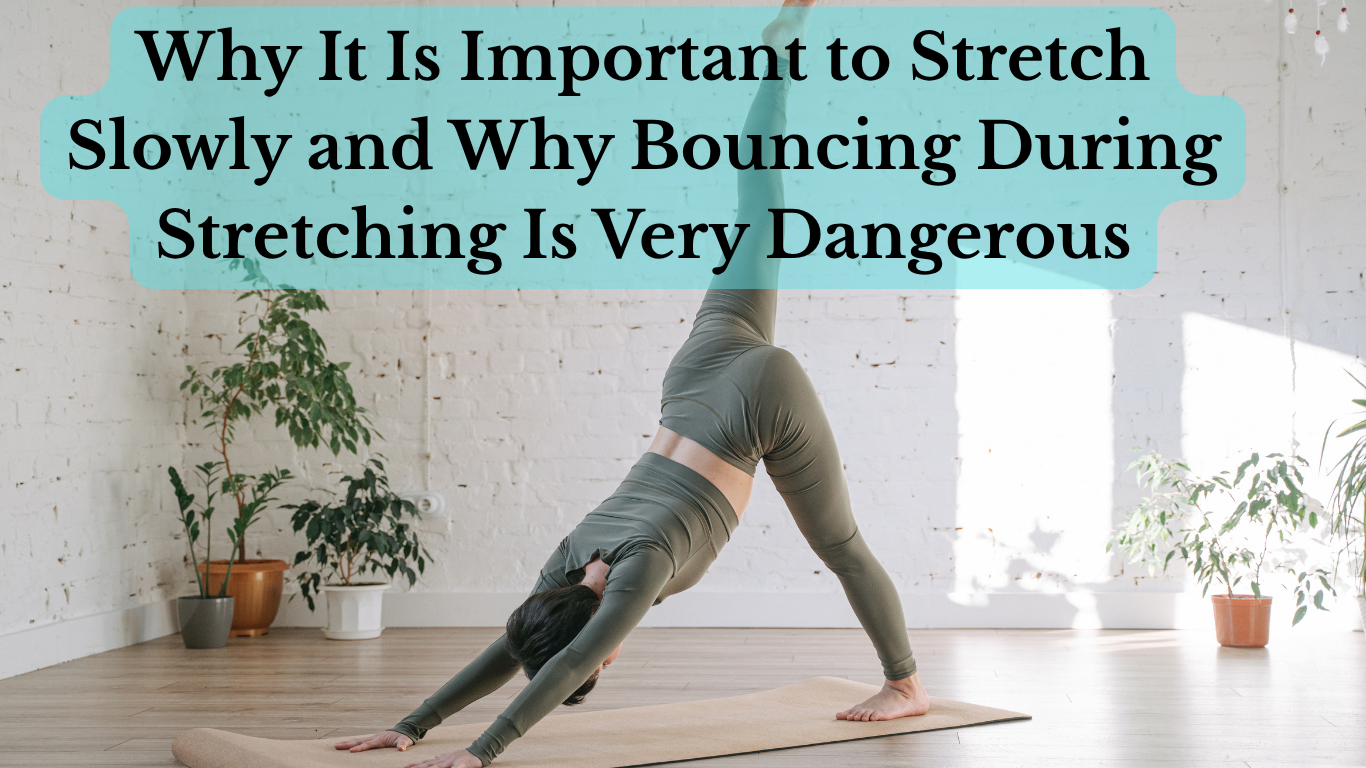
Have you ever been partway through a workout, eager to get to the actual exercise and tempted to rush through the stretching — or perhaps bounced repeatedly at the end of a stretch, trying to push just a little further — without fully understanding what you were doing to your body in those moments? Stretching is one of the most universally practised and most frequently misunderstood components of physical fitness — performed by everyone from elite athletes to casual gym-goers, and yet consistently approached with less understanding of its physiological mechanics than almost any other physical activity. This blog examines precisely why slow stretching is important and why bouncing during stretching — a practice known as ballistic stretching — carries genuine risks that the exercise community has come to take seriously.
Table of Contents
Understanding What Stretching Actually Does to the Body
Before examining the specific importance of slow stretching and the dangers of bouncing, it is essential to understand what is actually happening in muscle and connective tissue during a stretch — because the physiological reality of stretching is considerably more complex than the simple image of a muscle being lengthened suggests.
When a muscle is stretched, several distinct anatomical structures are simultaneously affected. The muscle fibres themselves — the contractile units that shorten and lengthen to produce movement — are elongated beyond their resting length. The connective tissue surrounding and threading through the muscle — including the epimysium covering the whole muscle, the perimysium surrounding fibre bundles, and the endomysium surrounding individual fibres — is also stretched, and this connective tissue component is frequently the primary limiting factor in flexibility for most people. The tendons connecting muscle to bone are affected by the transmitted force of the stretch, particularly at the musculotendinous junction — the meeting point of muscle and tendon that is among the most mechanically stressed and most injury-vulnerable structures in the musculoskeletal system. And the joint capsule and associated ligaments — the fibrous structures surrounding and stabilising the joint — are affected by the range of motion that stretching produces.
Within the muscle itself, two sensory structures play critical roles in the physiological response to stretching — and understanding them is the key to understanding both why slow stretching is important and why bouncing is dangerous.
The Muscle Spindle — The Stretch Reflex Sensor
The muscle spindle is a specialised sensory receptor embedded within muscle fibres — specifically within modified muscle fibres called intrafusal fibres that run parallel to the main contractile fibres. The muscle spindle’s primary function is to detect changes in muscle length and the rate of that change — providing the nervous system with continuous information about the muscle’s current length and how quickly it is being stretched.
When a muscle is stretched — particularly when it is stretched rapidly — the muscle spindles detect the length change and transmit signals to the spinal cord through sensory neurones. The spinal cord responds by sending motor signals back to the stretched muscle – causing it to contract. This response is the stretch reflex — sometimes called the ‘myotatic reflex’ — and its function is protective. It resists sudden, unexpected muscle lengthening that might cause injury, generating a muscular contraction that opposes the stretch before it can damage the muscle or its attachments.
The stretch reflex is a spinal reflex – it is mediated at the level of the spinal cord without requiring involvement of the brain, which is why it is extremely fast. The classic clinical demonstration of the stretch reflex is the knee-jerk response — a tap to the patellar tendon rapidly stretches the quadriceps, the muscle spindles detect the sudden stretch, the spinal cord responds with a contraction signal, and the lower leg kicks forward — all in approximately 25 to 50 milliseconds, before any conscious awareness of the tap.
The Golgi Tendon Organ — The Tension Sensor
The Golgi tendon organ is a second sensory structure located at the musculotendinous junction—the boundary between muscle and tendon. Unlike the muscle spindle, which detects muscle length and rate of length change, the Golgi tendon organ detects tension — the force being applied through the musculotendinous junction.
When tension in the musculotendinous junction rises to a sufficient level — whether through contraction, passive stretching, or both — the Golgi tendon organ sends inhibitory signals to the spinal cord that cause the muscle to relax. This response is called the ‘inverse stretch reflex‘ or ‘autogenic inhibition’ — and its function is also protective, preventing the generation of excessive tension that might damage the tendon or its attachments to bone.
The critical point about the Golgi tendon organ for stretching physiology is that its response requires sustained tension — it is not activated by brief, rapidly changing forces in the way that the muscle spindle is. It responds to sustained stretching that maintains tension at the musculotendinous junction long enough for the inhibitory signal to be generated and to produce the muscular relaxation that allows further lengthening.
These two sensory systems — the muscle spindle activating the stretch reflex and the Golgi tendon organ activating autogenic inhibition — are the physiological foundation for understanding why slow stretching is effective and why bouncing is dangerous.
Why It Is Important to Stretch Slowly
Slow Stretching Avoids Activating the Protective Stretch Reflex
The most fundamental reason for stretching slowly is that slow, gradual lengthening of a muscle does not activate the muscle spindle’s stretch reflex in the way that rapid stretching does. The muscle spindle is sensitive not only to the magnitude of length change but also to its rate — how quickly the muscle is being lengthened. Slow, gradual lengthening produces a much weaker spindle response than rapid lengthening at the same final length.
When stretching proceeds slowly, the muscle spindle’s signal to contract is correspondingly mild — and it can be overridden by the conscious relaxation that effective stretching requires. The muscle is able to lengthen toward its limit without fighting against a strong reflex contraction — and the range of motion achieved is genuinely limited by the elastic properties of the muscle and connective tissue rather than by a reflex contraction that is actively opposing the stretch.
When stretching proceeds rapidly — as in bouncing — the muscle spindle detects the rapid rate of length change and generates a strong, fast stretch reflex contraction. This contraction is exactly opposite in direction to the lengthening being attempted — the muscle contracts to resist the rapid stretch. The practical consequence is that the muscle being stretched is simultaneously being asked to lengthen and being reflexively commanded to shorten – a direct physiological conflict that does not merely prevent effective stretching but creates the mechanical conditions for tissue damage.
Slow Stretching Allows the Golgi Tendon Organ to Facilitate Relaxation
The Golgi tendon organ’s inhibitory response — the autogenic inhibition that causes muscular relaxation in response to sustained tension — is only available to a stretching approach that maintains tension for sufficient duration. This is the physiological basis of the sustained static stretch — holding a stretch for 20 to 60 seconds allows the Golgi tendon organ to respond to the sustained tension at the musculotendinous junction, generating the inhibitory signal that causes the muscle to relax and allows further lengthening.
This progressive relaxation during a sustained slow stretch is the physiological mechanism by which static stretching produces genuine improvements in flexibility over time. The muscle does not passively elongate — it is actively permitted to elongate by the inhibitory signal from the Golgi tendon organ that overrides the muscle spindle’s excitatory signal. Slow stretching creates the conditions under which this inhibitory mechanism can operate — and bouncing prevents those conditions from ever being established.
Slow Stretching Allows Connective Tissue to Adapt Safely
The connective tissue surrounding and threading through muscles — particularly the collagen-rich fascia and the dense connective tissue sheaths — is more resistant to elongation than the muscle fibres themselves and has different mechanical properties that make the rate of force application particularly important for safe stretching.
Connective tissue exhibits viscoelastic mechanical properties — it behaves partly like an elastic solid, which returns to its original shape when the deforming force is removed, and partly like a viscous fluid, which deforms gradually under sustained force and does not immediately recover. The viscous component of connective tissue’s response to force means that sustained, slow loading produces greater elongation than rapid loading of the same magnitude — the tissue flows gradually under sustained force in a way that it does not under sudden force.
Per research on connective tissue biomechanics, the safe elongation of connective tissue requires slow, sustained loading that allows the viscous flow component of the tissue’s response to occur gradually. Rapid loading — as produced by bouncing — stresses the elastic component of the tissue without allowing the viscous flow response, producing higher peak stresses in the tissue at any given level of elongation than slow loading would produce. These higher peak stresses increase the risk of microstructural damage to the collagen fibres that constitute the mechanical backbone of connective tissue.
Slow Stretching Maintains Neural Awareness and Body Communication
Slow stretching maintains the sensory awareness that allows the person stretching to monitor their body’s response and adjust accordingly. At slow speed, the sensations of stretch, mild discomfort, the approaching limit of comfortable range, and the warning signal of genuine pain are all distinguishable and actionable — the person can respond to these signals by easing the stretch, holding it steady, or carefully proceeding further.
Per research on proprioception and injury prevention, the maintenance of sensory awareness during physical activity is one of the primary mechanisms of injury avoidance — the ability to detect and respond to the body’s signals before they escalate to tissue damage. Slow stretching supports this awareness. Rapid or bouncing stretching overwhelms it — the speed of the movement produces forces before the sensory system can detect and respond to them.
Why Bouncing During Stretching Is Very Dangerous
Bouncing Repeatedly Activates the Stretch Reflex — Exactly Opposing the Goal of Stretching
The most fundamental danger of bouncing during stretching — the practice of repeatedly bouncing or pulsing at the end of a stretched position to force greater range of motion — is that every bounce activates the very protective reflex that stretching is intended to work around.
Each downward bounce in a hamstring stretch, each repeated rocking in a seated forward bend, or each pulsing reach in any stretch activates the muscle spindles through the rapid rate of length change it produces. The spindles respond with a stretch reflex contraction — the hamstrings contract to resist the rapid lengthening. The very next bounce is therefore being performed against a muscle that is reflexively contracting — a muscle that is actively resisting the stretch being attempted.
This creates a dangerous mechanical situation. The bouncing motion is applying force to a system that is simultaneously generating opposing force — and the meeting of these opposing forces at the musculotendinous junction, at the muscle-tendon interface, and within the muscle fibres themselves creates the conditions for tissue damage. The tissues are being pulled in one direction by the external force of the bounce while being pulled in the opposite direction by the reflex contraction — a mechanical conflict that the relatively fragile structures at the musculotendinous junction are particularly ill-equipped to absorb safely.
Bouncing Prevents the Golgi Tendon Organ From Producing Protective Relaxation
As established above, the Golgi tendon organ requires sustained tension to generate the inhibitory autogenic inhibition response that allows progressive muscular relaxation during stretching. Bouncing produces brief, intermittent tension spikes rather than sustained tension — each bounce applies force briefly and then releases it before the next bounce applies force again.
This intermittent force pattern never allows the sustained tension at the musculotendinous junction that the Golgi tendon organ requires to generate its relaxation response. The protective and facilitative mechanism that makes sustained slow stretching progressively more effective — the muscular relaxation that Golgi tendon organ activation produces — is never engaged by bouncing. The muscle never relaxes into the stretch; it is repeatedly startled by the next bounce before any relaxation can occur.
The net result is that bouncing achieves neither the immediate range of motion increase that the stretch reflex inhibition of slow stretching provides, nor the longer-term relaxation facilitation that Golgi tendon organ activation produces. It achieves neither physiological benefit of stretching — while simultaneously creating the mechanical conditions for injury.
Bouncing Produces Uncontrolled Force That Exceeds Safe Tissue Limits
The specific mechanical danger of bouncing is the generation of brief, high-magnitude force peaks that can exceed the tensile strength of the musculotendinous structures being stressed — producing acute tissue damage ranging from microstructural strain to complete rupture.
The mechanics of this danger are straightforward. When a person bounces at the end of a stretch, the momentum of the bouncing movement generates a force that is proportional to the mass being moved and the rate of change of velocity at the end of the bounce — the deceleration as the movement is stopped by the stretched tissue. This deceleration force is applied over a very brief time window, producing a sharp force peak — a high-magnitude impulse — that the tissue must absorb.
Per research on musculotendinous injury mechanics, the musculotendinous junction is the structure most vulnerable to strain injury — because it is the point at which force is transferred between the elastic muscle tissue and the stiffer tendon, and this mechanical mismatch creates stress concentrations that make the junction disproportionately vulnerable to the high-rate, high-magnitude forces produced by bouncing. Strains at the musculotendinous junction — from microtears in the muscle fibres at their attachment to the tendon to more complete tears of the musculotendinous unit — are the most common acute stretching injuries and are significantly more prevalent with bouncing than with slow static stretching.
The risk is compounded by the stretch reflex contraction that each bounce simultaneously activates. A muscle that is reflexively contracting is generating tension internally — and when an external force from the bounce is applied simultaneously to a muscle generating internal tension, the combined tensile stress on the musculotendinous junction is the sum of both. This combination of internal contraction tension and external bounce force creates a mechanical situation in which the total stress on the tissue is significantly greater than either force alone would produce — and significantly more likely to exceed the tissue’s failure threshold.
Ballistic Stretching Has a Higher Injury Rate Than Static Stretching
The clinical evidence on the relative safety of bouncing — formally termed ballistic stretching — versus slow static stretching is consistent in its conclusion, even if the absolute injury rate data varies by population and context.
Per research on stretching modalities and injury risk, ballistic stretching is associated with significantly higher rates of musculotendinous strain injury than static stretching — with the increased risk most pronounced in populations with limited baseline flexibility, in muscles and tendons that are cold or inadequately warmed before stretching, and in individuals with pre-existing musculotendinous injuries or reduced tissue resilience associated with aging.
Per sports medicine guidelines from the American College of Sports Medicine and equivalent bodies, ballistic stretching is generally not recommended for general population flexibility training — particularly for individuals without specific training in its proper application — and is considered most appropriate only in specific athletic contexts where sports scientists and physiotherapists can carefully supervise its application and where the ballistic nature of the target sport genuinely requires ballistic flexibility training.
The specific warning against bouncing in gym instruction, yoga classes, physiotherapy, and general exercise guidance reflects this evidence base — the risk-to-benefit ratio of bouncing relative to slow static stretching is unfavourable in the majority of contexts in which stretching is performed.
Cold Muscles Are Particularly Vulnerable to Bouncing Injury
The danger of bouncing during stretching is significantly amplified when the muscles being stretched are cold — that is, when they have not been adequately warmed through prior physical activity before stretching begins.
Muscle tissue has mechanical properties that are temperature-dependent — warm muscle is more compliant, more extensible, and more resistant to tearing than cold muscle. Per biomechanical research on temperature and muscle mechanical properties, the stiffness of muscle tissue decreases and its extensibility increases as temperature rises through the range of normal exercise warming — typically from a resting core temperature of approximately 37°C to an exercising temperature of 38 to 39°C.
Cold muscle is stiffer — it resists elongation more strongly at any given length and generates higher internal stresses at any given rate of elongation. Applying the high-rate, high-magnitude forces of bouncing to cold, stiff muscle tissue creates a substantially elevated risk of exceeding the tissue’s failure threshold — because both the tissue’s resistance to deformation and its susceptibility to high-rate force are at their most unfavourable.
This is why static stretching as a warm-up activity — stretching before the muscles have been warmed — is itself debated in the sports science literature, with some research suggesting that pre-exercise static stretching of cold muscles may reduce subsequent performance and elevate injury risk. The specific danger of bouncing cold muscles is even more pronounced — the combination of high-rate force application and reduced tissue compliance creates a particularly hazardous mechanical environment.
What the Evidence Says About Safe and Effective Stretching
Having established why slow stretching is important and why bouncing is dangerous, it is worth briefly considering what the evidence recommends as a genuinely effective and genuinely safe stretching approach.
Static stretching — slowly moving to the end of comfortable range and holding the position for 20 to 60 seconds — remains the most evidence-supported approach for improving flexibility safely. The sustained tension activates Golgi tendon organ inhibition, the slow rate avoids triggering a strong stretch reflex, and the hold duration allows connective tissue’s viscoelastic properties to produce safe, gradual elongation.
Proprioceptive neuromuscular facilitation — techniques that combine passive stretching with voluntary muscle contraction to enhance the Golgi tendon organ’s inhibitory effect — are the most effective stretching methods known, producing greater flexibility gains than equivalent static stretching in most research comparing the two. These techniques are best learned and applied with qualified physiotherapy or sports science supervision.
Dynamic stretching — controlled, smooth movements through the full range of joint motion without holding at the end point — is supported by evidence as an appropriate component of warm-up, producing range of motion benefits without the tissue risks of ballistic stretching, because the controlled nature of the movement avoids the high-rate force spikes that bouncing produces.
Per the American College of Sports Medicine guidelines on flexibility training, a comprehensive stretching programme should include static stretching of major muscle groups, performed at least two to three times per week, with each stretch held for 10 to 30 seconds and repeated two to four times per muscle group. These guidelines do not recommend ballistic stretching for general fitness populations.
Key Takeaways
The importance of slow stretching and the danger of bouncing during stretching are both grounded in the same physiological reality — the existence of the muscle spindle’s stretch reflex, whose activation by rapid length change produces a contraction that opposes the stretch and creates the mechanical conditions for injury. Slow stretching works with the body’s sensory systems — avoiding strong stretch reflex activation while allowing Golgi tendon organ inhibition to facilitate progressive relaxation and safe elongation. Bouncing works against them — repeatedly triggering the protective reflex that stretching is designed to respectfully circumvent, while generating the high-rate, high-magnitude forces that the musculotendinous junction is most vulnerable to.
Per sports medicine and physiotherapy research, the most effective stretching is the most patient stretching — the approach that gives the neuromuscular system time to respond, gives the connective tissue time to adapt, and gives the sensory awareness of the stretcher time to monitor and manage the process. The urgency to push further, faster, harder through bouncing is physiologically counterproductive and mechanically dangerous — the body’s flexibility responds to sustained, respectful engagement rather than to forceful repetition.
Stretch slowly. Hold the position. Breathe into the resistance rather than forcing through it. And resist the urge to bounce — not because it feels unproductive, but because the physiology is unambiguous: the bounce activates exactly the reflex that prevents the stretch from working, while simultaneously creating the conditions most likely to produce the injury you are stretching to prevent.