Have you ever stood before a painting, watched a performance, or read a poem and felt something shift inside you — not merely an aesthetic response but a genuine change in how you understood something about the world, something about another person’s experience, or something about an injustice you had previously been able to overlook? That shift — the moment when art moves from decoration to revelation, from entertainment to testimony — is the specific capacity that has made art one of the most powerful instruments of awareness and recognition available to human beings across every culture and every historical period. This blog examines 3 fundamental reasons why people have consistently turned to art as a medium for bringing awareness and recognition to the experiences, injustices, and truths that most needed to be seen.
Table of Contents
The Unique Capacity of Art to Communicate What Other Forms Cannot
Before examining the three specific reasons, it is worth establishing what makes art uniquely suited to the work of awareness and recognition — because this suitability is not accidental but is grounded in the specific ways that artistic expression engages human perception, emotion, and cognition differently from other forms of communication.
Art bypasses the defensive mechanisms that protect people from information and experiences that threaten their comfort, their assumptions, or their sense of the world as they have understood it. A political argument triggers a counter-argument. A statistical report produces intellectual engagement without emotional investment. A direct accusation of injustice generates defensiveness. But a painting, a novel, a piece of music, or a performance can deliver the same understanding — the same confrontation with a difficult reality — through the emotional and aesthetic experience of beauty, narrative, or formal craftsmanship in ways that the defences against direct argument do not intercept.
Per research on narrative and empathy, the human brain processes stories differently from abstract information — engaging the same neural pathways involved in actual experience rather than the more detached pathways engaged by declarative information. Art — in its narrative, visual, musical, and performative forms — activates this experiential processing, producing the felt understanding of another person’s reality that mere description cannot reliably generate. This is the neurological basis for the capacity of art to produce awareness and recognition that other forms of communication leave unreached.
1. Art Gives Voice to Those Whose Voices Have Been Silenced or Ignored
The first and most historically consistent reason people have used art to bring awareness and recognition is the specific capacity of artistic expression to transmit the experiences, the suffering, and the humanity of those whose voices have been suppressed — by power, by circumstance, by the social mechanisms that determine whose stories get told and whose are erased.
Throughout history, the groups most in need of recognition — enslaved people; colonised populations; persecuted minorities; women whose experiences were excluded from official discourse; and the poor and marginalised whose lives were invisible to those with the power to respond — have turned to art as the medium through which their reality could be made visible to those who had the power or the privilege to ignore it. Art has been the archive of the overlooked, the testimony of the silenced, and the mirror in which those with power have been confronted with the humanity of those they were exploiting or ignoring.
The spirituals of enslaved African Americans represent one of the most profound examples of this dynamic – musical forms that encoded the actual experience of enslavement, the longing for freedom, the community of suffering, and the spiritual resistance that sustained human dignity under conditions designed to destroy it. Per historical analysis of African American musical traditions, the spirituals were simultaneously a form of cultural preservation, a medium of covert communication, and a testimony to a humanity that the institution of slavery systematically denied. Harriet Beecher Stowe’s Uncle Tom’s Cabin — a novel rather than a traditional artistic form but operating through the same mechanism of narrative empathy — is credited by Lincoln himself with having contributed to the political conditions that made the Civil War possible, because it made the experience of enslaved people emotionally present to Northern white readers who had previously been able to regard slavery as an abstract Southern institution rather than a system of specific human suffering.
The art of Frida Kahlo offers another illustration of this principle – a body of work that made visible the specific experiences of physical suffering, female embodiment, and Mexican indigenous identity in ways that mainstream cultural discourse was not equipped to articulate. Kahlo’s paintings of her own body — broken by accident, transformed by surgery, marked by miscarriage — gave form to experiences that the cultural vocabulary of her era had no language for, creating the recognition that the experiences themselves were real, significant, and worthy of the attention they demanded.
Per research on art and social recognition, the testimony function of art — its capacity to make the invisible visible, to give form to the previously formless, to insist on the reality of experiences that dominant culture was structured to ignore — has been one of the most consistent motivations for artistic production across every historical period and every cultural tradition. The cave paintings of Lascaux, the protest folk songs of the American labour movement, the AIDS quilt, the murals of the Mexican revolution — each represents the same fundamental impulse: to make something real, to insist on its reality, and to demand that those who might otherwise look away actually see it.
The specific mechanism by which art gives voice to the silenced involves what literary theorist Paul Ricœur called narrative identity — the understanding that human beings constitute their sense of self and their sense of others through the stories they tell and hear. When the stories of marginalised people are told through art — when their experiences are given the form of narrative, image, or performance — they are incorporated into the culture’s available repertoire of human experience in ways that make them harder to exclude from moral consideration. The person whose story has been told in art is more difficult to ignore, to dehumanise, or to dismiss than the person whose story has never been given form.
2. Art Creates Emotional Bridges That Statistical and Analytical Accounts Cannot Build
The second major reason people have used art to bring awareness and recognition is the specific capacity of artistic expression to produce emotional understanding — the felt sense of another person’s reality — that statistical, journalistic, and analytical accounts of the same situation frequently fail to generate.
This is the problem that Stalin is reported to have expressed, with horrifying precision, in the observation that “one death is a tragedy, a million deaths is a statistic.” The human capacity for empathetic response is not proportional to the scale of suffering — it is, in fact, most powerfully activated by the specific individual case rather than the aggregate figure. The photograph of a single child, the story of a specific family, the intimate account of one person’s experience of a systemic injustice — these reach the emotional understanding of audiences in ways that statistical accounts of systemic suffering consistently fail to do.
Art exploits this feature of human emotional cognition deliberately and effectively. The artist documenting injustice, raising awareness of suffering, or seeking recognition for a marginalised community does not primarily work through abstraction and aggregation — they work through the specific, the particular, and the humanly intimate. The goal is not to inform but to produce the emotional understanding — the empathetic recognition — that translates into the kind of sustained moral engagement that awareness alone does not generate.
Dorothea Lange’s Migrant Mother — the 1936 photograph of Florence Owens Thompson that became the defining image of the Great Depression — illustrates this principle with extraordinary clarity. The photograph did not provide its audience with information they did not already have in the abstract — the scale of rural poverty and displacement during the Depression was widely reported. What it provided was the specific face, the specific expression of anxious dignity, the specific children pressed against their mother, that transformed abstract knowledge into felt understanding. Per research on the photograph’s impact, its publication in San Francisco newspapers produced immediate relief shipments to the camp where it was taken — a direct translation of emotional response into practical action that statistical reporting of equivalent suffering had not achieved.
Pablo Picasso’s Guernica — painted in response to the German and Italian aerial bombing of the Basque city of Guernica during the Spanish Civil War in 1937 — is perhaps the most celebrated single instance of art as political testimony in the twentieth century. The painting does not depict the bombing in documentary terms — it translates the horror, the suffering, and the moral obscenity of the attack into a visual language of fragmented bodies, agonised animals, weeping women, and the overwhelming chaos of violence that communicates the emotional reality of civilian massacre with a force that photographic documentation of the same event could not achieve in isolation.
Per art historical analysis of Guernica’s reception and impact, the painting achieved what Picasso intended — it made the bombing of Guernica internationally legible as a moral atrocity at a moment when the Spanish Civil War’s political complexity might otherwise have allowed it to be absorbed as a tactical military event. The painting insisted on the human cost — the specific suffering of specific people — in ways that compelled the emotional engagement of audiences who encountered it.
The emotional bridge that art constructs between the experience of the subject and the understanding of the audience operates through what philosopher Martha Nussbaum calls narrative imagination — the cultivated capacity to inhabit another’s experience imaginatively, to understand from the inside what another person’s situation feels like. Nussbaum argues, drawing on an extensive engagement with literature, philosophy, and the history of political thought, that this narrative imagination — cultivated through sustained engagement with literature, art, and humanistic education — is a prerequisite for the kind of informed, emotionally engaged citizenship that democratic society requires.
Per her analysis, the person who has read Dickens on the experience of industrial poverty, who has encountered Zola’s documentation of mining communities, who has sat with Toni Morrison’s depiction of the psychological legacy of slavery — that person has resources of emotional understanding that the person who has encountered the same realities only in statistical and analytical form does not possess. These resources are not merely aesthetic — they are political and moral resources that translate into the quality of engagement with social reality that art uniquely provides.
3. Art Persists Beyond the Moment — Creating Permanent Record and Cultural Memory
The third major reason people have used art to bring awareness and recognition is the specific capacity of artistic expression to survive its moment — to carry the testimony of specific experiences, specific injustices, and specific human realities across time in ways that journalistic, political, and documentary accounts do not reliably achieve.
The news cycle moves on. Political speeches are forgotten. Documentary evidence is archived and accessed only by specialists. But the work of art — the poem that distils an experience into language of sufficient power, the painting that captures a moment with sufficient truth, the novel that inhabits an experience with sufficient depth — survives as a living cultural presence that continues to generate the awareness and recognition its creator intended across generations and across cultures that were not part of the original moment of creation.
This persistence function of art as historical testimony is one of its most politically significant capacities — because it means that the experiences art documents cannot be administratively buried, officially denied, or simply forgotten through the passage of time in the way that other forms of testimony can. The systematic attempt by colonial powers and authoritarian regimes to suppress the art that documented their crimes — the Nazi burning of books and destruction of degenerate art, the Soviet restriction of non-socialist artistic expression, the colonial censorship of indigenous cultural production — reflects a clear understanding by those in power that art’s testimony is more durable and more dangerous than most other forms of resistance.
Elie Wiesel’s Night — the memoir of his experience as a teenager in the Nazi concentration camps — has been in continuous publication since 1960 and has sold more than 10 million copies, introducing generations of readers to the specific reality of the Holocaust who were not alive during it. Per research on Holocaust education and memory, the encounter with Wiesel’s testimony — the specific, intimate, first-person account of what was done to specific people — produces a quality of historical understanding and moral engagement that purely historical and documentary accounts, however comprehensive, do not replicate. The book does not merely inform — it bears witness, and bearing witness in artistic form means that the testimony can continue to demand the response of recognition from readers who will encounter it long after both the original witness and those who heard it first have died.
The murals of Diego Rivera — the vast public paintings covering the walls of government buildings in Mexico City with the history of Mexican civilisation, the Spanish conquest, the experience of the indigenous population, and the story of the Mexican revolution — represent the same principle applied to the medium of public visual art. Rivera’s intention was explicit — to create a permanent, publicly accessible record of Mexican history from the perspective of those who had been excluded from official historical narratives, using the walls of the most prominent public buildings in the country to insist on the visibility of that perspective in a form that could not be easily removed or ignored.
Per cultural analysis of Rivera’s murals, they succeeded in creating a permanent cultural presence for the historical experiences they depicted — the conquest’s violence, the indigenous civilisation it destroyed, the labour movement’s struggles — that continued to generate historical awareness and political recognition long after Rivera’s death and through multiple subsequent political administrations whose relationship to his message was complex.
The Harlem Renaissance — the extraordinary flowering of African American artistic production in the 1920s that included the literature of Langston Hughes and Zora Neale Hurston, the music of Duke Ellington, the visual art of Aaron Douglas, and the intellectual production of W.E.B. Du Bois — represented a deliberate and collective use of artistic expression to insist on the cultural richness, the intellectual seriousness, and the full humanity of African American experience at a moment when American society was systematically organised to deny each of these. Per historical analysis of the Harlem Renaissance’s cultural and political impact, the work produced during this period created a cultural record of African American life and creativity that persisted through the subsequent decades of civil rights struggle — providing both the evidence of the culture’s depth and the spiritual resources of pride and identity that the struggle required.
The AIDS quilt — the Names Project memorial quilt that eventually grew to include more than 100,000 panels each commemorating a person who died of AIDS — represents one of the most powerful examples of art as collective memorial and political testimony in late twentieth century American culture. Begun by Cleve Jones in 1985 and displayed on the National Mall in Washington for the first time in 1987, the quilt used the intimate, domestic form of textile and needlework — traditionally associated with care, family, and the private sphere — to make publicly visible the scale of a crisis that official culture and official response had been content to ignore because it was primarily affecting communities — gay men, intravenous drug users — that the Reagan administration had decided were expendable.
Per research on the AIDS quilt’s cultural and political impact, the quilt’s specific power lay in its combination of overwhelming scale — the sight of panels covering the National Mall made the epidemic’s human cost literally impossible to look away from — and intimate individual specificity. Each panel was made by someone who had loved the person it commemorated, containing objects, photographs, quotations, and images specific to that individual life. The quilt transformed the statistical abstraction of AIDS mortality into a visual field of specific human losses that demanded recognition in a way that no political speech, no news report, and no government document had achieved.
The Persistence of Art as Awareness Instrument — From Cave Walls to Digital Screens
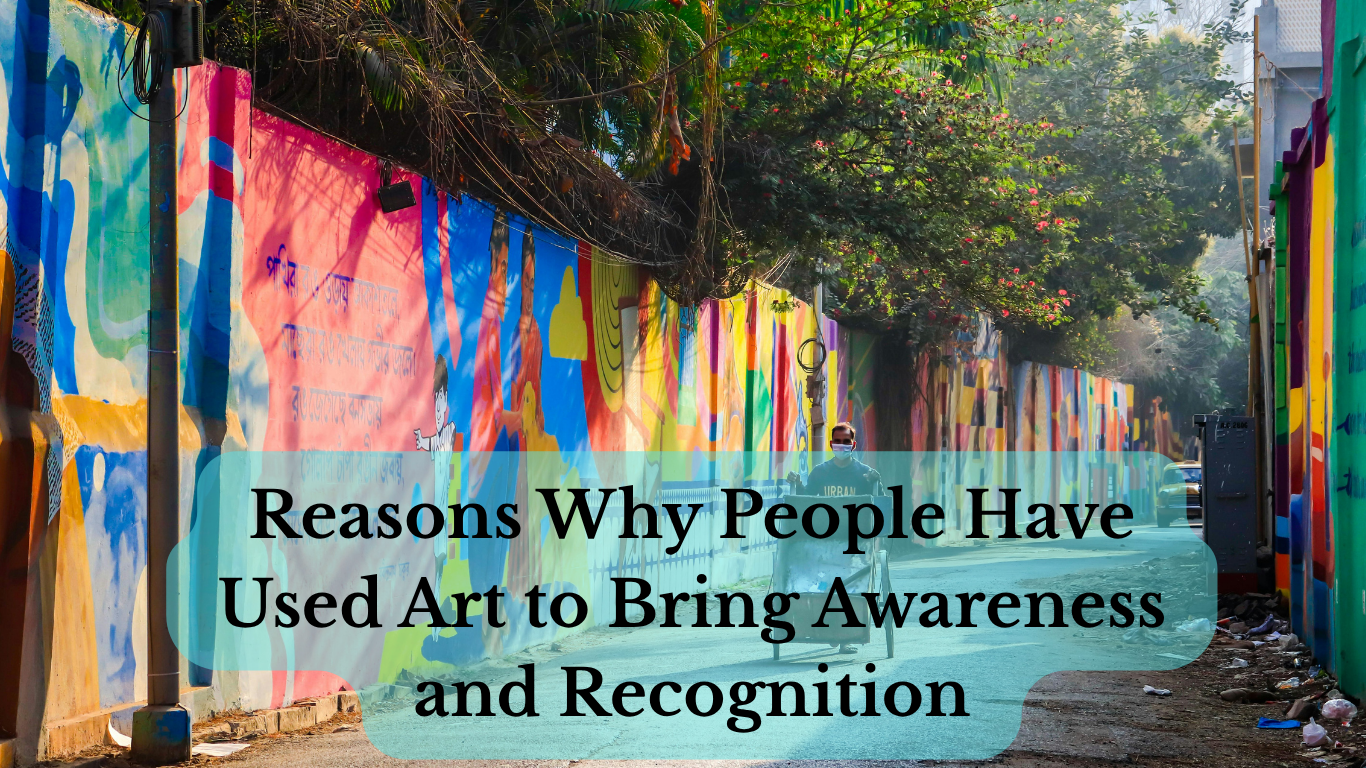
The three reasons examined in this blog operate not only in the historical examples discussed but in contemporary artistic practice — from the protest murals that appeared on the streets of American cities following the killing of George Floyd in 2020, to the documentary filmmaking that has given global visibility to environmental destruction, to the social media art activism that uses the tools of digital visual culture to generate awareness around contemporary injustices with a speed and a geographic reach that previous generations of awareness artists could not have imagined.
Per research on contemporary art activism and social change, the mechanisms through which art produces awareness and recognition are not fundamentally different in the digital era from those that operated in Rivera’s Mexico or Wiesel’s post-Holocaust testimony — the capacity to give voice to the silenced, to build emotional bridges that analytical accounts cannot construct, and to create lasting cultural records of experiences that power would prefer to erase. What has changed is the speed and scale of distribution, the accessibility of artistic production to those previously excluded from it by the economic barriers of traditional media, and the possibility of global solidarity that digital art activism creates.
Key Takeaways
The three reasons examined in this blog — art’s capacity to give voice to the silenced, to build emotional bridges that produce genuine understanding, and to create lasting cultural records that persist beyond the moment — are not three separate functions but three dimensions of the same fundamental capacity. Art witnesses. It insists on the reality of what has been seen. And it makes that witness available to every subsequent generation who encounters the work.
Per the consistent testimony of artists, activists, and scholars across every tradition in which art has been deployed in the service of awareness and recognition, the power of art for this purpose lies not in its opposition to beauty or its subordination of aesthetic value to political function — the greatest awareness art is almost always also the greatest art — but in the specific combination of formal craftsmanship and human truth that makes an artistic work capable of surviving its moment and continuing to generate the response of recognition that its creator intended.
Art does not merely describe the world. At its most powerful, it insists on the specific truths about the world that those with the power to ignore them most need to see — and it makes that insistence in a form durable enough to outlast every attempt to look away.