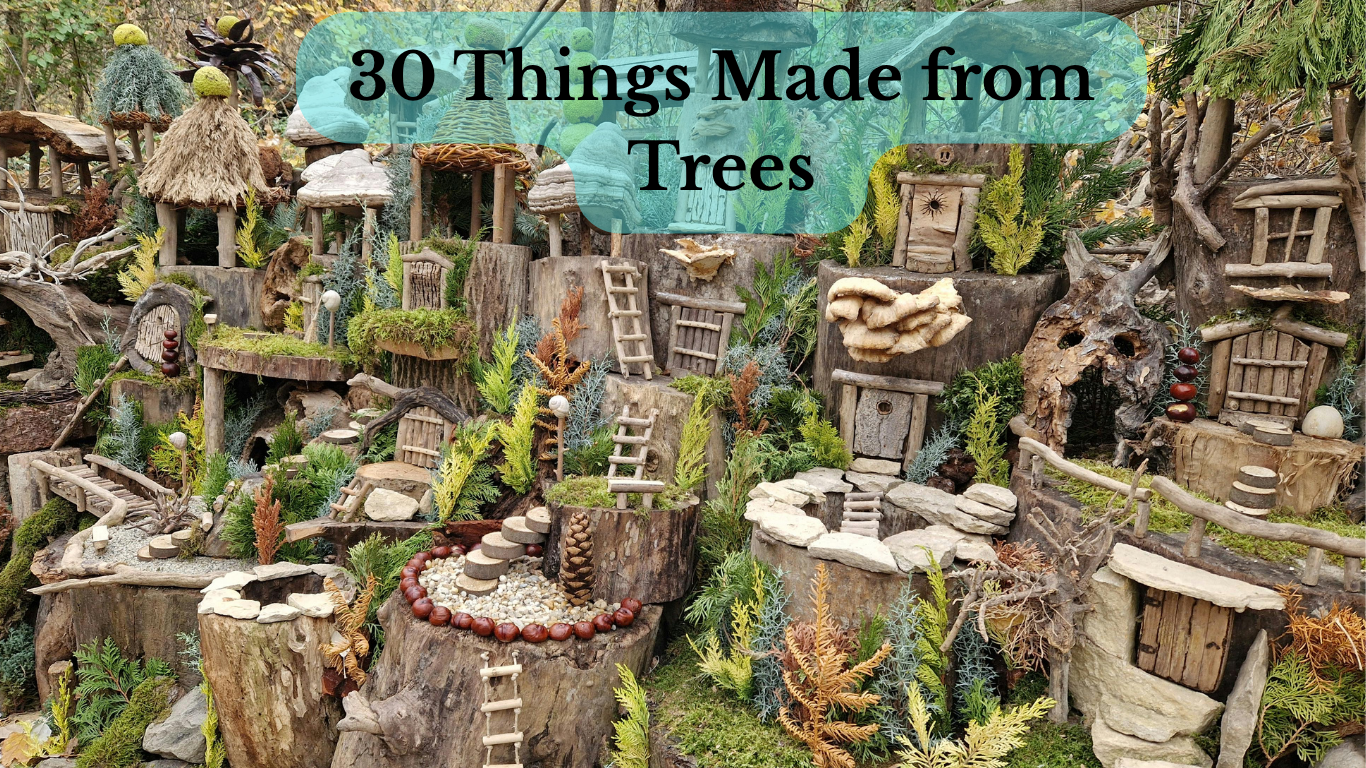
Have you ever paused to consider how many of the objects surrounding you at this precise moment — the chair you are sitting on, the paper in your notebook, the frame around the window, the wooden spoon in the kitchen, possibly the very floor beneath your feet — began their existence as a living tree? Trees are among the most extraordinarily versatile raw materials that nature has ever produced, and the range of products derived from them spans from the immediately obvious to the genuinely surprising. This blog examines 30 remarkable things made from trees — celebrating the extraordinary breadth of what a single natural material can become in human hands.
Table of Contents
1. Paper
Paper is perhaps the most globally significant product derived from trees — its invention fundamentally transformed human civilisation by making the storage and transmission of knowledge portable, affordable, and universal. Modern paper is produced primarily from wood pulp — the result of mechanically and chemically processing wood fibres until they can be pressed into thin, flat sheets. Per industry data, approximately four billion trees are harvested annually for paper production worldwide — a figure that underscores both the extraordinary scale of human paper consumption and the urgent importance of sustainable forestry practices.
2. Furniture
The relationship between trees and furniture is one of the oldest and most direct in human material culture — from the earliest carved wooden stools of ancient Egypt to the hand-jointed mahogany cabinets of eighteenth-century England to the flat-packed birch plywood of contemporary design. Different wood species offer different properties — oak’s hardness and grain; pine’s affordability and workability; walnut’s rich colour and density; teak’s natural weather resistance — and the furniture maker’s craft is substantially the art of matching the right wood to the right application.
3. Musical Instruments
The acoustic properties of wood — its ability to vibrate, resonate, and transmit sound — make it the primary material in the majority of the world’s musical instruments. The spruce top of a classical guitar, the maple back and sides of a violin, the rosewood fingerboard of a lute, the boxwood body of a recorder, the ebony keys of a piano — every element is chosen for its specific acoustic contribution to the instrument’s voice. Per lutherie tradition, the selection and matching of woods for acoustic instruments is a craft requiring decades of accumulated knowledge, because different cuts of the same species, from different trees, can produce measurably different acoustic results.
4. Houses and Buildings
Timber framing — the construction of buildings using a structural skeleton of wooden beams, posts, and rafters — is among the oldest and most widely practised construction methods in human history. From the post-and-beam farmhouses of medieval Europe to the balloon-frame houses of the American frontier to the contemporary mass timber architecture that is producing multi-storey wooden skyscrapers in cities around the world, wood’s combination of structural strength, thermal performance, workability, and renewability makes it one of the most compelling building materials available. Per structural engineering data on cross-laminated timber — the engineered wood product enabling modern multi-storey timber construction — wooden buildings can now be constructed to heights previously considered the exclusive domain of concrete and steel.
5. Books
The book is simultaneously a product of paper — derived from wood pulp — and frequently of wooden boards — the hardcover’s binding boards traditionally made from wood fibre — making it perhaps the most intellectually significant product of the tree in human culture. The transition from clay tablet to papyrus scroll to vellum codex to printed book was substantially a transition between different plant-derived recording surfaces, and the printed book’s particular combination of portability, durability, and information density has made it the dominant knowledge transmission technology for five centuries.
6. Cork
Cork is derived from the bark of the cork oak — Quercus suber — a remarkable tree native to the western Mediterranean whose bark regenerates after harvesting, making cork one of the most genuinely sustainable natural materials in commercial use. The cork oak’s bark is harvested by hand approximately every nine years without harming the tree, which continues to grow and can be harvested for over a century. Per sustainability research on cork production, cork oak forests in Portugal and Spain support extraordinary biodiversity, sequester significant carbon, and provide livelihoods for rural communities – making the cork bottle stopper a genuinely ecological product despite its apparently humble function.
7. Rubber
Natural rubber — the elastic polymer that made possible the tyre, the waterproof garment, and the surgical glove — is derived from the latex of the rubber tree, Hevea brasiliensis, native to the Amazon basin but now cultivated across tropical Asia, Africa, and the Americas. The latex is collected by tapping the tree’s bark — making shallow cuts that allow the milky sap to flow into collection cups without killing the tree. Per materials science research, natural rubber’s combination of elasticity, durability, and biocompatibility — its compatibility with human tissue — makes it irreplaceable in medical applications where synthetic alternatives have not achieved equivalent performance.
8. Aspirin
The original aspirin — acetylsalicylic acid — traces its chemical lineage directly to the bark of the willow tree — Salix species — from which salicin, the precursor compound to aspirin, was first isolated in 1828. Indigenous peoples across multiple cultures had used willow bark as a fever and pain remedy for centuries before its active compound was identified and eventually synthesised. Hippocrates recorded its use in ancient Greece. The chemical modification of salicin into the more stomach-friendly acetylsalicylic acid by Felix Hoffmann in 1897 produced the world’s most widely used pharmaceutical — a product whose tree-derived origins remain embedded in its chemical name.
9. Maple Syrup
Maple syrup is produced by collecting the sap of the sugar maple – Acer saccharum – and concentrating it through evaporation from its natural sugar concentration of approximately 2 to 3% to the finished syrup’s 66%. The sap flows in late winter and early spring when freezing nights and warm days create the pressure differential that drives sap movement in the tree — a process that requires very specific climatic conditions and makes genuine maple syrup production geographically concentrated in northeastern North America. Per food chemistry research, maple syrup contains over 65 distinct bioactive compounds not found in other sweeteners — many of which have anti-inflammatory and antioxidant properties whose health implications are actively researched.
10. Charcoal
Charcoal — the carbon-rich material produced by heating wood in an oxygen-limited environment — is one of humanity’s oldest processed materials, used for fuel, for art, for metallurgy, and most recently for water filtration and soil amendment. Activated charcoal — produced by further processing that creates an extraordinarily porous structure with a surface area of approximately 500 to 3,000 square metres per gram — is used in medical treatment of poisoning, in water filtration systems, in air purification, and in a growing range of cosmetic and food applications whose scientific support varies considerably.
11. Toothpicks
The toothpick is among the oldest wooden tools in human use — archaeological evidence of wooden toothpicks extends back to the Palaeolithic — and it remains one of the simplest and most direct expressions of wood’s workability. The birch wood toothpick, machine-produced in its billions from carefully selected birch logs, requires the wood to be cut, boiled, split, sharpened, and polished in a manufacturing process that produces a product of such precision that its humble appearance belies its technical production.
12. Pencils
The standard wooden pencil — in use since the sixteenth century discovery of the graphite deposit in Borrowdale, England — is produced from cedar wood, which is chosen for its straight grain, its workability, and its pleasant smell when sharpened. The graphite core — which is not actually lead despite the historical misnomer — is compressed with clay and encased in two half-round cedar pieces that are glued together and milled to the familiar hexagonal or round profile. Per manufacturing data, approximately 14 billion pencils are produced annually worldwide—requiring the equivalent of approximately 82,000 trees per year.
13. Wooden Floors
Hardwood flooring — the planks of oak, maple, cherry, walnut, bamboo, or exotic species that cover the floors of homes and commercial spaces worldwide — represents one of wood’s most enduring and most aesthetically valued applications. The appeal of wooden floors is partly aesthetic — the warmth of colour, the variation of grain, the sense of natural material underfoot — and partly practical, as hardwood floors are among the most durable and most easily maintained floor coverings available, with well-maintained examples lasting centuries.
14. Wine Barrels and Whisky Casks
The oak barrel is not merely a container — it is an active participant in the transformation of the liquid it holds. The porous structure of oak wood allows slow oxygen exchange through the barrel walls, moderating the tannins in wine and whisky and facilitating the development of complex flavours. The wood itself contributes flavour compounds — vanillin from the wood’s lignin, lactones that give bourbon its characteristic coconut notes, and a range of aromatic compounds whose development is influenced by the toast level applied to the barrel’s interior during manufacturing. Per research on wood chemistry and beverage maturation, the species of oak, the provenance of the wood, and the coopering process are all measurably significant contributors to the finished product’s character.
15. Cinnamon
Cinnamon — one of the world’s oldest and most widely used spices — is the dried inner bark of several trees in the genus Cinnamomum, native to Sri Lanka and Southeast Asia. True cinnamon — Cinnamomum verum — is harvested by peeling away the outer bark of young shoots, then carefully removing and drying the inner bark, which curls into the familiar quill form as it dries. The spice has been traded for over four thousand years — it appears in ancient Egyptian records, in the Hebrew Bible, and in the writings of ancient Greek historians — making it one of the longest continuously traded commodities derived from trees.
16. Turpentine
Turpentine — the solvent derived from the distillation of resin collected from pine trees — has been a fundamental material in painting, varnishing, and chemical manufacturing for centuries. Its use as a solvent for oil-based paints and varnishes remains its primary contemporary application, though its role in early medicine — it was used as a topical antiseptic and as an internal medicine in quantities that would now be considered alarming — reflects the historical breadth of tree-derived chemical applications.
17. Bamboo Products
While bamboo is technically a grass rather than a tree, its woody structure and its extraordinary versatility make it too significant to exclude from any discussion of wood-derived products. Bamboo is one of the fastest-growing plants on earth — some species grow over a metre per day — and its strength-to-weight ratio exceeds that of many conventional structural timbers. Bamboo is used for construction, flooring, furniture, textiles, paper, food — bamboo shoots are a significant food source across Asia — and an enormous range of everyday objects from chopsticks to cutting boards to bicycle frames.
18. Wooden Toys
The wooden toy — the carved horse, the stacking rings, the building blocks, the pull-along duck — is one of the oldest categories of manufactured object in human history, and its endurance in an era of plastic and electronic alternatives speaks to something more than nostalgia. Per developmental psychology research on children’s play, wooden toys’ weight, texture, temperature, and the way they respond to manipulation provide sensory experiences that plastic toys do not replicate — contributing to fine motor development, spatial reasoning, and imaginative play in ways that research continues to document and quantify.
19. Cricket Bats
The cricket bat is one of sport’s most precisely specified and most romantically charged pieces of wooden equipment — produced almost exclusively from white willow — Salix alba var. caerulea — a species whose combination of hardness, toughness, fibrous grain structure, and light weight makes it uniquely suited to the specific mechanical demands of striking a hard ball at high speed. The manufacturing of a professional cricket bat involves selecting the right willow cleft, shaping it to precise specifications, pressing the face to consolidate the fibres, and knocking it in — the prolonged process of hardening the face with a mallet before use that is itself a craft with its own traditions and techniques.
20. Wooden Boats
The wooden boat — from the dugout canoe hollowed from a single log to the planked hull of a traditional sailing vessel — is one of humanity’s oldest technologies, and the craft of wooden boat building has produced some of the most beautiful functional objects ever created. Different woods are used for different parts of the boat — teak for decking for its weather resistance and grip, oak for the frames for its strength and durability, spruce for masts for its stiffness-to-weight ratio — and the traditional wooden boat is a compendium of wood knowledge accumulated over millennia of maritime experience.
21. Nuts and Fruits
The tree’s own products — the nuts and fruits it produces as part of its reproductive biology — constitute some of the world’s most nutritionally significant foods. Walnuts, almonds, hazelnuts, chestnuts, pecans, and macadamias are all products of trees — as are apples, pears, cherries, plums, peaches, mangoes, avocados, coconuts, and olives. Per nutritional research, tree nuts are among the most nutrient-dense whole foods available – combining healthy fats, protein, fibre, vitamins, and minerals in a form that has been a foundational component of human diets for hundreds of thousands of years.
22. Dyes and Tannins
Trees have historically been primary sources of dyes and tanning agents whose importance to textile manufacture and leatherworking was foundational before the development of synthetic chemistry. Oak galls — the growths produced on oak trees by gall wasps — were the primary source of iron gall ink, used for centuries in manuscripts and printed books. The bark of oak and chestnut trees provided the tannins that converted raw hides into durable leather through the process of vegetable tanning — a method still preferred for certain high-quality leather applications. Logwood, derived from a Central American tree, provided the deep purple and black dyes that coloured the textiles of European courts for centuries after its introduction following the Spanish conquest.
23. Wooden Spoons and Kitchen Utensils
The wooden kitchen utensil — the spoon, the spatula, the rolling pin, the chopping board, the salad bowl — occupies a category of everyday objects whose design has been functionally optimised over millennia and whose wooden construction provides specific advantages over metal and plastic that account for their enduring presence in modern kitchens. Wood does not scratch non-stick surfaces. It does not conduct heat to burning temperatures. It does not harbour bacteria at higher rates than plastic, despite persistent popular belief to the contrary — per food science research, the naturally antimicrobial compounds in many wood species make wooden cutting boards at least as hygienic as plastic ones in normal kitchen use.
24. Wooden Picture Frames
The picture frame — that apparently simple border object whose function is to define, protect, and enhance the artwork it surrounds — is a product of considerable woodworking craft when executed at quality level. The carved and gilded frames of the Renaissance and Baroque periods were considered artworks in themselves, their production requiring specialist craftspeople distinct from both the artist and the general carpenter. The relationship between frame and artwork — the way the frame’s material, colour, and proportion affect the perception of what it contains — is a subject of genuine art historical and perceptual research.
25. Chopsticks
Chopsticks — the paired eating utensils used across much of East and Southeast Asia — are among the most produced wooden objects in the world. Per manufacturing data, China alone produces approximately 80 billion pairs of disposable wooden chopsticks annually — primarily from birch and poplar — a consumption figure that has generated significant environmental concern and inspired campaigns promoting reusable alternatives. The craft of making high-quality reusable chopsticks from lacquered hardwoods — with precisely calibrated taper, weight balance, and surface texture — is a distinct artisanal tradition whose products are valued objects in Japan, China, and Korea.
26. Wooden Bridges
Timber bridges — from the simple log crossing to the sophisticated engineered timber spans of contemporary infrastructure — represent one of wood’s most structurally demanding applications. Traditional wooden bridges using hand-hewn timber were the primary bridge technology in most of the world before steel and concrete became widely available, and the covered wooden bridges of New England — whose covering was designed not for aesthetic reasons but to protect the structural timber from weather and extend its service life — are among the most photographed rural structures in American landscape photography. Modern engineered timber bridges using laminated veneer lumber and cross-laminated timber are achieving spans and load capacities that challenge contemporary steel and concrete alternatives.
27. Wooden Clogs and Shoes
The wooden clog — footwear carved from a single block of wood or constructed with a wooden sole and leather upper — has been a primary footwear technology across much of Europe and Asia for centuries, providing waterproof, durable, and thermally insulating foot protection particularly suited to agricultural and maritime working conditions. The Dutch wooden clog — klomp — remains a cultural symbol whose traditional craft production continues alongside its now primarily tourist-oriented market. In contemporary fashion, the wooden sole has experienced repeated revival — the platform shoes of the 1970s, the clogs of the 1990s, and the various wooden-heeled designs of contemporary footwear all trace their structural lineage to the simple wooden sole.
28. Activated Charcoal Filters
The activated charcoal used in water filtration systems — from industrial water treatment to household filter jugs to the activated carbon blocks in under-sink filtration units — is derived from wood and other carbon-rich organic materials processed to create a material of extraordinary internal surface area and adsorptive capacity. Per water treatment research, activated carbon filtration is among the most effective available technologies for removing organic contaminants, chlorine, and a range of pharmaceuticals and endocrine-disrupting compounds from water — making the tree-derived filter material one of the most important components of clean water infrastructure worldwide.
29. Saunas
The sauna — the Finnish tradition of bathing in a small wooden room heated to between 70 and 100 degrees Celsius by stones heated by a wood fire or electrical element — is not merely a product of trees but is inseparable from them in its traditional form. The sauna room itself is constructed from specific softwoods — Nordic spruce and aspen are traditional choices for their low resin content, which prevents burning skin on contact — and the wood’s hygroscopic properties, its ability to absorb and release moisture, contribute to the distinctive atmosphere of the sauna environment. Per Finnish cultural research, the sauna has been described as “the poor man’s pharmacy” in Finnish folk tradition — its documented health benefits including cardiovascular improvement and stress reduction have been the subject of significant contemporary medical research.
30. Oxygen
The final and most important product of trees is not manufactured, not harvested, not processed, and not sold — but it is the product without which none of the other twenty-nine would matter. Through photosynthesis, trees absorb carbon dioxide and release oxygen — contributing approximately 28% of the world’s oxygen production through their collective photosynthetic activity, with the remainder produced by oceanic phytoplankton and other plants. A single mature tree produces enough oxygen annually to supply the breathing needs of two to eight people, depending on the species, the tree’s size, and the methodology used for the calculation. The oxygen we breathe, the carbon we sequester, the climate we inhabit — all are shaped in part by the trees that produced the other twenty-nine items on this list, and that produce the air that makes human life possible.
Key Takeaways
The thirty things on this list span medicine, music, food, construction, sport, art, and the fundamental chemistry of the atmosphere — and yet every one of them traces its origin to a living tree. The tree is not merely a source of timber and paper — it is one of the most versatile and most irreplaceable natural systems on earth, producing materials whose range and significance human ingenuity has been discovering, refining, and depending upon for the entirety of our species’ existence.
Per research on forest ecosystem services and material science, the products derived from trees are not merely economically significant — they are ecologically embedded in ways that make the health of the world’s forests inseparable from the health of the civilisation that depends on them. Every wooden floor, every paper book, every cinnamon-spiced dish, and every breath of oxygen-enriched air is a reminder of that dependence — and of the responsibility it entails.
The tree is not raw material waiting to be useful. It is already useful, in the forest, standing. Everything else it becomes is a bonus — and a debt we owe to the living systems that make it possible.