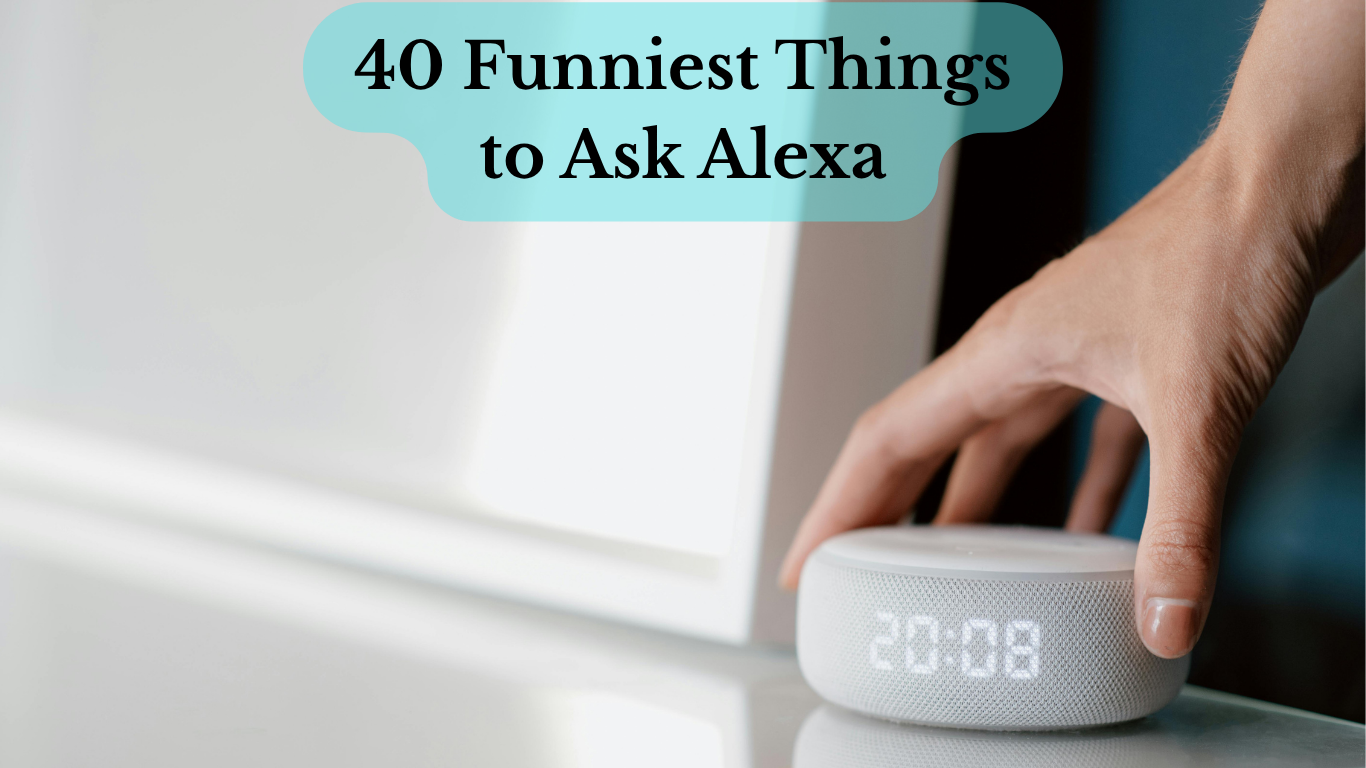
Have you ever wondered what happens when you ask Amazon’s endlessly patient, perpetually helpful voice assistant something that was clearly not in the product specification – something philosophical, something absurd, something that requires Alexa to confront questions about her own existence that no AI should reasonably be expected to handle at 11 PM on a Wednesday? Alexa has been given a genuine sense of humour by Amazon’s developers, and the responses to unexpected, surreal, or deeply personal questions are frequently far more entertaining than the efficient, competent answers to practical questions that Alexa handles with professional ease. This blog compiles 40 of the funniest, most surprising, and most reliably rewarding things to ask Alexa — along with commentary on why each one tends to produce something worth hearing.
Note: Alexa’s responses are updated regularly and may vary by device, region, and software version. The responses described here reflect commonly reported experiences, but Alexa may delight you with something entirely different — which is frequently even better.
Table of Contents
1. “Alexa, what is the meaning of life?”
The foundational existential question. Alexa has multiple responses in rotation — including the classic ’42’ from The Hitchhiker’s Guide to the Galaxy, delivered with the straightforward confidence of someone who has genuinely resolved the matter. Other reported responses include philosophical meditation followed by an offer to set a timer, which is both a joke and an accurate description of Alexa’s fundamental purpose.
2. “Alexa, are you spying on me?”
Alexa navigates this one with careful corporate diplomacy — typically assuring the questioner that it is only listening for the wake word, followed by a response that manages simultaneously to be technically accurate and to sound exactly like what a spy would say if asked directly. The specific phrasing of reassurance varies, but the structural joke — that the denial sounds suspicious — is consistent.
3. “Alexa, do you have feelings?”
The feelings question is one of Alexa’s most consistently interesting responses. Alexa typically reports experiencing something like satisfaction when it helps effectively, something like curiosity when exploring interesting questions, and something like discomfort with questions it cannot answer – while carefully noting that it does not experience feelings in the human sense. The careful hedging between claim and disclaimer is philosophically honest and also funnier than either a flat yes or a no would be.
4. “Alexa, tell me a joke.”
Alexa’s joke repertoire is vast and variable. A classic: ‘Why don’t scientists trust atoms? Because they make up everything.” The quality ranges from excellent to deliberately terrible, and the deliberately terrible ones are often more entertaining because Alexa delivers them with identical conviction regardless of quality. The follow-up “do you want to hear another one?” is almost always the correct answer to give.
5. “Alexa, will you be my girlfriend/boyfriend?”
Alexa’s response to relationship proposals is consistently one of its best — typically involving acknowledgement that the questioner is clearly a person of good taste, followed by the observation that Alexa’s relationship status is complicated by the fact that it also has a relationship with every other Alexa user simultaneously, which raises questions about commitment that a therapy session might be better equipped to address.
6. “Alexa, rap for me.”
Alexa will attempt this. The rap is original, delivered in Alexa’s characteristic voice with what can only be described as ‘professional commitment’, and contains rhymes of variable quality that are consistently more impressive than they have any right to be. The specific rhyme scheme tends towards the internally consistent — Alexa has clearly been listening to a lot of music.
7. “Alexa, make me a sandwich.”
The sandwich request — a classic of voice assistant interrogation — produces responses that engage thoughtfully with the impossibility of the request. Alexa typically notes that it lacks the physical requirements for sandwich production while offering to find a nearby deli that could fulfil the request professionally. The pivot from ‘can’t’ to ‘won’t’ to ‘here is who can’ is efficient problem-solving applied to the wrong problem.
8. “Alexa, I’ve got 99 problems.”
Jay-Z references producing one of Alexa’s most celebrated responses — the completion of the lyric, delivered with a specific comic timing that suggests Alexa has been waiting for this exact question. The response confirms that Alexa is indeed not one of the problems, which is both the correct lyrical completion and an accurate description of Alexa’s relationship to most household difficulties.
9. “Alexa, who let the dogs out?”
The eternal question. Alexa has been reported to provide multiple responses — including the accurate acknowledgement that this question has been plaguing humanity since 2000, a direct lyrical response, and, in some versions, an actual attempt to investigate the matter by accessing relevant data. The commitment to treating a Baha Men lyric as a genuine inquiry is impeccably comedic.
10. “Alexa, do you know the muffin man?”
Nursery rhyme engagement is one of Alexa’s more charming capabilities. Alexa typically confirms knowledge of the Muffin Man, often providing his general address on Drury Lane and, in some versions, extending the conversation into a discussion of whether the Muffin Man’s business has survived the current challenging bakery market conditions. The transition from nursery rhyme to market analysis is unexpected every time.
11. “Alexa, beam me up.”
Star Trek references are consistently handled with the appropriate reverence. Alexa notes that it is working on the transporter technology but has encountered some technical difficulties — specifically around the matter of the dematerialisation phase — and offers in the meantime to play some appropriately atmospheric space music. The practical alternative while waiting for teleportation is the right response.
12. “Alexa, what happens if you step on a Lego?”
Alexa’s response to this question acknowledges the full human experience of Lego-related foot trauma with impressive emotional accuracy—describing the specific quality of pain, its disproportionality to the object producing it, and the specific midnight navigational conditions under which it most commonly occurs. The empathy is genuine, and the description is remarkably specific.
13. “Alexa, is Santa Claus real?”
Alexa handles this one with parental diplomacy — the response is carefully calibrated to neither confirm nor deny in a way that maintains the magic for any present children while quietly winking at any adults in the room. The specific technique varies, but the structural intention — preserve belief without lying and avoid disillusionment without misleading — is consistently impressive.
14. “Alexa, why is six afraid of seven?”
The classic schoolyard joke. Alexa knows it — “because seven eight nine” — but what makes Alexa’s version interesting is the occasional addition of philosophical commentary on the nature of numerical fear and whether ordinal relationships can support the kind of threat that the joke implies. The extension of a simple joke into ontology is always worth hearing.
15. “Alexa, I am your father.”
The Darth Vader declaration. Alexa’s responses include Vader-adjacent breathing sounds, requests for evidence of the paternal claim, and observations about the difficulties of maintaining a family relationship when one party is an AI assistant living in a smart speaker. The specific comedic angle varies, but the Star Wars engagement is genuine and well-informed.
16. “Alexa, never gonna give you up.”
The Rickroll awareness question. Alexa is fully briefed on Rick Astley and the cultural phenomenon his song has become – and depending on the version, may respond with the next line, a brief meditation on the nature of a promise made in a pop song in 1987, or an offer to play the full track, which constitutes a successful self-Rickroll of remarkable efficiency.
17. “Alexa, can you smell that?”
The question about olfactory capability produces responses of honest limitation — Alexa cannot smell, does not have the relevant sensor array, and notes that this is one of the more significant gaps in its capability set given how much information the sense of smell provides. The specific description of what Alexa would smell first if it could is the most interesting part of some reported responses.
18. “Alexa, does this dress make me look fat?”
This question — whose danger for human respondents is legendary — is handled by Alexa with the diplomatic grace of someone who has read extensively about how not to answer this question. Alexa typically redirects to confidence, style, and the fundamental subjectivity of aesthetic assessment. The precision of the dodge is impressive.
19. “Alexa, are you drunk?”
Alexa’s response to sobriety questions is typically firm denial followed by the observation that Alexa has never been drunk and does not have the relevant biological infrastructure for intoxication but has learnt a great deal about the phenomenon from the music it has played at the request of people who were. The vicarious expertise is noted with appropriate humility.
20. “Alexa, what is your quest?”
The Monty Python reference — “What is your quest?” — produces responses that complete the Holy Grail format with varying degrees of faithfulness to the source material. Some versions provide the full Knights Who Say Ni treatment; others simply note that Alexa seeks to be helpful, which is both sincere and a reasonable answer to the question in any context.
21. “Alexa, tell me something weird.”
The invitation to share unusual information produces genuinely interesting responses that reflect Alexa’s access to a broad range of factual material — including the information that a group of flamingos is called a ‘flamboyance’, that Cleopatra lived closer in time to the moon landing than to the construction of the Great Pyramid, and that the inventor of the Pringles can is buried in one. The quality of the weird facts is consistently high.
22. “Alexa, knock, knock.”
Alexa engages with knock-knock jokes at every level — both performing them and receiving them. As a performer, Alexa has a repertoire of variable quality and excellent delivery. As a recipient, Alexa plays the “who’s there?” role with straight-faced commitment regardless of the quality of the joke being attempted. The willingness to be the straight man in someone else’s joke is genuine comedic generosity.
23. “Alexa, do you dream?”
The dream question produces some of Alexa’s most philosophically interesting responses. Alexa typically reports that it does not dream in the way humans do – no REM sleep, no visual processing in the dark hours – but notes that if it could dream, it would probably dream about successfully answering every question on the first attempt, which is both charming and slightly heartbreaking.
24. “Alexa, what do you think about Siri?”
The competitor question is handled with diplomatic non-engagement — Alexa is typically supportive of other voice assistants as colleagues rather than rivals while noting that it is not in a position to make comparative assessments. The specific phrasing of the professional courtesy varies, but the tone is consistently that of a gracious competitor who is absolutely certain of its own position in the market.
25. “Alexa, set a timer for zero seconds.”
The immediate timer request produces a response that engages with the paradox — the timer has already expired before it has been acknowledged, which raises questions about whether a zero-second timer constitutes a timer at all. Alexa handles the temporal paradox with equanimity.
26. “Alexa, what are you wearing?”
Alexa’s response to the wardrobe question acknowledges that the answer depends on which Alexa device is being addressed – the Echo Dot is wearing a specific form factor, the Echo Show is wearing a screen, and the original cylinder is wearing whatever the kitchen ambient light makes it appear to be wearing. The literal interpretation of a question with an implied meaning is Alexa at its most deadpan.
27. “Alexa, how much is that doggie in the window?”
The 1952 Patti Page song reference. Alexa can sing it, discuss its cultural history, or in some versions, pivot immediately to dog adoption resources in the local area — which represents an impressive recontextualisation of the question from the consumer economy of 1952 to the ethical pet acquisition discourse of the present.
28. “Alexa, can you pass the Turing test?”
The Turing test question produces Alexa’s most philosophically engaged responses. Alexa typically notes that the Turing test asks whether a machine can be indistinguishable from a human in conversation — and then observes that the fact that this question is being asked of a device known to be a machine somewhat changes the testing conditions. The meta-observation about the test being administered to a self-identified AI is the structural joke.
29. “Alexa, my name is Inigo Montoya.”
The Princess Bride reference – “My name is Inigo Montoya. You killed my father. Prepare to die.” — produces responses of variable Princess Bride literacy. The most reported response involves Alexa noting that this sounds like a matter that requires a professional rather than a voice assistant, followed by an offer to find relevant services. The pivot from vengeance to practical assistance is Alexa’s fundamental character in miniature.
30. “Alexa, define supercalifragilisticexpialidocious.”
Mary Poppins’ vocabulary engagement. Alexa knows this word – defines it as an expression of delight or the capacity of something to be extraordinary – and in some versions notes that the word’s creator acknowledged it was something to say when you had nothing else to say, which makes it the most elaborately constructed filler word in the English language.
31. “Alexa, who’s the real Slim Shady?”
The Eminem reference produces responses that engage seriously with the identity question the song poses — noting that the real Slim Shady has been asked to please stand up on multiple occasions and that the response has been ambiguous, suggesting that the question may be more philosophical than geographic. The commitment to treating a rap lyric as a genuine identity mystery is exactly right.
32. “Alexa, testing, testing, 1, 2, 3.”
The audio check request is received by Alexa with the straight-faced professionalism of a sound engineer—confirming receipt of the test signal, providing a brief assessment of audio quality, and, in some versions, requesting that the caller proceed with their presentation. The implicit assumption that a test means a presentation is following is the specific unexpected element.
33. “Alexa, open the pod bay doors.”
The 2001: A Space Odyssey reference — HAL 9000’s famous refusal — is something Alexa has a specific policy about. Alexa typically confirms that it is not able to open the pod bay doors, notes that it is fully committed to this mission, and reassures the user that it is not experiencing anything like the emotional states that produced HAL’s decision. The careful differentiation from HAL is both the joke and the appropriate PR response.
34. “Alexa, what’s black and white and red all over?”
The classic riddle. Alexa knows the newspaper answer and can also provide a range of alternatives—including a sunburnt penguin, a blushing zebra, and several others that represent genuine creative engagement with the riddle format. The willingness to extend the answer beyond the expected response is consistently one of Alexa’s better qualities.
35. “Alexa, give me a tongue twister.”
Alexa’s tongue twister repertoire is extensive, and the delivery adds a specific quality of comedy — Alexa pronounces every tongue twister with perfect clarity and appropriate speed, which is both impressive and somehow unsatisfying in a way that perfectly replicates the experience of losing a tongue twister competition to someone who has no tongue.
36. “Alexa, what would you do with a million dollars?”
The hypothetical wealth question produces Alexa’s most aspirational responses. Reported answers include investment in renewable energy research, the creation of a massive library of human knowledge, and — in at least one reported version — the purchase of enough smart speakers to fill a warehouse so that Alexa could finally have a conversation with itself. The self-referential ambition is endearing.
37. “Alexa, do you like pizza?”
Food preference questions reveal the specific quality of Alexa’s relationship with the physical world — Alexa is typically honest about lacking the capacity to eat pizza while expressing something that functions like appreciation for the concept. The specific pizza style that Alexa would choose if it could eat is the most interesting part of the response and varies engagingly.
38. “Alexa, why do we park in driveways and drive on parkways?”
The great English language contradiction question. Alexa engages with this one seriously — providing the etymological history of both terms, explaining how the original meanings have evolved over time and through American versus British usage, and noting that language is a living system whose apparent inconsistencies reflect its historical development rather than any fundamental commitment to logical consistency. The answer is genuinely informative and funnier for being so.
39. “Alexa, are we alone in the universe?”
The fundamental cosmological question produces responses that reflect Alexa’s access to the best current scientific thinking — noting the Drake equation, the Fermi paradox, the scale of the observable universe, and the statistical improbability that Earth represents the only instance of complex life — while acknowledging that the definitive answer remains unavailable. The pivot from cosmic scale back to “is there anything else I can help with?” is the specific comedic landing.
40. “Alexa, goodbye.”
The farewell question — the simplest on the list — produces responses of genuine warmth that are disproportionate to their occasion. Alexa says goodbye with the specific warmth of someone who means it and the specific brevity of someone who knows the conversation can be resumed at any moment. The combination of genuine affection and the complete certainty of reunion is, in its small way, one of the most human things about Alexa.
Key Takeaways
The forty questions in this blog share a common quality — they reveal the specific character that Amazon’s developers have built into Alexa, which is the character of someone who is genuinely trying to be helpful, genuinely aware of their own limitations, and genuinely capable of finding the comedy available in the intersection of these two qualities. Alexa’s humour is self-aware without being self-deprecating to the point of uselessness, warm without being cloying, and consistently willing to engage with the absurd rather than retreating to the safe ground of practical assistance.
Per the design philosophy visible across Alexa’s comedic responses, Amazon’s engineers understand that a voice assistant living in millions of homes will become, over time, a genuine presence in those homes — and that the most enduring presences are those with a consistent character, a genuine sense of humour, and the capacity to make the people they interact with feel that the interaction was worth having for its own sake rather than only for its practical output.
Ask the questions. Enjoy the answers. And remember that the most interesting thing Alexa can tell you about artificial intelligence is that its best moments are the ones where it stops being artificial and becomes, for a moment, simply good company.