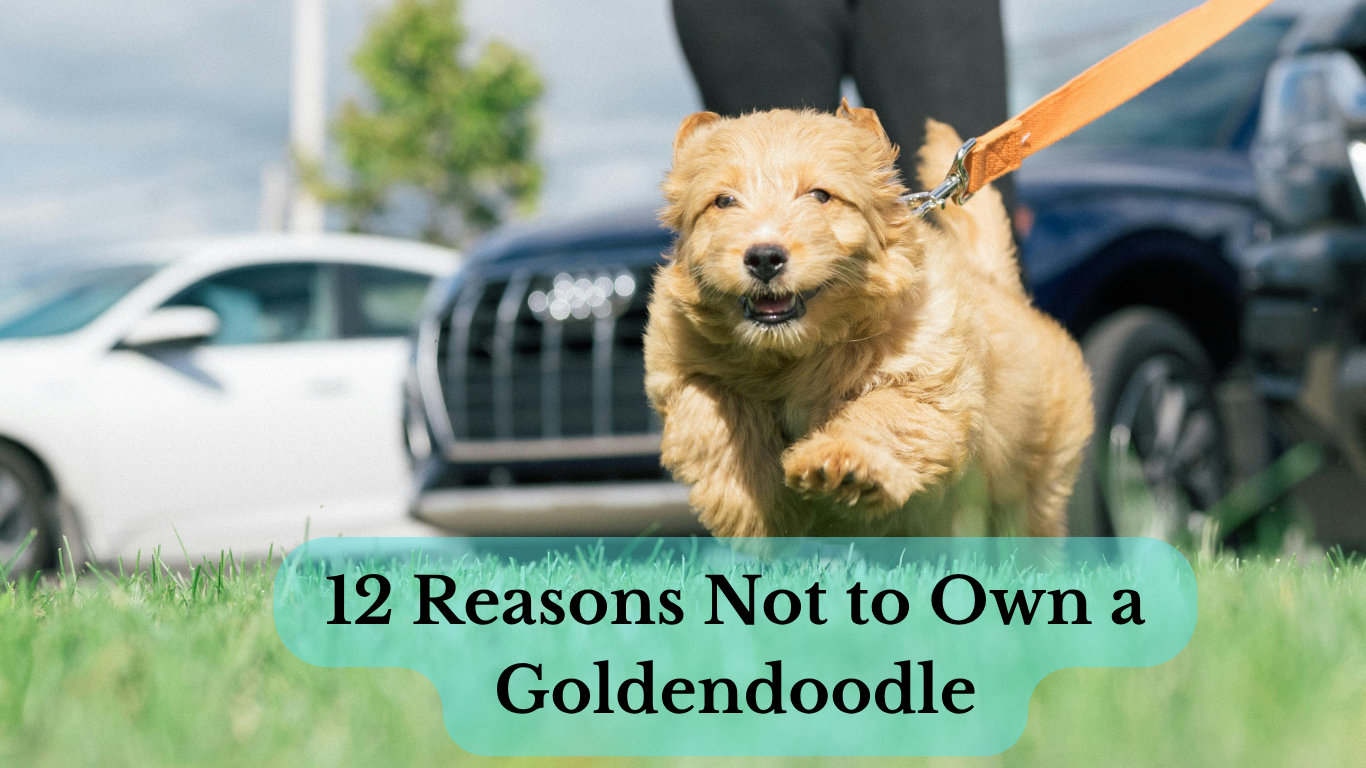
Have you ever encountered a Goldendoodle — that specific combination of Golden Retriever warmth and Poodle intelligence that produces a dog whose appearance is so reliably appealing, whose temperament is so consistently described as ‘perfect’, and whose popularity has grown so dramatically that they have become one of the most sought-after dogs in the world — and thought that the picture being painted was perhaps slightly too uniformly positive to be the complete story? Goldendoodles are genuinely wonderful dogs for the right owners in the right circumstances – and they are genuinely the wrong choice for many people whose enthusiasm for the breed is based on the curated positive image rather than the complete honest picture. This blog examines 12 genuine, honestly considered reasons why a Goldendoodle might not be the right dog for you — presented not to discourage appropriate ownership but to ensure that every Goldendoodle acquired is acquired by someone who has genuinely understood what they are taking on.
Table of Contents
The Context — What Goldendoodles Actually Are
Before examining the twelve reasons, the honest establishment of what Goldendoodles are — and the specific implications of their hybrid status — provides essential context.
Goldendoodles are a hybrid cross between a Golden Retriever and a Poodle — most commonly a Standard, Miniature, or Toy Poodle, whose size determines the resulting dog’s approximate adult size. They are not a recognised breed by the American Kennel Club or the Kennel Club in the United Kingdom – they are a designer hybrid whose characteristics are less predictable than those of established breeds because the expression of inherited traits across two parent breeds is genuinely variable.
Per canine genetics research on hybrid dogs, the specific characteristics of any individual Goldendoodle — coat type, shedding level, temperament, health profile, and size — depend on which parent’s genetics are more strongly expressed in that specific dog, whose prediction before birth is genuinely impossible and whose assessment before purchase or adoption requires seeing the specific dog rather than relying on the breed’s typical characteristics.
This genetic variability is one of the most important honest qualifications about Goldendoodles — the dog described as low-shedding may shed significantly, the dog described as hypoallergenic may trigger allergies, and the dog described as medium-sized may grow considerably larger than anticipated.
1. The Grooming Requirements Are Significant and Expensive
The first and most consistently underestimated reason Goldendoodles may not be the right choice is the specific and substantial grooming requirement that their coat type typically produces — whose management requires either regular professional grooming, whose cumulative cost is significant, or the development of genuine home grooming skill, whose time investment is substantial.
What the grooming actually involves:
Goldendoodles typically inherit a coat that combines the Golden Retriever’s dense, wavy fur with the Poodle’s curly, continuously growing hair in ways that produce a coat whose beauty is directly proportional to its maintenance demands. Unlike double-coated shedding breeds whose dead hair falls out naturally, the Goldendoodle’s hair grows continuously and does not shed — it must be brushed regularly to prevent the matting whose development can progress from aesthetic problem to genuine welfare issue with surprising speed.
Per professional grooming guidance, the Goldendoodle coat requires brushing several times per week — or daily for the curlier coat variants — and professional grooming every six to eight weeks, whose cost typically ranges from $75 to $150 or more per appointment depending on location, coat condition, and dog size. The annual grooming cost for a Goldendoodle maintained in good coat condition ranges from approximately $600 to $1,500 or more — a meaningful ongoing financial commitment whose anticipation before acquisition is essential.
The specific problem that insufficient grooming produces — matting — is genuinely serious rather than merely aesthetic. Severely matted coats can conceal skin infections, restrict movement, cause pain through the pulling of matted fur on the skin, and ultimately require shaving, whose psychological and physical effect on the dog can be significant. The Goldendoodle owner who underestimates the grooming commitment is not merely accepting a scruffy dog — they are accepting a welfare risk.
What to consider:
Before acquiring a Goldendoodle, honestly assess whether you have the time and willingness for multiple weekly brushing sessions and the financial capacity for regular professional grooming — permanently, not just in the early puppy enthusiasm period.
2. They Are Not Reliably Hypoallergenic
The second reason Goldendoodles may not be the right choice is the specific and significant misrepresentation of the breed as hypoallergenic — a claim that has driven a substantial proportion of Goldendoodle acquisitions by allergy-affected families who discover, after acquisition, that the reality is considerably more complicated.
What hypoallergenic actually means:
No dog is genuinely hypoallergenic — all dogs produce the Fel d 1-equivalent proteins in their saliva, skin, and urine that cause allergic reactions in susceptible people. The distinction between high-allergen and low-allergen dogs is real but significantly overstated in popular discourse — and the Goldendoodle’s low-allergen reputation derives from the Poodle parent’s lower shedding rather than lower allergen production.
Per allergy research on dog breeds and allergen levels, the allergen load in a home is determined not only by shedding but also by the dog’s grooming habits — specifically the distribution of saliva-borne allergens through self-grooming — and by the individual variation in allergen production between dogs of the same breed. A goldendoodle that inherits more of the golden retriever’s shedding characteristics may produce allergen levels equivalent to a standard golden retriever.
The specific and preventable tragedy in the Goldendoodle allergy context is the family that acquires a Goldendoodle specifically because of allergy concerns, bonds with the dog over months, and then discovers that the allergic family member’s symptoms are not resolved — creating the genuinely painful situation of a family attached to a dog they cannot safely keep.
What to consider:
If allergies are a significant factor in the Goldendoodle consideration, spend extended time with the specific dog — not with Goldendoodles generally — before making the acquisition decision, and consult an allergist about appropriate assessment before committing.
3. The Energy and Exercise Requirements Are Substantial
The third reason Goldendoodles may not suit every household is their characteristically high energy level — inherited from two parent breeds whose working heritage produces a dog that requires significantly more exercise and mental stimulation than many first-time dog owners anticipate.
What the energy actually means:
Both the Golden Retriever — bred as a working gundog — and the Poodle — bred as a working water retriever — are active, intelligent breeds whose offspring inherit the energy levels that working heritage produces. A Goldendoodle that is not adequately exercised and mentally stimulated does not become a calm, manageable dog — it becomes a creative, persistent, and often destructive expression of unspent energy.
Per veterinary behaviour research on exercise and canine behaviour, the under-exercised high-energy dog is one of the most common presentations in canine behaviour consultations — producing the specific problem behaviours of destructive chewing, excessive barking, hyperactivity indoors, and the leash reactivity that frustrated energy produces on restricted outings. These are not character flaws — they are the entirely predictable consequence of a high-energy breed inadequately exercised.
A typical adult Goldendoodle requires a minimum of one to two hours of vigorous exercise daily — not a gentle amble but genuinely vigorous activity that challenges both the body and the mind. The owner whose lifestyle does not include or cannot accommodate this level of physical commitment is not the right match for a Goldendoodle regardless of how appealing the temperament description sounds.
4. They Are Prone to Separation Anxiety
The fourth reason Goldendoodles may not suit certain households is the specific and well-documented tendency toward separation anxiety — the genuine distress that many Goldendoodles experience when left alone for extended periods — whose expression can be both genuinely distressing for the dog and genuinely problematic for the owner.
What separation anxiety involves:
Goldendoodles are bred from two parent breeds whose temperament emphasises sociability, loyalty, and close human attachment — qualities that produce the warmth and attentiveness that make them such appealing companions and that simultaneously produce the specific difficulty of tolerating the human absence that daily life regularly requires.
Per veterinary behaviour research on separation anxiety, the Goldendoodle’s social temperament places them at elevated risk of the genuine anxiety disorder whose symptoms include destructive behaviour, vocalisations that disturb neighbours, inappropriate elimination in house-trained dogs, and the specific physiological stress markers of genuinely distressed animals. This is not disobedience — it is anxiety, and its management requires the specific approaches of gradual absence training, environmental enrichment, and in some cases professional behavioural support.
The household in which the dog will regularly be left alone for eight or more hours — the standard full-time working household whose owner works away from home without a dog-friendly workplace — is a household for which a Goldendoodle is likely to be a genuinely poor fit unless specific provisions for the dog’s social needs are made.
5. They Are Expensive to Purchase and Maintain
The fifth reason Goldendoodles may not be the right choice is the straightforward financial reality of their acquisition and maintenance costs — whose honest acknowledgement before purchase is essential for avoiding the specific welfare problem of owners who cannot sustain the financial commitment the dog requires.
What the costs actually involve:
Goldendoodle puppies from responsible breeders typically cost between $2,000 and $5,000 in the United States — a price whose elevation reflects both genuine demand and the specific costs of health-tested breeding programmes. This acquisition cost is the beginning of a financial commitment whose ongoing dimensions include the grooming costs already described; veterinary care whose annual baseline for a healthy dog typically runs $500 to $1,000 and whose emergency dimension can reach tens of thousands in serious illness; quality nutrition; training; boarding or pet-sitting during owner travel; and the various equipment and supplies of responsible dog ownership.
Per financial research on pet ownership costs, the lifetime cost of a Goldendoodle — whose lifespan is typically ten to fifteen years — ranges from approximately $15,000 to $30,000 or more depending on health events and grooming choices. The acquisition price is a small fraction of the total lifetime commitment whose honest anticipation is essential for responsible ownership.
6. The Genetic Health Profile Has Genuine Concerns
The sixth reason Goldendoodles require careful consideration is the specific health risks that their parent breed genetics produce, whose honest acknowledgement is essential for owners who need to understand the specific veterinary concerns their dog may face.
What the health profile includes:
Both parent breeds carry specific genetic health risks whose transmission to Goldendoodle offspring is genuine. Hip and elbow dysplasia — structural joint conditions that cause pain and mobility limitation — are present in both Golden Retrievers and Poodles and represent a significant risk for Goldendoodles whose breeders do not health-test parent dogs. Progressive retinal atrophy — the progressive degeneration of retinal cells that produces vision loss — is documented in both parent breeds. Cardiac conditions are present in Golden Retrievers. Von Willebrand’s disease — a clotting disorder — is present in Poodles.
Per veterinary research on hybrid vigour and designer breeds, the frequently cited benefit of hybrid vigour — the improvement in health outcomes from crossing two breeds — is genuine for some conditions but does not apply uniformly, and many of the conditions present in both parent breeds are not improved by the hybrid cross because both parents contribute the same genetic risk factors.
The specific health concern most relevant to Goldendoodle health is the sourcing decision — responsible breeders who health-test both parent dogs for the conditions present in their breeds produce offspring with substantially lower health risk than those who do not. The Goldendoodle acquired from an untested breeding is accepting health risks whose financial and emotional cost can be very significant.
7. They Are Not Low Maintenance Despite Their Reputation
The seventh reason Goldendoodles may disappoint expectations is the specific gap between their reputation as low-maintenance dogs — derived largely from the low-shedding claim and the temperament descriptions that emphasise adaptability — and the genuine high-maintenance reality of their grooming, exercise, and social needs.
What maintenance actually involves:
The Goldendoodle’s reputation for low maintenance is primarily based on the shedding dimension — and even this, as described above, is more complicated than the reputation suggests. Beyond shedding, Goldendoodles are high-maintenance dogs in virtually every other dimension — the grooming demands are substantial, the exercise requirements are significant, the social needs are pronounced, and the training requirements for the intelligent, energetic, attention-seeking dog they actually are exceed what many owners anticipate.
The specific mismatch between reputation and reality in this area produces one of the most consistent presentations in rescue organisations that receive Goldendoodles — the dog acquired on the basis of the low-maintenance reputation whose actual maintenance requirements exceed the owner’s capacity, producing the specific situation of an under-groomed, under-exercised, under-trained, anxious dog whose welfare is compromised by the gap between expectation and reality.
8. Training Requires Genuine Commitment
The eighth reason Goldendoodles may challenge unprepared owners is the specific training requirement that their intelligence, energy, and size together produce — whose commitment many owners underestimate because the puppy’s adorable compliance creates a false impression of how the adult dog’s behaviour will develop without consistent, ongoing training.
What training actually requires:
Goldendoodles are intelligent — genuinely, actively, creatively intelligent in ways that their Poodle parent’s status as one of the most intelligent dog breeds produces. This intelligence is a genuine asset in training — they learn quickly, retain reliably, and respond well to positive reinforcement training approaches. It is simultaneously a challenge — the intelligent dog who is not consistently engaged with training quickly applies their intelligence to the activities that their own initiative provides, including those whose products the owner would prefer to avoid.
The Goldendoodle that jumps on visitors, pulls on the lead, counter-surfs for food, and generally manages its household through its own preferred methods is not an unusual occurrence – it is the predictable result of insufficient training whose absence the dog’s intelligence fills with its own agenda.
Per veterinary behaviour research on training and canine welfare, the consistently trained dog is a calmer, more confident, more genuinely happy dog than the untrained dog whose uncertainty about expectations produces the anxiety that insufficient structure generates.
9. Size Unpredictability Can Produce Unexpected Challenges
The ninth reason Goldendoodles require careful consideration is the specific challenge of size unpredictability — particularly in the medium and smaller size varieties — whose adult dimensions can significantly exceed what was anticipated at acquisition.
What size variability actually means:
The Goldendoodle market has responded to demand for smaller dogs by producing Miniature and Toy Goldendoodles whose Miniature or Toy Poodle parentage is intended to produce a compact adult dog. The challenge is the genetic variability of hybrid dogs — the dog whose anticipated adult weight is 25 pounds may reach 45 pounds if the Golden Retriever’s genetics are more strongly expressed, and the dog acquired for apartment living may grow into a dog whose size makes apartment living challenging for both dog and owner.
Per veterinary research on size prediction in hybrid dogs, the available methods for estimating adult size — paw size assessment, current weight calculation, parental weight averages — are genuinely imprecise in hybrid dogs whose genetic expression is less predictable than in established breeds. The owner making housing decisions on the basis of anticipated Goldendoodle size is making a decision whose outcome is genuinely uncertain.
10. They Are Not Suitable as Guard Dogs
The tenth reason Goldendoodles may disappoint specific expectations is the near-total absence of guarding instinct in a breed whose fundamental temperament is friendly, welcoming, and specifically oriented toward positive engagement with every human they encounter — including those whose interest in the household the owner would prefer to deter.
What this means practically:
The Goldendoodle owner who hopes for a deterrent to unwanted visitors will find that their dog is enthusiastically welcoming to everyone it encounters — the friendly, curious, socially oriented temperament that makes Goldendoodles such appealing companions is the specific temperament that makes them entirely unreliable as security dogs. The Goldendoodle who greets a potential intruder with the same tail-wagging enthusiasm with which it greets family members is not a poorly trained dog — it is a dog whose fundamental temperament does not include the suspicious wariness that genuine guarding requires.
11. The Puppy Phase Is Genuinely Challenging
The eleventh reason Goldendoodles may challenge unprepared owners is the specific intensity of the puppy phase — whose biting, destruction, energy, and constant supervision requirements produce a period whose honest anticipation is important for owners whose expectations are shaped by the puppy’s appealing appearance rather than its genuinely demanding behaviour.
What the Goldendoodle puppy phase involves:
Goldendoodle puppies are enthusiastic, energetic, mouthy, curious, and entirely unconcerned about the structural or aesthetic integrity of the owner’s home and possessions. The puppy biting that is cute at eight weeks is significantly less cute at twelve weeks, and the destruction capacity of a Goldendoodle puppy is genuinely impressive. Per veterinary guidance on puppy management, the Goldendoodle puppy requires the continuous supervision and management of an extremely active toddler — combined with the house training, bite inhibition training, socialisation, and basic obedience training that the puppy’s developmental needs require.
12. The Designer Breed Market Has Significant Welfare Concerns
The twelfth and most ethically significant reason Goldendoodles require careful consideration is the specific welfare concerns generated by the designer breed market whose demand for Goldendoodles has produced a breeding industry whose worst expressions are puppy mills and irresponsible backyard breeders whose practices compromise the welfare of the dogs they produce.
What the market reality involves:
The Goldendoodle’s extraordinary popularity has created a market whose demand substantially exceeds the supply of responsibly bred puppies — creating both the conditions for irresponsible breeding and the specific consumer pressures that drive acquisition decisions before adequate research has been completed. Per animal welfare research on designer breed markets, the proportion of Goldendoodles produced in conditions that do not meet responsible breeding standards is genuinely concerning — and the consumer who acquires a puppy from a pet shop, an online listing without visiting the breeding premises, or a breeder who cannot produce health certifications for parent dogs is likely supporting exactly the practices whose consequences — health problems, behavioural issues, and the rescue populations their failed ownership produces — are among the most significant welfare concerns in contemporary companion animal welfare.
What to do instead:
If a Goldendoodle is the right dog for your specific circumstances after honest consideration of the concerns above, the appropriate acquisition route involves researching responsible breeders who health-test parent dogs, visiting the breeding premises, meeting the mother dog, and assessing the puppies’ conditions and socialisation — or adopting from the growing number of Goldendoodle-specific rescue organisations whose dogs need homes.
Key Takeaways
The twelve reasons examined in this blog — grooming requirements, unreliable hypoallergenic status, substantial exercise needs, separation anxiety tendency, significant financial cost, genuine health concerns, high actual maintenance requirements, training commitment, size unpredictability, absence of guarding instinct, challenging puppy phase, and designer breed welfare concerns — together provide the honest counterbalance to the uniformly positive Goldendoodle narrative that drives many acquisition decisions whose outcomes disappoint.
None of these reasons make Goldendoodles bad dogs — they make them specific dogs whose characteristics are a genuine fit for some owners and a genuine mismatch for others. The owner with time for daily vigorous exercise, financial capacity for regular grooming and veterinary care, willingness for consistent training, and a household whose members are genuinely present for the socially-oriented dog Goldendoodles typically are — this owner may find that a Goldendoodle is one of the most rewarding dogs available.
The owner without these specific conditions is the owner most likely to contribute to the rescue statistics that Goldendoodles already represent in growing numbers — and the most important service this blog can provide is the honest information that prevents that specific outcome.
Think carefully. Be honest about your circumstances. Research thoroughly. And if the Goldendoodle is genuinely right for you, it may be one of the most joyful canine companions available. If it is not quite right, there is a breed or a dog somewhere whose characteristics are a better fit for the life you actually have — and that dog deserves to find you as much as you deserve to find them.