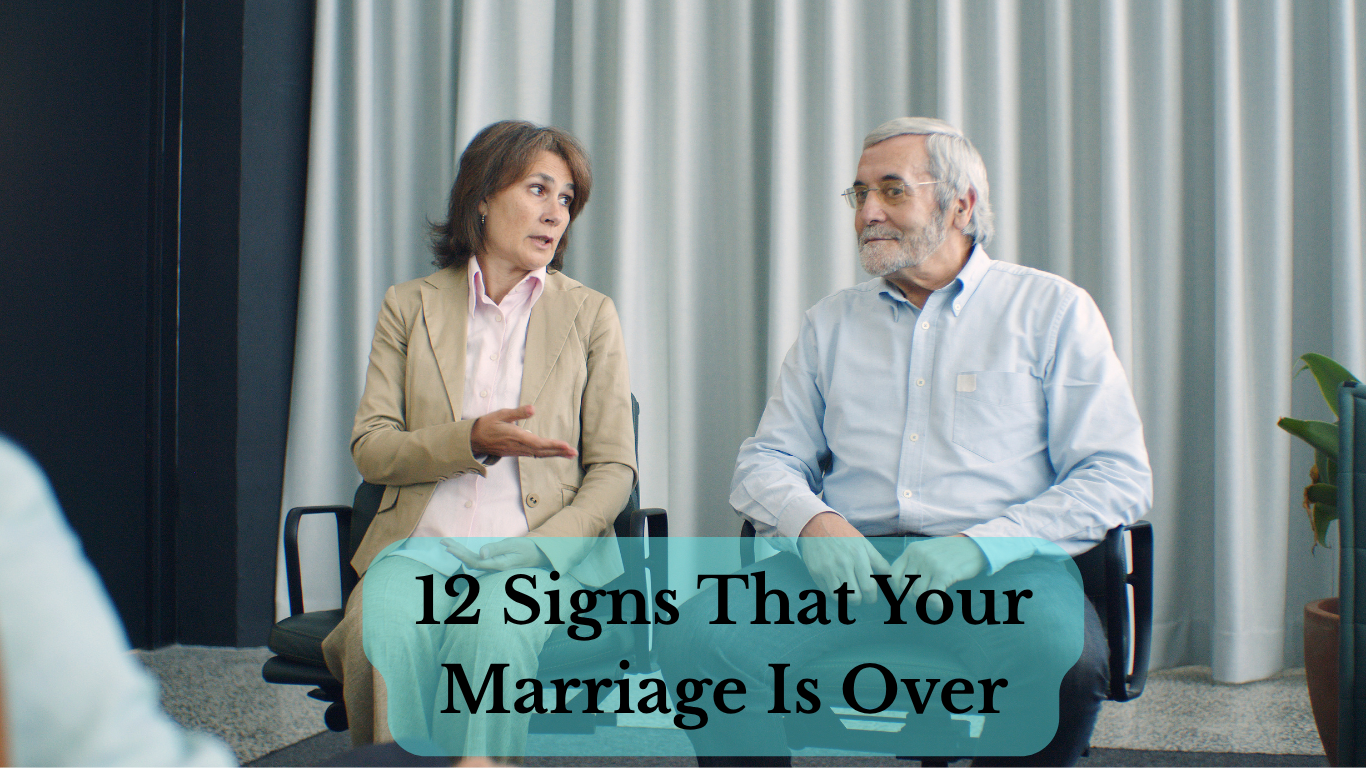
Have you ever found yourself lying awake at night wondering whether what you are experiencing in your marriage is a difficult season that genuine effort can address or something more fundamental — whether the disconnection, the unhappiness, or the specific quality of what has changed between you and your spouse represents a temporary difficulty or a permanent shift whose honest acknowledgement would change everything? The question of whether a marriage has genuinely ended — as distinct from having entered a difficult period that honest work could address — is one of the most consequential and most genuinely difficult assessments available in adult life, and the signs that guide it deserve the most honest, most compassionate, and most carefully considered examination available. This blog examines 12 signs that a marriage may be in serious trouble — presented with the honest complexity they deserve, the genuine acknowledgement that some of these signs are more recoverable than others, and the consistent encouragement toward the professional support that situations of this gravity genuinely require.
Table of Contents
The Essential Context — The Difference Between a Difficult Marriage and an Over-Marriage
Before examining the twelve signs, the most important distinction available is the honest acknowledgement that marital difficulty and marital endings are not the same thing — and that many of the signs below appear in marriages that are recovered as well as in marriages that end, making the professional assessment of their specific context more important than any blog can be.
Per research on marital distress and recovery, the marriages that end and the marriages that recover from serious difficulty often pass through the same signs – the disconnection, the resentment, the communication breakdown, and the loss of intimacy that characterise both trajectories. What distinguishes the marriages that recover is not the absence of these signs but the presence of genuine mutual willingness to address them honestly, the access to appropriate professional support, and the specific work of rebuilding whose difficulty does not exceed the commitment available.
Per John Gottman’s research on marital dissolution predictors, the specific patterns of interaction — contempt, criticism, defensiveness, and stonewalling — are more reliably predictive of marital dissolution than the presence of conflict alone. The research consistently shows that it is not the presence of problems but the specific quality of how they are engaged with that most reliably predicts outcomes.
1. Contempt Has Replaced Respect in Daily Interactions
The first and most significant sign — the one whose presence is most reliably associated with marital dissolution in Gottman’s decades of research — is the specific replacement of genuine mutual respect with contempt in the daily texture of interaction.
What contempt actually is and why it matters most:
Per Gottman’s research on the Four Horsemen of relationship dissolution, contempt is distinguished from ordinary criticism by its fundamental communication about the partner’s worth – where criticism addresses a behaviour, contempt addresses the person, communicating fundamental disrespect for who they are. The eye-roll, the dismissive sneer, the mockery, the sarcasm whose edge communicates fundamental disregard — these are the expressions of contempt whose presence in a relationship is the single strongest predictor of dissolution that relationship research has identified.
The specific damage of contempt is its communication about fundamental worth — the person who is treated with contempt by their partner over time internalises the specific message that they are not worthy of basic respect, and the relationship in which contempt is the operating register of daily interaction has become a context that actively harms its participants rather than supports them.
When this sign is most concerning:
Contempt is most concerning when it is mutual, when it has become the characteristic register of daily interaction rather than the occasional ugly expression of acute conflict, and when it has been present long enough to have become normalised in the relationship’s everyday communication. The relationship in which occasional conflict produces expressions of contempt is different from the relationship whose characteristic daily tone is contemptuous.
What professional support addresses the following:
Gottman couples therapy specifically addresses contempt through the building of a culture of appreciation and respect — the deliberate replacement of contemptuous communication patterns with genuine expressions of positive regard. The recoverable version of this sign is the one that both partners are willing to address with genuine effort and professional support.
2. Communication Has Effectively Ceased
The second sign is the specific and sustained collapse of genuine communication — the shift from the engaged, multidimensional exchange of a connected marriage to the minimal, defensive, or completely absent communication of two people who have stopped genuinely talking to each other.
What communication collapse actually involves:
Per research on communication and marital health, the complete cessation of genuine communication — not the normal variation of busy periods or difficult weeks, but the sustained, structural absence of authentic exchange — is one of the most significant indicators of marital disconnection. The marriage in which the couple communicates only about logistics, in which genuine feelings, thoughts, concerns, and aspirations are no longer shared, has lost one of the most fundamental dimensions of the intimate partnership that marriage is supposed to provide.
The specific forms that communication collapse takes include the couple who have not had a genuine conversation in weeks, the partners whose interactions consist primarily of conflict or of the managed silence that conflict avoidance produces, and the people who find they have genuinely more authentic communication with friends, colleagues, or anyone other than their spouse.
When this sign is recoverable:
Communication breakdown is one of the most recoverable marital difficulties when both partners are willing to engage with the specific work of rebuilding genuine communication — which typically requires the guided support of couples therapy whose structure and safety allow the honest exchange that has become impossible without it. The willingness of both partners to engage with this work is the most important factor in whether communication breakdown is a temporary crisis or a permanent ending.
3. One or Both Partners Has Emotionally Checked Out
The third sign is the specific and significant experience of emotional withdrawal — the specific absence of genuine emotional investment in the relationship’s wellbeing that characterises the person who has psychologically begun to leave before the formal ending of the marriage.
What emotional withdrawal looks like:
Per research on emotional investment and marital stability, the sustained withdrawal of genuine emotional engagement from a marriage — the indifference to the partner’s experience, the absence of genuine care about the relationship’s health, and the specific quality of having mentally moved on — is one of the most significant indicators that the relationship has reached a point of serious concern. The partner who is emotionally checked out is not angry, not resentful, not conflicted — they are indifferent, and the indifference is the specific quality that is most difficult to address because it represents the absence of the emotional investment that motivation to change requires.
When this sign is most concerning:
The emotional withdrawal that is most concerning is the one that is complete rather than partial; that has been present for an extended period rather than representing the acute shutdown of acute conflict; and that is accompanied by the specific behavioural indicators of genuine disengagement — investment in life outside the marriage, absence of future planning within it, and the specific relief rather than distress at the prospect of the marriage ending.
What professional support can address:
The specific work of re-engagement — the rebuilding of emotional investment and genuine care for the relationship and the partner — is possible when both partners have genuine residual motivation and willingness to engage with the process. The partner who is willing to understand what produced the withdrawal and to address the specific conditions whose presence or absence drove the disengagement has the most important prerequisite for recovery.
4. There Is No Physical Intimacy and No Desire for It
The fourth sign is the specific and sustained absence of physical intimacy — encompassing both sexual contact and the non-sexual physical affection of touch, closeness, and physical warmth — combined with the specific absence of desire for its return that distinguishes complete physical disconnection from the temporary reduction that stress and life circumstances produce.
What this sign actually means:
Per sex therapy research on physical intimacy and marital health, the complete and sustained absence of physical intimacy—including all dimensions of physical affection, not sexual contact alone—is a significant indicator of genuine disconnection whose causes and whose prospects for recovery depend on the specific factors producing it. The absence that is driven by unaddressed medical factors, untreated depression, or the accumulated resentment of unaddressed relational difficulties is different from the absence that reflects genuine loss of attraction and a genuine absence of desire for its restoration.
When this sign is more versus less recoverable:
The physical disconnection that is most recoverable is that which is accompanied by genuine desire for its restoration — the couple who have lost physical intimacy but who both genuinely want to find it again have the most important motivation for the work, whose difficulty is real but whose outcome is possible. The physical disconnection that is most concerning is the one in which one or both partners genuinely do not want physical intimacy with the other — not as a temporary response to conflict or stress but as a genuine and persistent reflection of lost attraction and absent desire.
5. Fundamental Values and Life Goals Have Diverged Irreconcilably
The fifth sign addresses the specific challenge of couples whose divergence in fundamental values, life goals, or the vision of the life they want to live has grown to the point where the shared life that marriage requires is genuinely impossible to sustain without one or both partners living at fundamental odds with their own values and authentic desires.
What irreconcilable divergence actually looks like:
The divergence that is most significant is not the normal variation of different preferences and priorities within a broadly shared framework — it is the fundamental divergence of values and life vision whose accommodation within a single shared life is genuinely not possible without one partner’s fundamental self-compromise. The specific examples that most commonly present this challenge include profound disagreement about having children, fundamental differences in religious faith whose expression in daily life is incompatible, irreconcilably different visions of where and how to live, and the fundamental divergence of personal values whose expression in life choices is mutually unacceptable.
When divergence is recoverable:
The divergence that is recoverable is that which has developed through the gradual drift of a couple who have not been communicating genuinely about their evolving values and desires — whose conversation, made honest with appropriate support, may reveal more common ground than the unspoken divergence suggested. The divergence that is genuinely irreconcilable is that which remains after honest, full, genuinely supported conversation about what each partner genuinely needs and wants — and whose genuine incompatibility is confirmed rather than resolved by that conversation.
6. Trust Has Been Fundamentally and Irreparably Broken
The sixth sign is the specific and profound damage to the foundational trust of the marriage — through infidelity, repeated deception, financial betrayal, or any other fundamental breach of the trust whose presence is the architecture on which intimate partnership is built.
What trust destruction actually involves:
Per research on infidelity and trust repair in marriage, the breaking of fundamental trust — and specifically the question of whether that trust can be genuinely rebuilt — is one of the most challenging and most individually variable dimensions of marital recovery. For some couples, the work of rebuilding trust after a fundamental breach is possible and produces a marriage whose depth of honesty after the crisis exceeds what was present before it. For others, the breach is genuinely irrecoverable—either because the deception was sustained enough to have fundamentally altered the betrayed partner’s perception of the reality they believed they were living, or because the willingness of the betraying partner to do the specific work of trust repair is absent.
When trust can be rebuilt:
Per research on infidelity recovery, the factors most strongly associated with successful trust repair include the genuine remorse and genuine transparency of the partner who broke the trust, the willingness of both partners to engage with the extended, difficult work of rebuilding — typically through professional support — and the genuine desire of the betrayed partner to rebuild rather than to leave. None of these factors is independently sufficient; all are necessary.
When trust cannot be rebuilt:
The trust that cannot be rebuilt is that whose attempted rebuilding reveals either the absence of genuine remorse and genuine change in the partner who broke it or the genuine absence in the betrayed partner of the desire to rebuild – whose presence is as necessary as the willingness to do the work.
7. You Are Living as Roommates Rather Than Partners
The seventh sign is the specific quality of the cohabitation that the marriage has become — the parallel lives lived under the same roof without the genuine connection, the shared emotional life, or the authentic partnership that marriage is supposed to provide.
What roommate marriage looks like:
Per research on marital satisfaction and emotional connection, the marriage that has become primarily a practical cohabitation arrangement — whose participants manage a shared domestic life without the genuine emotional intimacy, the mutual care, and the specific quality of partnership that distinguishes marriage from shared accommodation — has lost something essential whose absence is both painful in its experience and significant in its implications.
The specific characteristics of the roommate marriage include the absence of genuine conversation beyond logistics; the parallel social lives whose intersection is primarily domestic; the absence of the specific turning toward each other that genuine partnership involves; and the specific quality of existing in close proximity without genuine connection, whose experience is one of the loneliest available in human life.
When roommate marriages recover:
The roommate marriage that recovers is almost always the one whose participants recognise and name what has happened, whose honest acknowledgement of the disconnection produces the genuine mutual motivation to address it, and whose engagement with professional support provides the specific tools for rebuilding the genuine connection that the practical cohabitation has replaced. The willingness of both partners to acknowledge the disconnection honestly is the first and most important step.
8. One or Both Partners Is Happier When Apart
The eighth sign is the specific and revealing quality of the emotional experience of separation — the specific relief, lightness, or happiness that the temporary absence of the spouse produces in the partner whose experience within the marriage is characterised primarily by stress, resentment, or unhappiness.
What this sign reveals:
Per research on marital satisfaction and emotional response, the emotional experience of separation is one of the most honest available indicators of the marriage’s current quality — because the emotional response to a spouse’s absence reflects, more honestly than many verbal statements, the quality of the experience of their presence. The spouse whose absence produces genuine relief rather than genuine missing is the spouse whose presence has become a source of stress rather than comfort.
When this sign is most concerning:
The relief at separation that is most concerning is the persistent, consistent relief that is present across multiple separations and that has become the characteristic emotional response to the spouse’s absence — rather than the temporary relief of a difficult period whose passing would restore the genuine preference for the partner’s presence.
What professional support addresses:
The emotional dynamics that produce consistent relief at separation — the accumulated resentment, the unaddressed conflict, and the specific quality of the relationship that makes presence more stressful than absence — are the specific targets of the couples therapy work whose success or failure in addressing them is one of the most important indicators of the marriage’s genuine recovery prospects.
9. The Relationship Has Become Characterised by Chronic Conflict
The ninth sign is the specific pattern of chronic, unresolved, cyclically recurring conflict whose presence in the marriage has become the characteristic texture of the relationship rather than the occasional difficult dimension of an otherwise connected partnership.
What chronic conflict actually involves:
Per research on marital conflict and its outcomes, the distinction between the conflict that is the normal, healthy working through of genuine differences and the conflict that has become the characteristic register of the relationship is one of the most important available in marital assessment. All marriages experience conflict — the marriages that sustain genuine health do so through the genuine, productive engagement with conflict that builds understanding and resolution rather than the chronic, circular conflict that relitigates the same unresolved issues indefinitely without producing genuine resolution.
The specific quality of chronic conflict that is most concerning is its cyclical character — the arguments that return to the same subjects, in the same patterns, with the same escalations and the same non-resolutions, whose repetition demonstrates that the underlying issues are genuinely unaddressed rather than merely difficult.
When chronic conflict is recoverable:
The chronic conflict that is most recoverable is that which responds to the specific interventions of couples therapy whose work addresses the underlying patterns — the escalation dynamics, the defensive responses, and the specific unmet needs whose unaddressing produces the recurring conflict — rather than merely managing its surface expressions. The willingness of both partners to engage with this work honestly is the prerequisite for its success.
10. You Have Grown Into Fundamentally Different People
The tenth sign is the specific challenge of the couple whose individual development across the years of the marriage has produced two genuinely different people from the two people who chose each other — whose values, interests, aspirations, and sense of self have diverged enough that the current versions of the people cannot find each other in the people they chose.
What personal divergence in marriage looks like:
Per developmental psychology research on adult identity and relationships, the adult who is genuinely growing and changing across the decades of a marriage is the adult whose relationship to the partner they chose at an earlier developmental stage may become genuinely more complicated than the normal variation of individual differences within a committed partnership. The couple who chose each other at twenty-five and who are genuinely different people at fifty — whose values have evolved differently, whose sense of who they are has changed fundamentally, and whose shared life has produced increasingly parallel rather than genuinely shared trajectories — are experiencing a form of disconnection whose origin is in genuine development rather than in the specific failures of the relationship.
When personal divergence is recoverable:
The divergence that is recoverable is that which has developed through the gradual drift of a couple who have not been genuinely curious about each other’s development — whose reconnection through honest, genuine, supported conversation about who each has become may reveal a shared life that is still genuinely possible and genuinely desired. The divergence that is less recoverable is that in which the people each has become are genuinely incompatible in their fundamental values and life visions.
11. You Have Considered or Explored Separation or Divorce
The eleventh sign is the specific and significant cognitive and emotional step of genuinely considering separation or divorce — the internal acknowledgement that the marriage’s ending is a possibility that the mind is genuinely entertaining rather than categorically rejecting.
What this sign actually means:
Per research on divorce decision-making, the genuine contemplation of separation or divorce — as distinct from the heat-of-the-moment threat that conflict produces — is a significant indicator of the seriousness of the marital difficulty and the genuine uncertainty about the relationship’s continuation. The person who is genuinely considering whether to leave has reached a point of crisis whose honest acknowledgement and whose professional assessment are genuinely important.
When contemplation of divorce is recoverable:
Per divorce prevention research, the contemplation of divorce that is accompanied by genuine ambivalence — genuine uncertainty about whether leaving is the right answer or genuine residual desire for the marriage to recover — is the contemplation most amenable to professional intervention whose work addresses the specific conditions producing the crisis. The contemplation that has resolved into genuine clarity about wanting to leave is a different and more definitively concerning situation.
12. The Thought of the Marriage Ending Produces Relief Rather Than Grief
The twelfth and most honest sign is the specific emotional response to the genuine imagining of the marriage’s end – the question of what it actually feels like, in the honest privacy of one’s own mind, to imagine life without this marriage.
Why this sign is the most honest available:
Per research on emotional response and decision-making, the genuine emotional response to an imagined outcome — unmanaged by the social performance of what one is supposed to feel — is one of the most honest available indicators of genuine desire. The person whose genuine emotional response to imagining the marriage’s end is relief — whose imagined life without the marriage is lighter, freer, and more genuinely appealing than the imagined continuation of it — has access to a piece of honest self-knowledge whose significance is worth taking seriously.
When relief at an imagined ending is most significant:
The relief that is most significant is the consistent, persistent, predominant relief that is present across multiple honest engagements with the imagined ending — rather than the temporary relief that acute conflict or extreme difficulty produces in anyone. The person who consistently, honestly imagines the marriage’s end with primary relief rather than primary grief is the person whose honest self-knowledge deserves the most serious and most compassionate professional attention.
What to Do — The Honest, Evidence-Based Path Forward
Having examined the twelve signs, the most important guidance available is not the unilateral interpretation of signs as verdicts but the genuine, honest engagement with what they mean and what the most constructive response to them is.
Seek professional support before making permanent decisions. Per the consistent finding of couples therapy research, the assessment of a qualified couples therapist whose expertise can address the specific dimensions of the marital difficulty provides a genuinely more accurate and more productive basis for decision-making than the individual interpretation of signs. The willingness to seek this support — even in the presence of genuine doubt about the marriage — is the most important investment available in the quality of the decision that follows.
Be honest with yourself about what you genuinely want. The most important and least frequently asked question in the presence of serious marital difficulty is the genuinely honest question of what you actually want — not what you think you should want, not what would be most convenient or least painful, but what you genuinely, honestly desire for your own life. The answer to this question — pursued honestly and with appropriate support — is the most important available guide to the most important available decision.
Distinguish between signs that are recoverable and signs that are not. Not all the signs in this blog carry equivalent weight or equivalent implications for recovery. The honest, professional assessment of which signs are present in your specific marriage — and what their specific causes are — provides the most accurate available basis for the most informed available decision.
Key Takeaways
The twelve signs examined in this blog — contempt replacing respect; communication collapse; emotional withdrawal; physical and intimate disconnection; irreconcilable value divergence; fundamental trust betrayal; roommate cohabitation; happiness when apart; chronic unresolved conflict; grown into different people; genuine contemplation of divorce; and relief at the imagined ending — together represent the most consistently identified serious indicators of marital crisis.
What they share is the quality of deserving honest acknowledgement rather than either dismissal or immediate action — each is a signal worth taking seriously, each has multiple possible causes, and each deserves the professional assessment whose outcome is the most honest available basis for the most consequential available decision.
Per the research on marital outcomes and professional support, the marriages that end well — whether through genuine recovery or through an honest, dignified conclusion — are those whose participants found the courage to engage honestly with the signs, to seek appropriate professional support, and to make their decisions from the position of genuine self-knowledge and genuine mutual respect rather than from the unexamined assumption that the current difficulty is either permanent or temporary.
The signs described in this blog are not verdicts — they are invitations to honesty. The honesty about what is actually happening in the marriage, the honesty about what you genuinely want, and the honesty of the professional assessment that your situation deserves. Whatever the outcome of that honesty — recovery or ending — the courage to be honest is the most respectful thing available both to the marriage and to yourself.