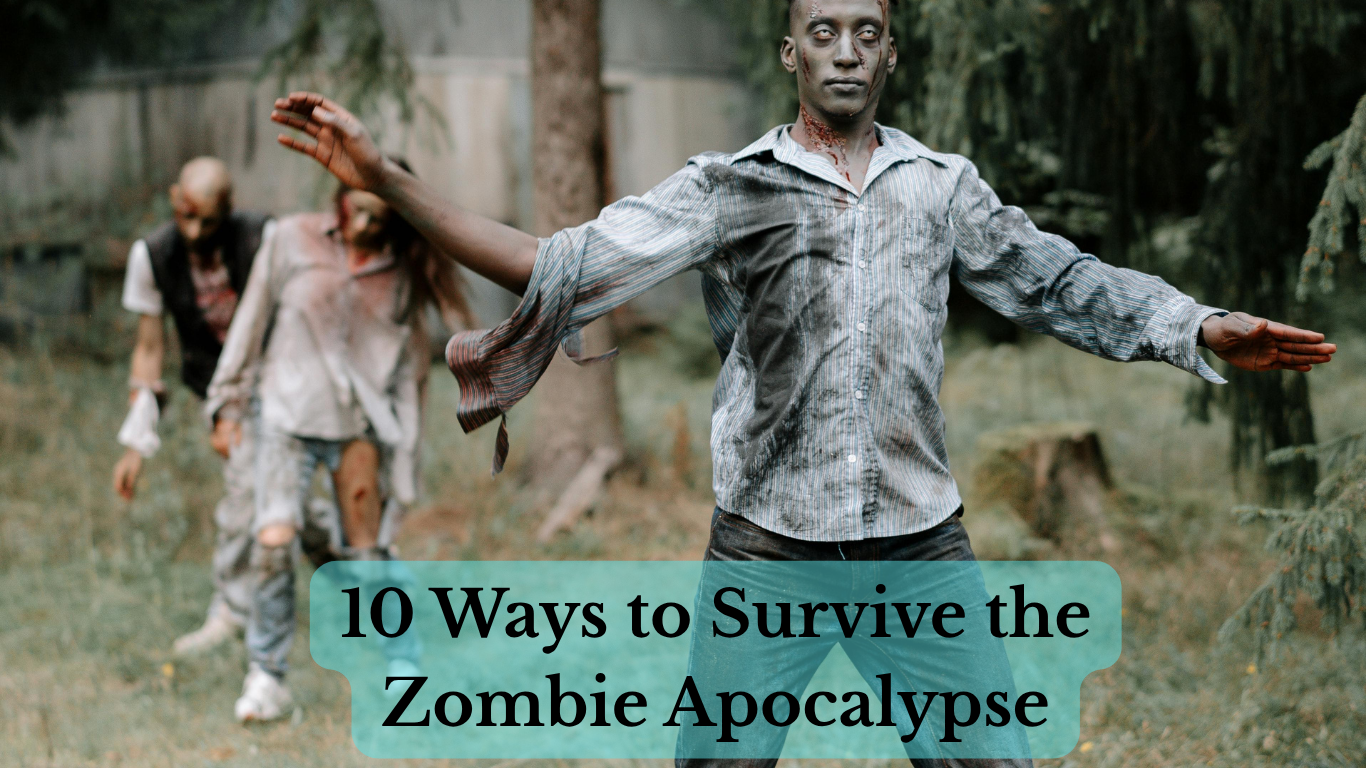
Have you ever found yourself watching a zombie film or series — perhaps The Walking Dead, perhaps 28 Days Later, perhaps World War Z — and thought, with the specific mixture of entertainment and mild self-examination that the genre reliably produces, that you should probably think more carefully about which of the characters you would actually be in this scenario and whether the answer is as flattering as you would prefer? The zombie apocalypse is one of the most enduring and most instructive thought experiments in popular culture — not because zombies are a genuine preparedness concern, but because the genre is essentially a stress test of human decision-making, social organisation, and survival psychology under conditions of maximum pressure. This blog examines 10 ways to survive the zombie apocalypse — with the serious survival science where it exists, the genre wisdom where it applies, and the honest acknowledgement throughout that the zombie apocalypse is the most entertaining lens through which to examine the genuinely useful question of what it would actually take to keep yourself and the people you care about alive when everything normal has stopped working.
Table of Contents
1. Secure Your Initial Location — The First 72 Hours Are Everything
The single most important decision in any survival scenario — zombie apocalypse or otherwise — is the choice of initial shelter and the speed with which it is secured. In the zombie genre, the characters who die first are almost universally those who stand in the street trying to understand what is happening, and the characters who survive longest are those who make rapid, decisive decisions about where to be and what to do before the situation has fully resolved itself.
Per genuine emergency preparedness research — and the zombie apocalypse thought experiment maps reasonably well onto real pandemic and civil disorder scenarios in this dimension — the first 72 hours of any major disruption are the period of maximum danger and maximum opportunity. Systems are failing but have not yet reached their new equilibrium. Other people are making irrational decisions driven by panic. The infrastructure is compromised but not yet entirely absent. The decisions made in this window — shelter, water, food, communication — disproportionately determine outcomes over the much longer subsequent period.
The ideal initial shelter in the genre and in genuine survival scenarios shares several characteristics. It is defensible — with limited entry points that can be monitored and secured. It is elevated — providing visibility and the tactical advantage of height. It is away from the highest density of initial outbreak — cities, transportation hubs, and the locations where the highest concentration of potentially infected or desperate people will be moving in the early chaos. And it contains or is adjacent to the resources — water, food, medical supplies — that the first critical period requires.
Per the zombie genre’s consistent lesson on this point, the instinct to shelter in place rather than immediately moving to a theoretically better location is often correct — the dangers of movement in the early chaos of an outbreak frequently exceed the disadvantages of an imperfect initial shelter. The character who stays put in a defensible location while others are trying to travel frequently outlasts those who are caught in transit.
2. Water Security Is Non-Negotiable and More Urgent Than Food
The survival priority that the zombie genre consistently gets wrong — subordinating water to food and weapons in the characters’ apparent hierarchy of concern — is the one that genuine survival science gets most emphatically right. The human body can survive approximately three weeks without food. It cannot survive three days without water. In a scenario where municipal water systems have failed — as they would within days of any serious infrastructure collapse — water security is the most urgent practical survival concern.
Per wilderness survival research and emergency preparedness guidance, a person engaged in moderate physical activity requires approximately three to four litres of water per day — more in hot weather, more during illness, and more during the physical exertion that any active survival scenario generates. A group of five people requires a minimum of fifteen to twenty litres per day — a quantity that is genuinely challenging to procure, transport, and purify in a post-infrastructure environment.
The zombie survival approach to water security involves several sequential strategies. Collection — identifying and accessing surface water sources, including rivers, streams, lakes, and rainfall collection. Purification — the use of boiling, chemical treatment, or filtration to make collected water safe to drink. Storage — the accumulation of purified water in appropriate containers during periods of relative security for use during periods when collection is not possible.
The specific zombie apocalypse lesson on water that most characters learn too late is that water sources attract other survivors — and other survivors, in the genre’s consistent portrayal, frequently represent a threat comparable to or exceeding the zombies themselves. The water source that keeps you alive is the water source that everyone else also needs, and its control is among the most consistently contested resources in the genre’s survival scenarios.
3. Learn to Be Quiet — Noise Discipline Is Survival Discipline
The zombie genre has embedded in popular culture the principle of noise discipline — the understanding that in a world where sound attracts lethal attention, the ability to move quietly, communicate quietly, and operate without the ambient noise of normal life is a genuine survival skill whose cultivation is worth deliberate effort.
In the genre, the characters whose noise discipline is worst die first — they shout when whispering would serve, they run on gravel when walking on grass is possible, they use firearms when quieter alternatives exist, and their vehicles, generators, and daily activities broadcast their location to every threat within auditory range.
The genuine survival principle here extends beyond the zombie scenario into any situation in which drawing unwanted attention is dangerous. The broader principle is situational awareness — the continuous monitoring of one’s environment for information relevant to safety and the management of one’s own signature — visual, acoustic, and olfactory — in ways that minimise unnecessary exposure to detected threats.
Per the genre’s consistent lesson, the survivor who has developed genuine situational awareness is not the most heavily armed or the most physically formidable — they are the one who is most consistently aware of what is in their environment and most consistently disciplined about what they are broadcasting into it.
4. Build and Maintain a Trustworthy Group — But Keep It Small
The zombie genre’s most consistent and most genuinely instructive social observation is the relationship between group size, group cohesion, and group survival — a relationship whose dynamics play out with remarkable consistency across the genre’s most serious entries.
Small groups of genuinely trustworthy, genuinely competent, genuinely committed individuals consistently outperform both solitary survivors and large groups in the genre’s scenarios — and the survival logic is genuine. The solitary survivor has no redundancy — injury, illness, or a single moment of lowered alertness is potentially fatal. The large group has coordination problems, resource competition, and the inevitable infiltration of the untrustworthy and the incompetent that eventually produces the internal conflicts that destroy groups more reliably than external threats.
Per genuine research on small group dynamics and performance under stress — which the military, emergency response, and wilderness survival literature has extensively studied — the optimal group size for combined effectiveness and cohesion is approximately four to seven people. Large enough for redundancy and complementary skills. Small enough for genuine trust, efficient communication, and resource management that does not require bureaucracy.
The genre’s most important lesson about group composition is the selection criterion for membership — which should be competence, trustworthiness, and the ability to contribute something the group needs, in that order. The group that accepts members on the basis of prior relationship, sentimentality, or the moral imperative to help everyone who presents themselves will face the specific challenges that the genre reliably delivers when the group composition prioritises social obligation over practical function.
5. Diversify Your Skills — The Specialist Is the Most Vulnerable Person
The zombie genre’s consistent portrayal of survival skill requirements reveals one of the most genuinely useful preparedness insights available in the entertainment medium — the specialist is the most vulnerable person in a post-infrastructure survival scenario, because the infrastructure that makes specialisation possible is the infrastructure that has failed.
The surgeon who cannot hunt, the mechanic who cannot grow food, the accountant who cannot navigate without GPS — these characters face the specific vulnerability of having invested their developmental years in skills whose application depends on a system that no longer exists. The characters who survive longest in the genre’s most rigorous scenarios are those who have maintained a broad base of practical skills across multiple domains — agriculture, construction, medicine, navigation, mechanical repair, and the various other competencies that pre-industrial human beings maintained as a matter of ordinary life.
Per genuine emergency preparedness research, the skills most valuable in a sustained infrastructure disruption scenario include water procurement and purification, basic medical care and wound treatment, food production and preservation, fire making and management, navigation without electronic assistance, basic construction and shelter improvement, and the mechanical skills required to maintain and repair the basic tools that each of these activities requires.
The zombie apocalypse lesson here is the same as the genuine preparedness lesson — the person who has invested some portion of their developmental attention in the practical skills that modernity has made unnecessary is significantly better positioned for any scenario in which modernity’s infrastructure fails than the person who has invested exclusively in the skills that modernity rewards.
6. Establish a Sustainable Food System — Hunting and Foraging Are Short-Term Solutions
The zombie genre’s food problem is one of the most consistently underplayed — characters who are surviving weeks and months in post-infrastructure scenarios frequently eat without the food system, whose maintenance would need to be their primary daily occupation, being shown in any detail.
The genuine survival reality is that sustainable food production — not foraging, not scavenging, not hunting, but actual agriculture — is the only viable long-term food security strategy for a group of any size. Foraging provides supplements. Hunting provides irregular protein. Scavenging provides a short-term bridge from the collapse to a new equilibrium. But the caloric requirements of an active survival group, maintained indefinitely, require the deliberate growing of food at a scale that the genre rarely shows and genuine preparedness thinking must take seriously.
Per agricultural history and survival food production research, the minimum viable agriculture for a small group’s food security requires suitable land, appropriate seeds, adequate water, sufficient tools, and the specific knowledge of cultivation that most contemporary people do not possess and that is genuinely difficult to acquire under pressure from first principles.
The zombie apocalypse lesson — consistent with the genuine preparedness lesson — is that the group that has secured agricultural land and begun food production before their scavenged supplies are exhausted has a fundamentally different long-term survival trajectory from the group that is still foraging when those supplies run out. The farm is the most valuable piece of zombie apocalypse real estate available, and the farming knowledge is the most valuable skill set in the group.
7. Develop Your Medical Capability — Infection Will Kill More Than Zombies
The genre’s honest portrayal of survival mortality consistently shows that infection — of the non-zombie variety — kills more survivors than zombie encounters. Wound infection, untreated illness, obstetric complications, dental infection, and the various medical emergencies that modern healthcare makes survivable become the primary mortality cause in any extended post-infrastructure scenario.
Per medical research on pre-antibiotic mortality — which provides the most relevant historical parallel for a post-healthcare-infrastructure scenario — the leading causes of death before the antibiotic era were infections that modern medicine makes trivially manageable. A cut that becomes infected, a tooth abscess, appendicitis, pneumonia — these are the medical events that will end survival scenarios whose participants have survived every external threat.
The zombie apocalypse medical capability investment involves several components. Knowledge — the specific medical knowledge of wound management, infection recognition and treatment, basic surgical techniques, and the management of the most common medical emergencies that survival scenarios generate. Supplies — the antibiotics, the wound care materials, the surgical instruments, and the medications whose presence makes the knowledge applicable and whose absence makes it theoretical. Skills — the hands-on practice of the specific medical procedures that theory alone does not provide.
Per the genre’s consistent lesson, the group that has a medically competent member is the group that survives the medical attrition that eventually depletes groups without equivalent capability. And the group that has invested in preserving and using antibiotics correctly is the group that survives the infections whose fatality in a post-antibiotic context would otherwise be high.
8. Understand the Psychology of Sustained Stress — The Mind Fails Before the Body
The zombie genre’s most psychologically sophisticated entries — The Road, The Last of Us, and the later seasons of The Walking Dead — consistently identify the mind’s failure as the most significant threat to long-term survival. Characters who are physically capable, practically skilled, and externally safe nevertheless deteriorate psychologically in ways that compromise their judgement, their relationships, and ultimately their survival.
Per research on sustained stress and psychological functioning, the specific psychological challenges of extended high-threat survival scenarios include the erosion of motivation and hope whose maintenance requires the experience of genuine positive progress, the accumulation of traumatic experience whose unprocessed legacy interferes with present functioning, the interpersonal conflicts generated by prolonged close-proximity stress, and the specific moral deterioration that the genre consistently explores — the erosion of pre-apocalyptic ethical commitments under the pressure of survival necessity.
The zombie apocalypse psychological survival investment involves several genuine preparedness principles. The maintenance of routine — which provides the psychological scaffolding of normalcy whose complete absence accelerates deterioration. The deliberate cultivation of hope — through the establishment of goals, the celebration of achievements, and the maintenance of a forward-looking narrative that survival has purpose. The processing of loss and trauma through whatever means the group’s resources support — which in a resource-limited scenario may mean conversation, ritual, and the specific interpersonal support that genuine community provides.
Per the genre’s most consistent lesson, the group that maintains genuine social cohesion — that treats its members as fully human rather than as functional units — is the group that maintains the psychological resources that sustained survival requires. The community that has retained its humanity is consistently more durable than the one that has abandoned it in the name of efficiency.
9. Know When to Move and When to Stay — The Bug-Out Decision Is the Most Important Tactical Choice
The zombie genre’s most consistently fatal decision is the wrong choice between staying and moving — the characters who stay when they should move and the characters who move when they should stay fill the genre’s mortality statistics in roughly equal measure.
Per genuine emergency preparedness doctrine — and the zombie scenario maps well onto genuine mass casualty and civil disorder scenarios here — the bug-out decision involves the assessment of several variables whose balance determines the right choice. The threat level at the current location — is it rising, stable, or falling? The defensibility and resource adequacy of the current location — does it support the group’s needs for the relevant time horizon? The safety of the proposed route — what are the specific threats between here and there? The adequacy of the destination — does it offer genuinely better conditions than the current location?
The genre’s consistent lesson is that movement is dangerous — the vulnerability of a group in transit is significantly higher than the vulnerability of the same group in a secure stationary position — and that the decision to move should be driven by evidence that the current position is genuinely untenable rather than by anxiety, rumour, or the general feeling that somewhere else must be better.
Per genuine preparedness doctrine, having a predetermined bug-out plan — knowing where you would go, by what route, and carrying what minimum supplies — is significantly more valuable than making the decision under pressure. The plan made before the crisis is made with more information, more time, and more rationality than the plan made in its middle.
10. Maintain Your Humanity — The Genre’s Most Important Lesson
The tenth survival strategy is the one that the zombie genre has consistently identified as the most important and the most consistently abandoned — the maintenance of the ethical commitments, the compassionate impulses, and the genuinely human values that distinguish the survivor worth saving from the survivor who merely continues to exist.
The zombie genre’s most profound entries are not primarily about survival tactics — they are about what survival costs when it is pursued without ethical constraint and what it means to maintain human values in the face of every pressure to abandon them. Rick Grimes’s repeated confrontation with his own capacity for violence. Joel’s choice at the end of The Last of Us, whose moral complexity the game refuses to resolve simply. The Walking Dead‘s persistent question of whether the living are more dangerous than the dead and what the answer means for who the survivors are becoming.
Per the genre’s consistent moral logic — and per genuine psychological research on moral injury and post-traumatic growth — the survivors who maintain their ethical commitments under maximum pressure are not the ones who have compromised their survival efficiency for sentimental reasons. They are the ones who have preserved the psychological and social resources that make survival worth having and make the group worth surviving with.
The specific practical survival argument for maintaining humanity is the social trust argument — the group whose members treat each other and others with genuine ethical regard is the group capable of genuine trust whose social benefits produce better collective decisions, more honest communication, and more durable cohesion than the group operating on pure transactional self-interest.
Per the genre’s ultimate lesson — stated most clearly in The Road‘s father’s commitment to being “the good guys” regardless of the cost — the question the zombie apocalypse is actually asking is not “how do you stay alive?” but “what kind of person are you while you do?” The answer to that question is both the most important survival strategy and the most important question that the genre, at its best, has always been asking.
Key Takeaways
The ten survival strategies examined in this blog — securing initial shelter, prioritising water, developing noise discipline, building a trustworthy small group, diversifying skills, establishing sustainable food production, developing medical capability, managing survival psychology, making good bug-out decisions, and maintaining humanity — together constitute both a reasonably coherent zombie apocalypse survival framework and a genuinely useful set of emergency preparedness principles whose application extends well beyond the fictional scenario that structures them.
The zombie genre endures not because zombies are a genuine concern but because the scenario they create — the complete removal of the infrastructure, the institutions, and the social systems that modern life depends on — is the most extreme version of a question that genuine emergency preparedness asks in more modest form. What would you do if the systems failed? What skills do you have? What resources do you have access to? Who would you trust? What kind of person would you be?
Per the genuine emergency preparedness research that the zombie scenario popularises — and whose genuine recommendations include the 72-hour emergency kit, the knowledge of local water sources, the basic first aid training, and the community relationships that real emergencies actually depend on — the value of the zombie thought experiment is its specific ability to make preparedness interesting to people for whom “natural disaster preparedness” is not inherently compelling.
The zombies are not coming. The emergency is. Have a plan, know your neighbours, store some water, and — most importantly — decide now what kind of person you are going to be when the normal things stop working. The answer to that question is the most important preparation available.