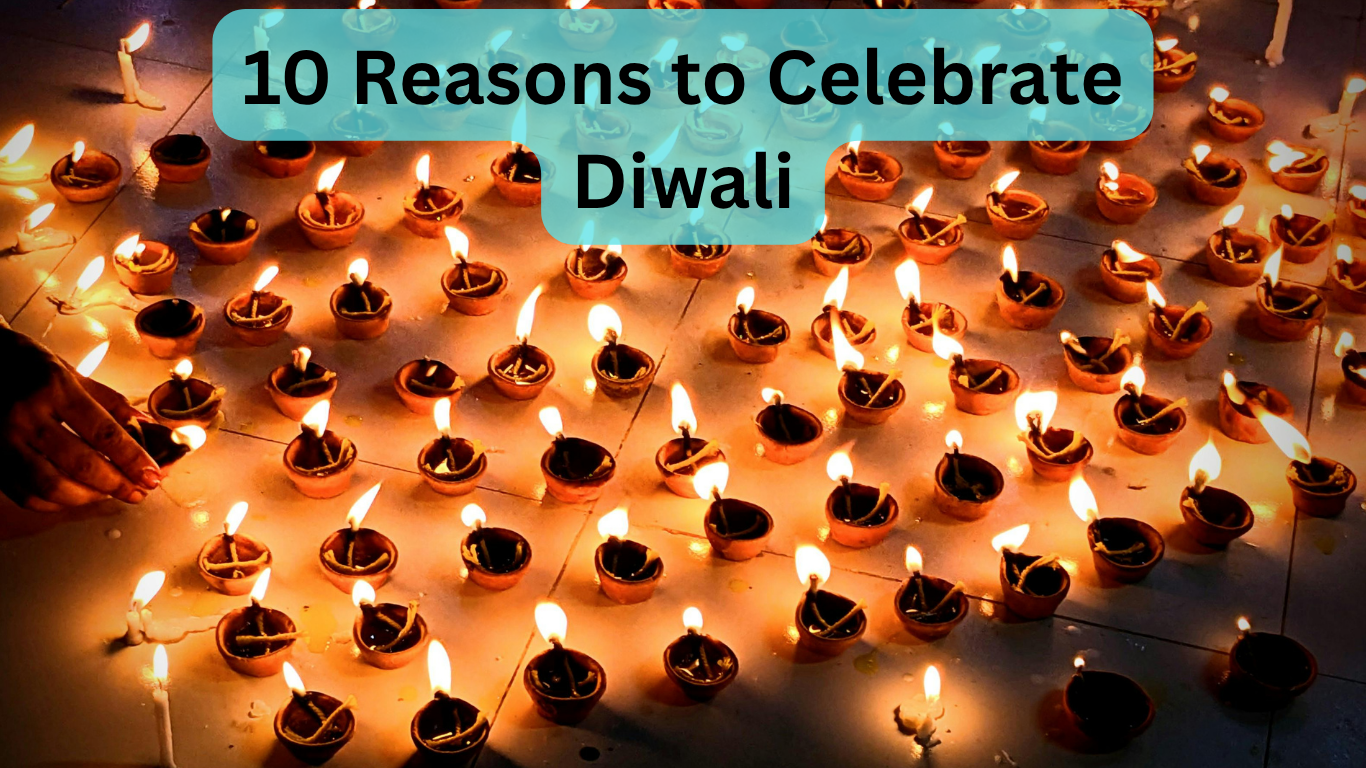
Have you ever witnessed the moment when thousands of oil lamps are lit simultaneously — their warm flames multiplying across the darkness in every direction, each one small and individually modest but together transforming the night into something that feels genuinely sacred — and understood, perhaps without any further explanation, why this festival has been celebrated across South Asia and the South Asian diaspora for thousands of years with a devotion and a joy that neither time nor geography has diminished? Diwali — the Festival of Lights — is one of the most celebrated, most visually magnificent, and most spiritually rich festivals in the world, observed by more than a billion Hindus, Sikhs, Jains, and some Buddhists across India, Nepal, Sri Lanka, and communities throughout the global diaspora. This blog examines 10 genuine, considered, and warmly informed reasons to celebrate Diwali — whether as a lifelong observer of the tradition or as someone encountering its depth and beauty for the first time.
Table of Contents
The Festival of Lights — A Brief Introduction
Before examining the ten reasons, a brief orientation to Diwali’s scope and diversity is useful — because one of the most significant things about Diwali is that it is not a single celebration with a single meaning but a festival whose significance varies across religious traditions, regional cultures, and family practices in ways that reflect the extraordinary diversity of the communities who observe it.
For Hindus — the largest group of Diwali observers — the festival primarily celebrates the return of the god Rama to Ayodhya after fourteen years of exile and his defeat of the demon king Ravana, as narrated in the Ramayana. It also celebrates the goddess Lakshmi, the deity of wealth, prosperity, and good fortune, whose blessings are specifically sought during Diwali. For Sikhs, Diwali coincides with Bandi Chhor Divas — the celebration of the Sixth Guru, Guru Hargobind’s release from imprisonment alongside 52 other princes. For Jains, it marks the attainment of moksha — spiritual liberation — by Lord Mahavira. The festival spans five days in the Hindu calendar, falling in the month of Kartik — typically in October or November — and its specific observances vary by region, community, and tradition.
What unites all of these observances — across their theological differences — is the central symbolism of light overcoming darkness, knowledge overcoming ignorance, and good overcoming evil that gives Diwali its universal resonance and its capacity to speak to people far beyond the specific religious traditions that celebrate it.
1. It Celebrates the Universal Triumph of Light Over Darkness
The first and most fundamental reason to celebrate Diwali is the central symbolic meaning that gives the festival its name — Deepavali, from the Sanskrit words deepa (lamp) and avali (row), meaning literally “row of lights.” The lighting of diyas — the small clay oil lamps that are the festival’s defining visual symbol — is not merely decorative but deeply symbolic, enacting the universal human conviction that light is stronger than darkness and that the illumination of knowledge, goodness, and spiritual awareness overcomes the darkness of ignorance, evil, and spiritual blindness.
This symbolism is not exclusive to any single religious tradition — it resonates across every human culture and every spiritual framework that has used light as a metaphor for what is most worth seeking. The person who lights a Diwali diya is participating in one of humanity’s most ancient and most universal symbolic gestures — the declaration that light matters, that its cultivation is worth the effort, and that even a single small flame changes the character of the darkness it inhabits.
Per the traditions of Diwali observance across communities, the lighting of diyas is the act around which all other celebrations organise themselves — the shops and homes decorated with thousands of lights, the rangoli patterns that welcome Lakshmi, the fireworks that fill the sky with colour, the gatherings of family and community that the festival brings together are all expressions of the same central conviction that the light of the festival represents.
2. It Celebrates the Victory of Good Over Evil
The second reason to celebrate Diwali is the narrative foundation that gives the festival its deepest spiritual meaning — the celebration of righteousness overcoming its opposite, of good prevailing over evil, of the forces that diminish human dignity being defeated by those that affirm it.
The Ramayana narrative that underlies much Hindu Diwali observance — Rama’s return to Ayodhya after his defeat of Ravana — is not merely a mythological story but a teaching about the nature of dharma, the moral order that sustains human life and society. Rama represents the ideal of righteous conduct — devotion, courage, fidelity, and the willingness to sacrifice personal comfort for the sake of dharma. Ravana represents the abuse of power, the subordination of ethical obligation to personal desire, and the arrogance that leads to destruction. The festival celebrates not merely Rama’s military victory but the triumph of the values he embodies over those that Ravana represents.
Per the spiritual traditions of Diwali observance, this celebration of good over evil is not a passive commemoration of a historical event but an active renewal of commitment to the values the narrative enshrines — a yearly reminder that the qualities represented by Rama are worth cultivating in one’s own life and that the qualities represented by Ravana are worth recognising and resisting.
3. It Brings Families and Communities Together
The third reason to celebrate Diwali is the most immediately and most universally experienced — the specific quality of togetherness that Diwali produces, gathering families across generations and communities across distances in a shared celebration whose warmth and joy are among the festival’s most treasured dimensions.
Diwali is one of those festivals that functions as a magnet for the scattered — adult children return to their parents’ homes, relatives who live at distance make the journey, communities gather in temples and community spaces, and the specific quality of Diwali togetherness — the preparation of traditional foods, the lighting of diyas together, the exchange of gifts and sweets, the shared fireworks and the shared memories of previous Diwalis — produces the particular warmth of a celebration that is simultaneously ancient and freshly experienced each year.
Per research on festival participation and psychological wellbeing, the experience of shared cultural celebration — the sense of belonging to a tradition and a community larger than the individual household — is one of the most reliably positive contributors to subjective wellbeing and social connectedness. Diwali, with its five-day duration and its multiple opportunities for different forms of communal gathering, provides an extended period of this quality of shared experience that shorter celebrations cannot replicate.
The preparation for Diwali — the cleaning and decorating of homes, the making of traditional sweets and snacks, the selection and exchange of gifts — is itself a period of communal activity whose process is as celebrated as its product. The mother and daughter making mathri together, the grandparent teaching the grandchild to draw rangoli, the family selecting diyas at the market — these are the specific textures of Diwali togetherness that those who have experienced them carry as some of their most valued memories.
4. It Honours Lakshmi and Invites Prosperity and Abundance
The fourth reason to celebrate Diwali is the specific spiritual dimension of Lakshmi puja — the worship of the goddess of wealth, prosperity, good fortune, and spiritual abundance that is central to Diwali observance across Hindu traditions.
Lakshmi represents not merely material wealth but the full range of what prosperity means — the abundance of health, happiness, good relationships, spiritual awareness, and the resources that allow a family and community to flourish. The Diwali invitation to Lakshmi — expressed through the cleaning and illuminating of homes to welcome her, through the drawing of auspicious rangoli at the threshold, through the puja whose prayers ask her blessings for the year ahead — is both a spiritual practice and an expression of the human hope that what we cultivate and value will grow and flourish.
Per Hindu theological understanding, Lakshmi visits only homes that are clean, orderly, and properly lit — which is why Diwali preparation includes the thorough cleaning of homes and the lighting of diyas in every room and at every doorway and window. This tradition has both a spiritual meaning — the prepared, illuminated home is ready to receive blessing — and a practical one — the annual deep-cleaning that Diwali preparation motivates is genuinely beneficial for the health and order of the household.
The Diwali tradition of beginning new business ventures, completing financial accounts, and offering prayers for prosperity in the coming year reflects the festival’s function as a new beginning — an annual reset of intention and aspiration — that gives the celebration of Lakshmi its practical as well as spiritual dimension.
5. It Celebrates Knowledge and the Pursuit of Learning
The fifth reason to celebrate Diwali is the specific dimension of the festival associated with Saraswati — the goddess of knowledge, learning, music, and the arts — whose worship is associated with Diwali in some regional traditions and whose presence in the festival reflects the broader Diwali theme of light as the illumination of knowledge overcoming the darkness of ignorance.
The metaphor of the diya is as much epistemological as it is spiritual — the lamp that lights the darkness is the knowledge that illuminates what was previously unseen or misunderstood. The festival’s celebration of light is therefore simultaneously a celebration of the pursuit of understanding — the individual and collective effort to know more clearly, see more honestly, and act more wisely that is the ongoing project of human civilisation.
The tradition in many families of purchasing new notebooks and beginning new learning at Diwali — the specific practice of starting a new account book, a new journal, or a new study effort at the festival — reflects this epistemological dimension of the celebration. The new year that Diwali inaugurates is an invitation not merely to hope for material prosperity but to commit to the learning and growth that genuine flourishing requires.
6. It Is an Extraordinary Sensory and Cultural Experience
The sixth reason to celebrate Diwali is the most immediately accessible — the sheer sensory richness of the festival’s celebration, which creates an aesthetic experience of rare completeness and beauty.
The visual dimension alone — the thousands of diyas illuminating every surface, the elaborate rangoli patterns in rice flour and coloured powders at every threshold, the fireworks painting the night sky with cascading colour, the elaborate decorations of marigold garlands and torans at doorways and windows — creates a visual environment of extraordinary warmth and beauty. Combined with the sounds of celebration — the firecrackers, the music, the prayers, the laughter of gathered families — the aromas of traditional foods and incense, and the specific quality of the light that diyas produce — warmer and more intimate than electric light, drawing people together rather than illuminating them from above — Diwali engages the full sensory experience in a way that few other celebrations can match.
The food of Diwali deserves its own acknowledgement in this sensory celebration. The traditional sweets — mithai including ladoo, barfi, gulab jamun, kheer, and dozens of regional specialities — are made with the particular care that festival cooking everywhere reflects. The preparation and sharing of traditional foods is one of the most consistent expressions of cultural identity and familial love in the Diwali celebration, and the specific sweets associated with specific families and specific regions carry memory, identity, and affection in their ingredients.
7. It Offers a Meaningful New Year and Fresh Beginning
The seventh reason to celebrate Diwali is its function as a new year celebration in several Hindu traditions — the Vikram Samvat new year begins the day after Diwali in some regional Hindu calendars, and the festival’s placement at the end of one agricultural and commercial cycle and the beginning of the next gives it the specific quality of a threshold moment — a time to complete what needs completing, release what needs releasing, and begin what needs beginning.
The new year dimension of Diwali is expressed through a range of specific practices. Business communities traditionally close their accounts on Diwali — settling debts, completing transactions, and beginning the new accounting year with fresh books. Homes are thoroughly cleaned and renovated — the removal of what has accumulated, the repair of what has deteriorated, and the fresh decoration that welcomes the new year in a physical environment that reflects the renewal of intention. Personal commitments are made — the Diwali equivalent of new year resolutions that acknowledge the festival’s invitation to start the coming year with greater awareness, generosity, or devotion than the previous year contained.
Per psychological research on temporal landmarks and behaviour change, the specific power of threshold moments — new years, new seasons, significant milestones — for motivating the fresh start that genuine change requires is well-evidenced. Diwali provides this temporal landmark with a specific additional power — the spiritual context that gives the fresh beginning its significance beyond mere calendar change.
8. It Expresses Gratitude and Generosity Through Gift-Giving and Charity
The eighth reason to celebrate Diwali is the tradition of gift-giving, the exchange of sweets and good wishes, and the specific Diwali emphasis on generosity and charitable giving that reflects the festival’s understanding of prosperity as something to be shared rather than accumulated.
The Diwali exchange of gifts — mithai, dry fruits, clothing, household items, and in contemporary practice the full range of consumer goods whose festive packaging announces their association with the celebration — is fundamentally an expression of gratitude and connection. The gift says that the relationship matters, that the giver has thought about the recipient, and that the prosperity of Diwali is something to be distributed through the network of relationships that gives life its richness.
The tradition of charitable giving at Diwali — dana, the giving to those in need, which is specifically emphasised as a Diwali virtue in many traditions — reflects the festival’s spiritual teaching that genuine prosperity includes the prosperity of those around us. The Diwali lamp that illuminates only one home has not fully expressed its symbolism — the light is most truly itself when it is shared, when it lights other lamps, when the illumination spreads beyond its point of origin.
Per research on gratitude practices and wellbeing, the deliberate expression of gratitude through the giving and receiving of gifts, the sharing of food, and the specific acknowledgement of the relationships that enrich life is one of the most reliable contributors to subjective wellbeing and relational quality. Diwali’s cultural scaffolding for these expressions — the tradition that makes generosity the expected and celebrated norm rather than the exceptional effort — is one of its most psychologically valuable features.
9. It Connects Participants to an Ancient and Living Cultural Heritage
The ninth reason to celebrate Diwali is the specific value of participation in a tradition that connects the present moment to thousands of years of human cultural history — the experience of doing what countless generations before have done, in ways that carry their meaning precisely because of the continuity that makes them recognisable across time.
Diwali has been celebrated for at least 2,500 years — some accounts trace its origins to the period of the Indus Valley Civilisation, making it among the oldest continuously observed festivals in human history. The diya lit today on a Delhi balcony or a London windowsill or a Toronto doorstep is lit in the same gesture, with the same intention, for the same symbolic purpose as the diya lit in the same family’s ancestral village three or thirty generations ago. The continuity is not merely historical — it is experiential, and the experience of participating in it connects the individual to something larger than their own life and their own moment.
Per research on cultural heritage participation and identity, the experience of participating in ancestral traditions — particularly through festivals whose rituals are recognisable across generations — is one of the most powerful contributors to cultural identity, intergenerational connection, and the sense of belonging that psychological wellbeing requires. For members of the South Asian diaspora living far from their ancestral homes, the celebration of Diwali is an act of cultural maintenance whose importance to identity and belonging extends far beyond the festival itself.
10. It Invites Everyone Into Its Light
The tenth and final reason to celebrate Diwali is the one whose importance has grown as Diwali has become increasingly celebrated globally — the specific quality of Diwali as a festival whose central symbolism is so universal, whose visual beauty is so immediately accessible, and whose values are so broadly shared that it extends a genuine invitation to participation that goes beyond the communities who observe it as their own ancestral tradition.
The symbolism of light overcoming darkness, of knowledge illuminating ignorance, of good prevailing over evil, of prosperity and generosity enriching communities — these are not the exclusive property of any single religion or culture. They are among the most universal of human values, and their celebration in the specific, beautiful, sensory-rich form of Diwali is an invitation that many people outside the festival’s ancestral communities have gratefully accepted.
Major world cities including London, New York, Sydney, and Singapore have established significant public Diwali celebrations that draw participants from every background — the festival’s visual and communal richness makes it naturally and genuinely welcoming. Political leaders across the world have recognised Diwali as a public celebration of values worth affirming — and the United States, the United Kingdom, Australia, Canada, and many other nations now mark Diwali officially as a celebration of the communities whose light it represents.
The authentic celebration of Diwali by those for whom it is an ancestral tradition is at the centre — it is their festival, their heritage, their most intimate expression of cultural and spiritual identity. But the light they celebrate does not stay within the community that lights it — it illuminates everything it touches. And that, perhaps, is the most Diwali-true thing about Diwali’s global reach.
Key Takeaways
The ten reasons examined in this blog — the celebration of light over darkness, the triumph of good over evil, the gathering of families and communities, the honouring of Lakshmi and the invitation of prosperity, the celebration of knowledge and learning, the extraordinary sensory and cultural richness, the fresh beginning of a new year, the expression of gratitude and generosity, the connection to ancient living heritage, and the universal invitation of its central symbolism — together convey something of the depth and the breadth of a festival that has sustained human devotion, joy, and communal celebration for thousands of years.
Diwali is not a single thing with a single meaning. It is a five-day conversation between ancient spiritual teachings and living human communities, between individual households and the universal human longing for light, between the specific traditions of specific communities and the values that speak beyond any particular tradition to the whole of humanity.
Per the testimony of everyone who has ever been present for a genuine Diwali celebration — the grandmother lighting the first diya, the children arranging the rangoli, the family gathering for puja, the night sky filled with the light of ten thousand lamps — the festival’s capacity to produce genuine joy, genuine reverence, and genuine connection is not diminished by familiarity or by time.
Light your lamp. Share your sweets. Welcome the goddess. Celebrate the return of what is righteous and the defeat of what diminishes. And remember that the light you tend in your own home is not only for your own illumination — it is for everyone who can see it from wherever they stand.