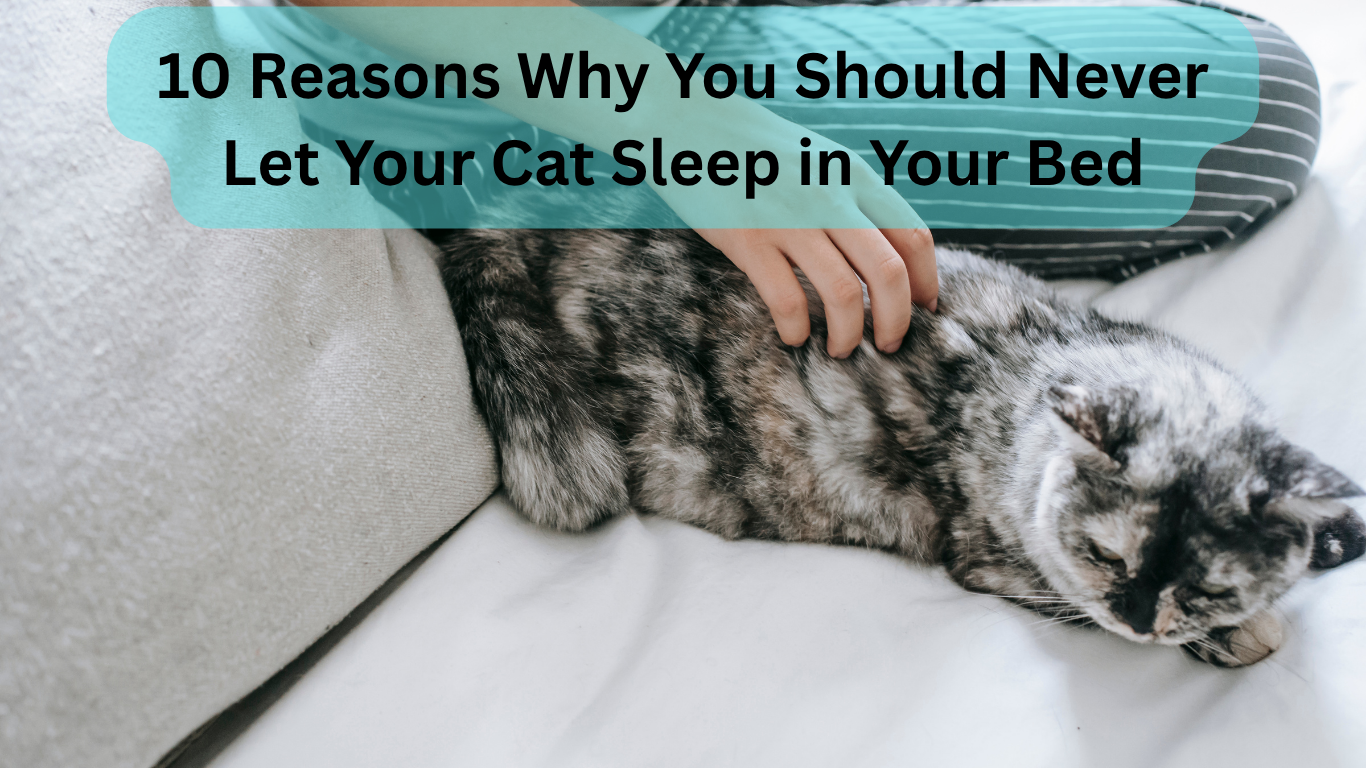
Have you ever found yourself at the edge of your own bed — because a cat has occupied the centre of it with the specific territorial confidence of a creature that considers the sleeping arrangement entirely settled in their favour — and wondered whether the sleep disruption, the fur situation, and the vague concern about hygiene were sufficient grounds for eviction, or whether the specific warmth of a purring cat pressed against your legs was worth all of it? The question of whether to allow cats to sleep in human beds is one of the most reliably debated topics in cat ownership, generating strong opinions from veterinarians, allergists, sleep researchers, and the cats themselves — whose opinion is consistent and not open to negotiation. This blog examines 10 commonly cited reasons not to let your cat sleep in your bed — presenting each with honest engagement and the scientific context that distinguishes genuine concern from overcaution.
Table of Contents
1. Sleep Disruption — The Most Consistently Documented Concern
The concern: Cats are crepuscular and nocturnal animals whose peak activity periods include the hours between approximately 2 AM and 4 AM — which are not the hours most humans have identified as ideal for activity. The cat who shares a bed may wake their owner for feeding demands, play solicitation, grooming activity, position changes, or simply the presence of a small warm creature who has decided that the human’s face is the optimal location for the next three hours.
What the evidence says: Per research by the American Academy of Sleep Medicine and the Mayo Clinic Sleep Disorders Center, a substantial proportion of pet owners report sleep disruption associated with pets sleeping in the bed — with cats specifically associated with the nocturnal activity patterns whose expression during shared sleeping hours produces measurable sleep fragmentation.
Per a Mayo Clinic study on pet sleeping arrangements and sleep quality, approximately 20% of pet owners who share a bed with their pet describe the pet as disruptive to their sleep. However, the same research found that the majority of pet owners report their pets as neutral or positive for sleep quality — including specific reports of improved sleep security, reduced anxiety, and the specific comfort of a warm companion whose presence facilitates sleep onset.
The honest verdict: Sleep disruption is a genuine and legitimate concern, particularly for cats whose nocturnal activity is significant. It is also individual — the cat whose nighttime activity is minimal and whose preferred sleeping position is compatible with their owner’s sleep is a different concern from the cat who treats the sleeping human as an obstacle course and their face as a destination. If your cat is disrupting your sleep, the concern is genuine and the solution is practical.
2. Allergies — A Genuine Medical Concern for Susceptible Individuals
The concern: Cat allergens — primarily the Fel d 1 protein produced in cats’ saliva, skin glands, and anal glands — are among the most common and most potent indoor allergens. Sleeping in close proximity to a cat for eight hours provides sustained, high-concentration allergen exposure whose cumulative effect on allergic individuals is significant.
What the evidence says: Per allergy research, cat allergens are lightweight and sticky — they adhere to surfaces including bedding and remain airborne easily, meaning that the bed shared with a cat accumulates allergen concentrations significantly higher than rooms the cat does not occupy. For individuals with cat allergies, the bedroom and particularly the bed represent the highest-concentration allergen exposure environment in the home.
Per the American College of Allergy, Asthma and Immunology, for people with diagnosed cat allergies, keeping cats out of the bedroom is one of the most consistently recommended environmental control measures — because the reduction of allergen exposure during the eight hours of sleep can meaningfully reduce overall allergen burden even when the cat occupies other areas of the home.
The honest verdict: For people without cat allergies, this concern is genuinely minimal. For people with diagnosed cat allergies who are nevertheless committed to cat ownership, bedroom exclusion is medically relevant advice whose benefit is well-supported. For the majority of cat owners without allergies, the concern does not apply.
3. Zoonotic Disease Transmission — Real Risks in Specific Contexts
The concern: Cats can carry certain pathogens transmissible to humans — including Toxoplasma gondii, Bartonella henselae (the cause of cat scratch disease), ringworm, and in rare cases Pasteurella from bites and scratches — whose transmission risk in the shared sleeping context has generated genuine veterinary and public health concern.
What the evidence says: Per a review published in the CDC’s Emerging Infectious Diseases journal, while the documented cases of zoonotic disease transmission associated specifically with pet sleeping arrangements exist, they are rare in the context of healthy adult humans with indoor cats. The cases most associated with significant risk involve immunocompromised individuals — people undergoing chemotherapy, living with HIV, taking immunosuppressive medications, or with other conditions impairing immune function — for whom the general principle of limiting close contact with pets during high-risk periods applies broadly.
Per veterinary public health research, the routine risk of zoonotic disease transmission from a healthy, indoor, regularly veterinary-cared-for cat to a healthy adult human is genuinely low. The cats most associated with elevated transmission risk are those with outdoor access — who are exposed to wildlife, soil pathogens, and other vectors — and those not receiving regular veterinary care whose parasite and pathogen burden is unmanaged.
The honest verdict: For healthy adults with indoor cats receiving regular veterinary care, the zoonotic risk is genuinely low and should not be the primary driver of sleeping arrangement decisions. For immunocompromised individuals, consultation with their healthcare provider about pet contact is appropriate and the concern is genuine.
4. Parasite Exposure — Fleas, Ticks, and Intestinal Parasites
The concern: Cats with outdoor access or inadequate parasite prevention can carry fleas, ticks, and intestinal parasites — including Toxocara — whose presence in the sleeping environment creates genuine exposure risk for their human bedmates.
What the evidence says: Per veterinary parasitology research, the parasite risk from cats in the sleeping environment is directly related to the quality of the cat’s parasite prevention programme and their access to outdoor environments where parasite exposure occurs. The indoor cat on a comprehensive, veterinarian-recommended flea, tick, and intestinal parasite prevention programme represents a genuinely low parasite transmission risk.
The concern is most legitimate for cats with outdoor access in high-parasite-burden areas, cats with inconsistent or absent parasite prevention, or cats whose grooming and physical condition suggests unmanaged parasite burden. Regular veterinary care, appropriate parasite prevention, and awareness of the cat’s health status address the majority of this concern for most cat owners.
The honest verdict: A parasitologically well-managed indoor cat represents a low parasite risk in the sleeping environment. Outdoor cats or cats with inadequate parasite prevention represent a genuine concern that regular veterinary care directly addresses.
5. Cat Fur and Dander Accumulation in Bedding
The concern: Cats shed fur continuously — some breeds more dramatically than others — and the bedding shared with a cat accumulates fur and dander whose presence represents a hygiene consideration, an allergen consideration, and the specific practical inconvenience of sleeping with cat fur in one’s mouth, nose, and general person.
What the evidence says: This is the most mundane concern on the list and also one of the most practically genuine — cat fur in bedding is both real and manageable through the specific countermeasures of regular bedding washing and grooming of the cat. The fur accumulation concern is not a health concern for non-allergic individuals — it is a practical management concern whose significance depends entirely on the individual’s tolerance for fur in their sleeping environment and their willingness to maintain the laundry and grooming regimens that manage it.
Per practical cat management guidance, washing bedding at high temperatures weekly, maintaining regular cat grooming, and using allergen-reducing mattress and pillow covers are the primary practical tools for managing the fur and dander situation for owners who choose to allow bed sharing.
The honest verdict: Genuine practical concern, minimal health concern for non-allergic individuals, entirely manageable with appropriate hygiene practices.
6. The Cat’s Own Sleep Quality
The concern: The reverse of the sleep disruption concern — the argument that the sleeping human themselves disrupts the cat, whose sleep quality in a shared bed may be compromised by the human’s movements, temperature changes, and the general unpredictability of human sleep behaviour.
What the evidence says: Per feline behaviour research, cats sleep between 12 and 16 hours daily and demonstrate remarkable adaptability in their sleeping arrangements — the cat who chooses to sleep in a human bed has made that choice with full awareness of the environment’s characteristics and presumably finds it acceptable, as evidenced by the choice’s repetition. Cats are capable of sleeping deeply in a wide range of environments and of relocating if the current environment becomes insufficiently restful.
The honest verdict: This concern, while charming in its consideration for the cat’s wellbeing, is probably not the primary reason most people consider evicting their cat from the bed. Cats are generally capable of advocating for their own sleep preferences with considerable effectiveness.
7. Relationship and Partner Considerations
The concern: The cat who shares a bed is sharing a bed with everyone in that bed — including partners whose relationship with the cat, and whose tolerance for the specific spatial arrangements the cat imposes, may differ from the primary owner’s. The cat who inserts themselves between partners, claims the preferred side of the bed, or whose presence is a source of genuine friction between partners represents a legitimate relational consideration.
What the evidence says: Per research on pets and relationship dynamics, disagreements about pet behaviour — including sleeping arrangements — are among the more commonly cited sources of minor relationship friction in couples who differ in their attachment to and tolerance for pets. The practical management of this concern requires the specific combination of honest communication between partners and reasonable mutual accommodation that characterises the management of most cohabitation preferences.
The honest verdict: A genuine consideration for couples with differing views on feline bed-sharing, managed through the specific interpersonal tools of honest communication and mutual respect rather than through categorical rules about cat exclusion.
8. Potential Hygiene Concerns From Outdoor Cats
The concern: The outdoor cat who returns from their external adventures — which may include contact with wildlife, soil, other animals, and the full range of outdoor environmental exposures — and immediately claims their position in the bed represents a specific and legitimate hygiene concern whose significance depends heavily on the nature and extent of the outdoor access.
What the evidence says: Per veterinary hygiene research, the outdoor cat’s environmental exposure profile is genuinely different from that of the indoor cat — they have contact with soil organisms, wildlife, other domestic animals, and the range of pathogens present in the outdoor environment whose mitigation in the indoor sleeping context requires the regular veterinary care, parasite prevention, and vaccination programmes that manage outdoor cats’ specific exposure risks.
The practical management of this concern includes the specific options of excluding outdoor cats from the bedroom after outdoor access, maintaining a strict veterinary care programme that manages the pathogen and parasite risks of outdoor exposure, and the assessment of the specific outdoor environment’s risk profile that informs a proportionate response.
The honest verdict: A more legitimate concern for outdoor cats than indoor cats, manageable through appropriate veterinary care and practical hygiene measures.
9. Children and Immunocompromised Individuals — Specific Vulnerable Groups
The concern: The general risk categories that apply to healthy adults are amplified for specific vulnerable groups — young infants whose immune systems are not yet fully developed, children who may have sleeping behaviours that create specific risks, and immunocompromised individuals whose reduced capacity to manage pathogen exposure makes the lower-risk situations of healthy adults genuinely higher-risk situations for them.
What the evidence says: Per paediatric and immunology guidance, the specific concern for infants is not primarily zoonotic disease but the physical risk of a cat — however gentle — sharing a sleeping space with a very young infant whose ability to manage a cat lying against their face is limited. The recommendation to keep cats out of infants’ sleeping spaces is consistent across paediatric guidance for this physical reason rather than primarily for infectious disease reasons.
For immunocompromised individuals, consultation with their healthcare provider about pet contact — including sleeping arrangements — is appropriate and the provider’s guidance should take precedence over general population advice.
The honest verdict: The infant concern is genuine and consistent with paediatric safety guidance. The immunocompromised concern is genuine and individual — managed through consultation with healthcare providers whose assessment of the specific risk profile informs proportionate guidance.
10. The Practical Case For — What the Research Also Shows
The tenth point in this blog is the honest counterbalance to the preceding nine — the genuine and research-supported case for the benefits of cat bed-sharing that the concern-focused framing of the preceding points incompletely represents.
Per research on human-pet bonding and psychological wellbeing, the benefits of close physical contact with companion animals — including the specific context of sleeping — include reduced stress and anxiety, lower blood pressure, improved mood, the specific comforting quality of the tactile and auditory experience of a purring cat, and the attachment security that the consistent presence of a companion animal provides.
Per survey research on pet sleeping arrangements, the majority of cat owners who share their beds with their cats report the experience as positive — citing the warmth, the comfort, the sense of companionship, and the specific soothing quality of a purring cat as genuine contributors to their sleep quality and psychological wellbeing.
The honest picture of cat bed-sharing is not the one-sided concern narrative that the “reasons not to” framing produces — it is the balanced recognition that genuine concerns exist, that they are mostly manageable through practical measures, and that for healthy adults with healthy indoor cats, the decision to share or not share a bed is a personal preference whose management benefits from honest engagement with the genuine considerations on both sides rather than categorical advice in either direction.
Key Takeaways
The ten considerations examined in this blog — sleep disruption, allergies, zoonotic disease, parasites, fur and dander, the cat’s own sleep, relationship considerations, outdoor cat hygiene, vulnerable group concerns, and the genuine benefits — together represent the honest complexity of a decision that categorical advice consistently oversimplifies.
The honest summary is that for healthy adults with healthy indoor cats receiving regular veterinary care, the genuine risks of cat bed-sharing are genuinely modest and manageable through the practical measures of regular veterinary care, appropriate parasite prevention, regular bedding washing, and honest assessment of whether the cat is actually disrupting sleep. The benefits — warmth, companionship, the specific comfort of a purring cat — are real and personally significant for many cat owners.
For individuals with cat allergies, compromised immune function, very young infants in the household, or specific health conditions whose management is complicated by animal contact, the concerns carry more genuine weight and consultation with healthcare providers is appropriate.
Whether your cat sleeps in your bed is ultimately a personal decision whose best version is made with honest awareness of the genuine considerations on both sides — and with the recognition that the cat, regardless of your decision, has its own views on the subject and the specific combination of persistence and comfort that makes those views difficult to override.