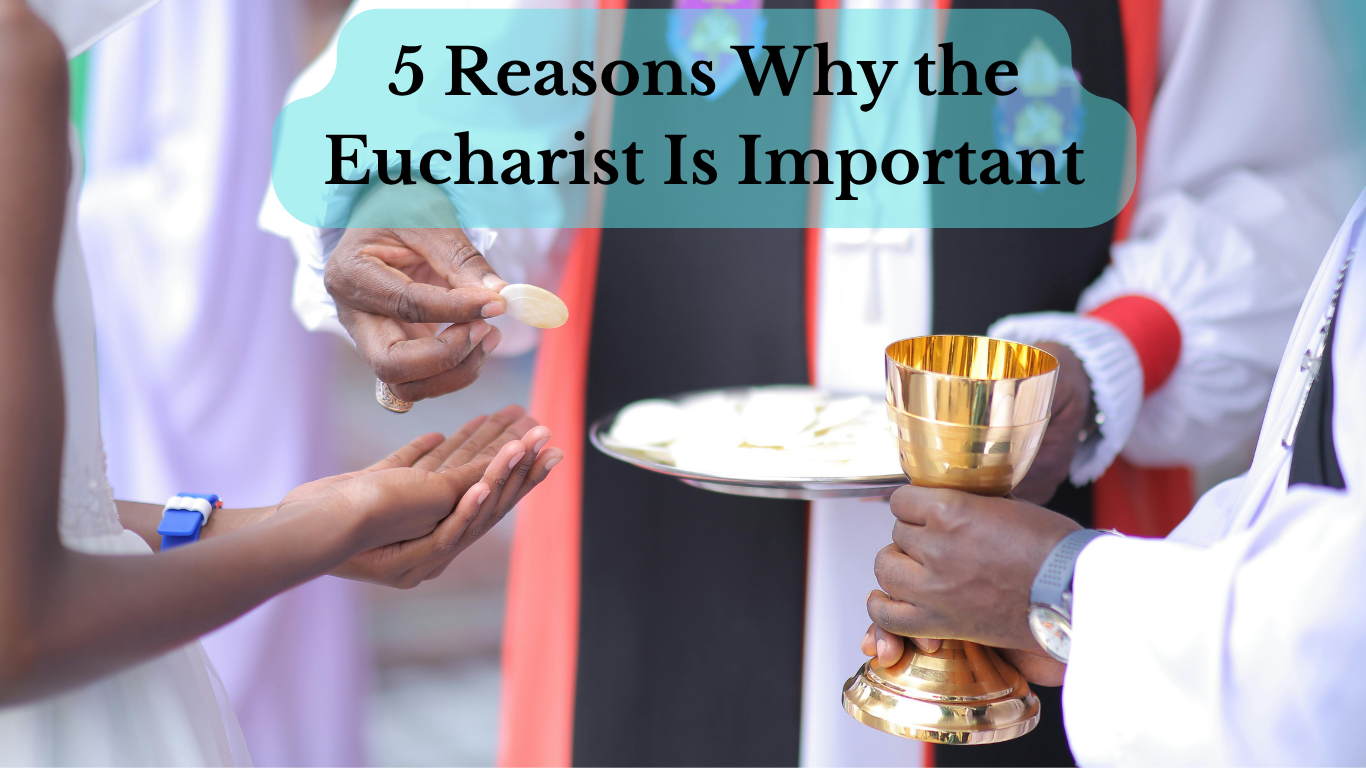
Have you ever stood at the communion rail, or approached the altar, or held in your hands the bread and the cup — and found yourself aware, in the specific way that repetition sometimes paradoxically produces rather than diminishes, that what is happening in this moment is more significant than the ordinary ritual familiarity of its performance suggests? The Eucharist — known across Christian traditions as Holy Communion, the Lord’s Supper, the Mass, the Breaking of Bread, or the Divine Liturgy — is the central act of Christian worship in the majority of the world’s Christian traditions, observed weekly or daily by more than a billion Christians globally and yet carrying a depth and a significance whose exploration rewards far more sustained attention than its familiarity typically receives. This blog examines 5 of the most important reasons why the Eucharist matters — theologically, spiritually, ecclesially, and personally — for the Christian life.
Table of Contents
The Historical Context — What the Eucharist Is and Where It Comes From
Before examining the five reasons, the historical and scriptural foundation of the Eucharist deserves honest establishment — because an act of such central importance to Christian worship is best understood in relation to the specific events that instituted it and the specific words that accompanied its institution.
The Eucharist is rooted in the Last Supper — the final meal Jesus shared with his disciples before his arrest, trial, and crucifixion, described in Matthew 26, Mark 14, and Luke 22, and referenced by Paul in 1 Corinthians 11. At this meal, Jesus took bread, gave thanks, broke it, and gave it to his disciples with the words “This is my body given for you; do this in remembrance of me.” He then took the cup, gave thanks, and gave it to them with the words “This cup is the new covenant in my blood, which is poured out for you.”
These words — “do this in remembrance of me” — constitute the specific institution of a practice that the early church immediately took up and has maintained continuously across every Christian tradition since. The early church “devoted themselves to… the breaking of bread” (Acts 2:42) and gathered on the first day of the week specifically “to break bread” (Acts 20:7) in a pattern of eucharistic worship that predates every subsequent theological development about its meaning.
1. The Eucharist Is the Continuing Proclamation of Christ’s Death and Resurrection
The first and most theologically foundational reason the Eucharist is important is the specific claim made by Paul in 1 Corinthians 11:26 — “For whenever you eat this bread and drink this cup, you proclaim the Lord’s death until he comes.” The Eucharist is not merely a commemoration of a past event. It is an ongoing proclamation whose subject is the central event of the Christian faith and whose continuation until Christ’s return gives it both a historical and an eschatological dimension that makes it irreducibly important.
The proclamation the Eucharist makes is specific and comprehensive. It proclaims the Incarnation — that God became flesh and inhabited a body capable of being broken and blood capable of being poured out. It proclaims the Cross — that this breaking and pouring out happened for a specific saving purpose that the words of institution identify. It proclaims the Resurrection — because the one who gave his body and blood is the one who rose, whose risen life is the life of the one to whose table the church gathers. And it proclaims the Parousia — the return that the “until he comes” anticipates and whose expectation gives the eucharistic gathering its forward-looking, hopeful dimension.
Per the consistent theological reflection of the church across every tradition that takes the Eucharist seriously, the act of receiving the bread and cup is not a passive consumption of religious symbols. It is an active participation in the proclamation of the gospel — the physical enactment, in the body of the receiver, of the same gospel that is declared in preaching, embodied in Christian living, and anticipated in the church’s eschatological hope. Every eucharistic celebration is a proclamation whose congregation is not only the gathered church but also the principalities and powers to whom the church announces that the Lord who was crucified is risen and will return.
2. The Eucharist Is the Means of Genuine Encounter With the Living Christ
The second reason the Eucharist is important — and the one whose specific content is most theologically diverse across Christian traditions — is the specific claim that in the Eucharist, the gathered community encounters the living Christ in a way that is real, personal, and transformative, whose nature is described differently by different traditions but whose reality is affirmed by virtually all of them.
The Catholic and Orthodox traditions affirm the Real Presence of Christ in the eucharistic elements — the bread and wine becoming, through the words of consecration and the work of the Holy Spirit, the body and blood of Christ in a way that is substantially real rather than symbolically representative. The Lutheran tradition affirms a real presence “in, with, and under” the bread and wine — a genuine corporal presence that does not require the philosophical framework of transubstantiation but is no less real for its different articulation. The Reformed tradition, represented most clearly in Calvin’s understanding, affirms a genuine spiritual presence — Christ truly present to faith in the eucharistic action, encountered by the believer whose faith receives what the elements signify and seal. Even the Baptist and free church traditions that most strongly emphasise the memorial character of the Lord’s Supper affirm that it is an occasion of genuine encounter with Christ through the Spirit’s presence in the gathered community.
Per John 6:53-56 — “Very truly I tell you, unless you eat the flesh of the Son of Man and drink his blood, you have no life in you… Whoever eats my flesh and drinks my blood remains in me, and I in them” — the eucharistic language of encounter with Christ has its deepest scriptural roots in Jesus’s own teaching, whose language was offensive enough to cause many disciples to walk away (“This is a hard teaching. Who can accept it?”) John 6:60) and whose seriousness Jesus maintained despite the offence.
Whatever the specific theological framework through which the presence is understood, the consistent testimony of Christians who have received the Eucharist faithfully across decades and centuries is the testimony of genuine encounter — of the specific quality of presence available in this act that is not identical to the presence available in prayer, in Scripture, or in ordinary Christian fellowship, and whose regular reception is one of the most significant formative practices of the Christian life.
3. The Eucharist Constitutes and Nourishes the Body of Christ
The third reason the Eucharist is important is the specific ecclesiological reality it both expresses and produces — its role in constituting, maintaining, and nourishing the community of the church as the body of Christ.
Per 1 Corinthians 10:16-17 — “Is not the cup of thanksgiving for which we give thanks a participation in the blood of Christ? And is not the bread that we break a participation in the body of Christ? Because there is one loaf, we, who are many, are one body, for we all share the one loaf” — the Eucharist has a corporate dimension that is inseparable from its personal one. The one loaf shared by the many is the physical expression and the spiritual reality of the one body constituted by sharing it. The church that gathers at the table is not merely a collection of individuals, each having their own private encounter with Christ — it is a community whose sharing of the one bread is the expression and the creation of its unity in the one body.
Per the theological development of this Pauline theme in patristic theology — most powerfully in Augustine’s observation, “You are the body of Christ and its members.” It is your own mystery that is placed on the Lord’s table” — the Eucharist is simultaneously the church receiving Christ and the church receiving itself — being formed and reformed as the body whose common life the sharing of the one bread both enacts and nourishes.
The ecclesiological importance of this Eucharistic reality is why the deliberate separation from the Eucharistic table — whether through wilful absence from communal worship or through the severing of eucharistic fellowship that schism represents — has been understood in the Christian tradition as a serious matter. The person who absents themselves from the table has not merely missed a spiritual benefit — they have withdrawn from the specific act through which the body is constituted and maintained. The community whose eucharistic life is healthy is a community whose corporate identity as the body of Christ is being regularly enacted, expressed, and renewed.
4. The Eucharist Connects Every Celebration to the Same Table Across Time and Space
The fourth reason the Eucharist is important is the specific quality of temporal and communal connection it provides — the reality that every eucharistic celebration connects the gathering community, across all the differences of time, place, language, and culture, to the same table, the same Lord, and the same community of the church that reaches from the upper room to the present moment and forward to the eschatological feast.
Per the theology of liturgical anamnesis — the specific biblical concept of memorial that is not merely the intellectual recall of a past event but the liturgical making-present of its saving reality — every Eucharist is simultaneously the Last Supper remembered, the Cross proclaimed, the Resurrection celebrated, and the Wedding Supper of the Lamb anticipated. The time structure of the Eucharist is not linear — it collapses the distinctions between past, present, and future in the specific way that the liturgy has always understood to be possible when the eternal intersects with the temporal.
The connection across space is equally significant. The Mass celebrated in a cathedral in Rome, the Lord’s Supper observed in a house church in China, the Divine Liturgy offered in an Orthodox monastery in Greece, and the Communion service conducted in a Baptist chapel in rural Alabama are, despite their profound differences of form, language, and theological understanding, celebrations of the same meal, at the same table, presided over by the same Lord, gathering the same body that spans every time and every place.
Per the eschatological theology of the Eucharist — most clearly expressed in the Didache’s eucharistic prayer, “as this bread was scattered on the mountains and then gathered and became one, so may your church be gathered from the ends of the earth into your kingdom” — the Eucharist is not merely a present-tense act of worship. It is the anticipatory taste of the feast that Jesus promised in Matthew 26:29 — “I tell you, I will not drink from this fruit of the vine from now on until that day when I drink it new with you in my Father’s kingdom” — the specific foretaste of the eschatological banquet whose full arrival the church awaits.
5. The Eucharist Forms the Character of Those Who Receive It Faithfully
The fifth reason the Eucharist is important is the most personally formative — the specific claim that the regular, faithful, attentive reception of the Eucharist over years and decades gradually shapes the character, the values, and the way of being in the world of those who receive it, in ways whose cumulative effect is among the most significant available in the Christian life.
The Eucharist forms the character of its participants in several specific ways that deserve individual attention.
It forms generosity — because the Eucharist, whose central action is the breaking and giving of Christ’s body and the pouring and sharing of his blood, is an act whose repeated reception gradually shapes the receiver toward the same self-giving that the act enacts. Per the consistent pastoral observation of spiritual directors across traditions, the person who receives the Eucharist faithfully over decades is the person whose life increasingly reflects the self-giving pattern of the one whose body they have received.
It forms gratitude — because the Eucharist is, in its most basic Greek meaning, an act of eucharistia — thanksgiving. The gathering for the Lord’s Supper is the gathering whose central disposition is thanks — for the Incarnation, for the Cross, for the Resurrection, for the gift of life, and for the promise of the coming kingdom. The regular orientation of the whole self toward thanksgiving in the eucharistic act is the regular formation of the character whose default orientation toward life is gratitude rather than complaint.
It forms humility — because the Eucharist is the act of receiving rather than achieving. The body and blood are not earned, merited, or deserved. They are given. The repeated reception of what cannot be earned is the repeated formation of the character that knows its own dependence on grace rather than its own self-sufficiency — the character most open to the further grace that the Christian life requires.
It forms community — because the Eucharist is never a solitary act. It is always the gathering of the community around the one table, the sharing of the one loaf, and the reception of the one cup — the specific enacted reality of the one body whose members are formed in their relatedness to each other by the act of sharing. The person whose spiritual formation is primarily solitary is missing the specific formation available only in the shared act of the community at table.
Per the consistent testimony of Christians who have received the Eucharist as the central practice of a long spiritual life, the cumulative formative effect of decades of faithful eucharistic reception is not a matter of the individual elements of any single celebration — it is the slow, steady, barely perceptible formation of the whole person toward the pattern of the one whose body and blood they have repeatedly received. “What you receive, you are becoming” — this is the formative claim of eucharistic theology at its most honest.
Key Takeaways
The five reasons examined in this blog — the Eucharist as a proclamation of Christ’s death and resurrection, as the means of genuine encounter with the living Christ, as the constitution and nourishment of the church as the body of Christ, as the connection of every celebration to the same table across time and space, and as the gradual formation of the character of those who receive it faithfully — together constitute a theology of the Eucharist that is both doctrinally serious and personally significant.
What they share is the consistent refusal to treat the Eucharist as a ritual whose importance is merely symbolic or whose value is exhausted by its immediate emotional effect. The Eucharist is important because what it does — what it proclaims, whom it mediates, what it constitutes, where it connects, and what it forms — is important in ways whose depth and whose continuity across the church’s entire history commends the most sustained, the most attentive, and the most faithful engagement available to those who come to the table.
Per the consistent exhortation of Christian tradition — “Come, for all is now ready” — the table is prepared. The invitation is standing. The reasons to come are real, are deep, and are worth returning to as often as the church gathers to break the bread and share the cup.
Come to the table. Come regularly. Come attentively. Come with the awareness that what is happening here is more significant than familiarity suggests — that the body broken and the blood poured out are given for you specifically, that the one who gave them is present in the giving, and that the receiving of them is among the most important things available to a Christian life.