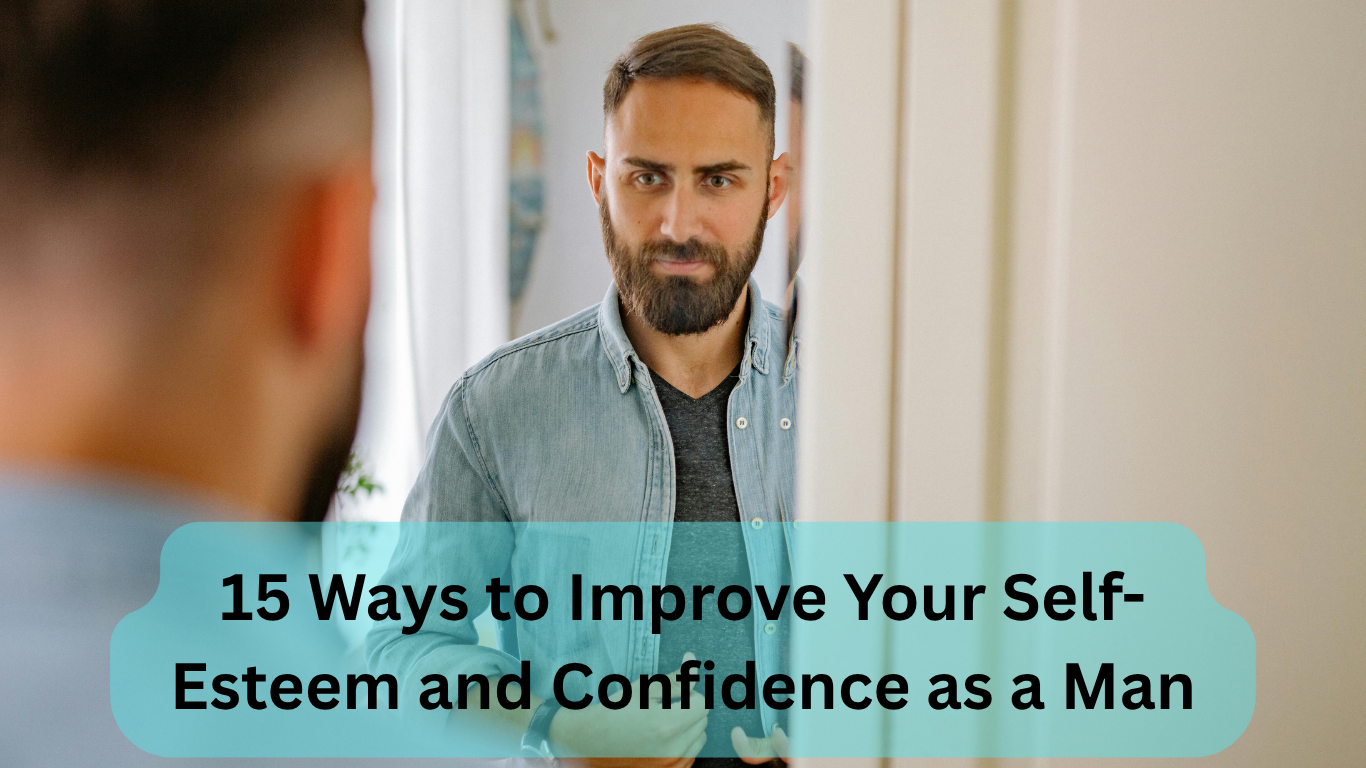
Have you ever noticed that the cultural conversation about male confidence tends to oscillate between two equally unhelpful poles — the aggressive performance of dominance that passes for confidence in some quarters, and the dismissal of male insecurity as a problem too trivial or too politically inconvenient to take seriously? Genuine confidence in men — the kind that is internally grounded rather than externally performed, that makes a man more present and more available rather than more defended and more aggressive — is one of the most valuable things a man can develop, for himself, for the people he loves, and for the communities he inhabits. This blog examines 15 genuine, evidence-informed, and honestly considered ways to improve self-esteem and confidence as a man — not the performed confidence of the highlight reel but the real kind, built on substance rather than image.
Table of Contents
What Genuine Confidence Actually Is
Before examining the fifteen ways, it is worth establishing what genuine confidence is — because the popular conflation of confidence with dominance, certainty, and the absence of self-doubt has produced a model of male confidence that is both psychologically inaccurate and practically harmful.
Genuine confidence is not the absence of self-doubt — it is the ability to act meaningfully despite it. It is not the performance of certainty — it is the settled sense of one’s own value that does not require external validation to remain intact. It is not dominance over others—it is competence in one’s own domain and security enough in one’s own identity to genuinely support others without feeling threatened by their success.
Per psychological research on self-esteem and confidence, the most durable and most functional form of self-esteem is what researchers call contingency-free self-esteem — a sense of one’s own worth that is not dependent on specific performance outcomes, social comparisons, or external approval. This form of self-esteem is associated with psychological resilience, genuine humility, and the capacity for genuine relationships — the opposite of the brittle, defensive pseudo-confidence that requires constant external proof to maintain.
1. Build Competence in Things That Matter to You
The most direct and most reliably effective way to build genuine confidence is the development of genuine competence — the deliberate investment of time, effort, and practice in skills, knowledge, and capabilities that actually matter to you and the earned self-assurance that comes from knowing you can do something well.
Confidence built on competence has a specific quality that confidence built on affirmation or performance does not — it is grounded in reality. The man who knows he can do something because he has done it, who has the skill because he has practised it, who has the knowledge because he has studied and applied it, has a confidence in that domain that cannot be taken away by someone’s opinion of him. The confidence is real because the competence is real.
Per research on self-efficacy — psychologist Albert Bandura’s concept of the belief in one’s own capability to accomplish specific tasks — the most powerful source of self-efficacy is mastery experience — the direct experience of having accomplished something through one’s own effort. No amount of positive affirmation or motivational content produces the specific quality of confidence that actual achievement generates.
The practical application is direct — identify the domains in which you want to feel more confident, and invest genuinely in developing real capability in them. Not the performance of capability. Not the appearance of knowledge. Actual, tested, practised competence whose possession you can verify independently of others’ opinions.
2. Invest in Your Physical Health and Strength
The second way to improve self-esteem and confidence as a man is the systematic investment in physical health — exercise, nutrition, sleep, and the physical capability development that produces the specific kind of embodied confidence that good physical health generates.
The relationship between physical health and confidence operates through multiple pathways. The most direct is biochemical — regular exercise increases testosterone, reduces cortisol, increases serotonin and dopamine, and produces the neurobiological conditions that are associated with positive mood, reduced anxiety, and increased energy. These neurobiological effects are not trivial or incidental — they directly affect the emotional and cognitive experience of confidence in ways that are measurable and significant.
The second pathway is the specific confidence of physical capability — the knowledge that one’s body is functional, capable, and reliable, which produces a form of physical self-assurance whose absence is particularly undermining of confidence in men whose sense of competence has historically included physical capability. The man who exercises regularly, who has developed some level of physical strength or endurance, and who maintains a healthy weight and adequate sleep inhabits his body differently from the man who does not — with less physical anxiety, less self-consciousness, and more of the ease of occupying a body that is being reasonably well maintained.
The third pathway is discipline — the experience of showing up for physical training consistently and of keeping the commitments to oneself that a regular exercise practice requires produces a form of self-respect that directly supports self-esteem. Per research on habit formation and self-regulation, the experience of successfully maintaining a discipline – particularly a physical one whose results are visible and whose demands are real – is one of the most reliable builders of the general self-efficacy that underpins broader confidence.
3. Address the Stories You Tell Yourself About Who You Are
The third way to improve self-esteem and confidence is the deliberate examination and revision of the internal narratives — the stories about who you are, what you are capable of, and what you deserve — that either support or undermine the confidence you are capable of developing.
Every person carries a narrative about themselves – an implicit set of claims about their own worth, capability, and deservingness – whose content was mostly written in childhood and adolescence by the experiences, relationships, and messages of those formative years. For many men, these narratives contain specific undermining messages — “You’re not smart enough,” “You don’t measure up,” and “Men like you don’t get that” — that were absorbed as truths during periods when critical assessment was impossible and that continue to operate as truths in adult consciousness long after their original sources have lost relevance.
Per cognitive behavioural therapy research on self-esteem, the identification and examination of these core beliefs — the specific narrative claims about the self that drive self-undermining behaviour — are one of the most effective therapeutic interventions available for genuine self-esteem improvement. The process involves identifying the specific narrative claim, examining the evidence for and against it with the honest rigour one would apply to any factual claim, and replacing it with a more accurate and more enabling narrative that the evidence actually supports.
The internal narrative work is not positive thinking in the sense of affirmation without basis. It is an honest examination of whether the story you have been telling yourself is actually true — and the discovery, in most cases, that the limiting narratives were written by people who were themselves limited, in circumstances that are no longer the circumstances of your life.
4. Build and Maintain Genuine Friendships
The fourth way to improve self-esteem and confidence is the deliberate cultivation of genuine male friendship — the kind of relationships with other men that go beyond surface-level interaction into the honest, mutually supportive, genuinely knowing quality of connection whose absence in men’s lives has been extensively documented as a significant contributor to male mental health challenges.
Per research on male social connection and wellbeing, men who maintain close friendships — relationships involving genuine emotional disclosure, mutual support, and the experience of being genuinely known and accepted — demonstrate consistently higher self-esteem, greater psychological resilience, and lower rates of depression and anxiety than those without equivalent connections. The friendship gap in men’s lives – the tendency to maintain acquaintances rather than friendships, activity partners rather than genuine intimates – is a documented and significant contributor to male confidence and self-esteem deficits.
Genuine friendship supports confidence through the specific experience of being genuinely known and accepted — of having a person or persons in your life who know your failures, your fears, and your limitations and whose acceptance of you is not contingent on your performance or your image. This experience of unconditional acceptance, even in its human and imperfect form, is one of the most powerful sources of the security that genuine confidence requires.
The development of genuine male friendship in contemporary culture is harder than it should be — the absence of structural contexts for friendship formation, the social conditioning against male emotional disclosure, and the time demands of adult life all work against it. But the investment required is worth making — and the most direct route is simply the willingness to initiate genuine conversation, to be honest about your own experience, and to create the conditions in which another man’s honesty is welcomed rather than deflected.
5. Do the Things You Are Afraid Of — Systematically
The fifth way to improve confidence is the deliberate, systematic engagement with the specific things that fear is preventing you from doing — the approach towards rather than away from the situations that most challenge your confidence, whose avoidance maintains the fear and whose engagement diminishes it.
Per research on anxiety, avoidance, and confidence, the relationship between fear and avoidance creates a specific self-maintaining cycle. The avoided situation is perceived as threatening — avoidance provides temporary relief from anxiety — but avoidance also prevents the experience of successful navigation that would demonstrate that the feared situation is manageable. The avoidance maintains the anxiety and prevents the competence-building experience that would resolve it.
The systematic engagement with feared situations — the therapeutic approach called exposure — is the most effective available intervention for reducing anxiety and building confidence in the specific domains where avoidance has maintained fear. For confidence development this means the deliberate, progressive approach toward the specific situations that fear most reliably prevents the public speaking being avoided, the difficult conversation deferred, and the new skill not started because failure seemed likely.
The key word is ‘systematic’ — the approach that builds confidence is not the single courageous leap but the consistent, progressive engagement with manageable versions of the feared situation, building competence and evidence of survivability with each engagement, gradually expanding the range of situations that can be navigated with confidence. Each time you do the thing you were afraid to do and discover that the feared outcome either did not materialise or was survivable, the confidence available for the next engagement increases.
6. Develop Financial Competence and Stability
The sixth way to improve self-esteem and confidence as a man is the development of genuine financial competence — the ability to manage money effectively, to understand your financial situation honestly, to make deliberate financial decisions, and to build the financial stability whose absence is one of the most consistent and most practically significant sources of male anxiety and diminished confidence.
Financial anxiety is among the most common and most practically impactful contributors to male self-esteem challenges — not because money determines worth, but because financial instability creates a continuous background anxiety whose drain on cognitive and emotional resources is substantial and whose resolution is genuinely empowering. The man who understands his financial situation clearly, who has a deliberate approach to managing it, and who is building toward the stability that financial security represents has removed a significant source of anxiety from his life and replaced it with a genuine competence whose possession is itself confidence-building.
Per research on financial literacy and wellbeing, the most significant determinant of financial confidence is not wealth level but financial knowledge — the understanding of basic financial principles, the ability to read and manage a budget, and the capacity to make informed financial decisions. These competencies are learnable, and their development produces the specific confidence of knowing one’s own situation clearly and acting on it deliberately.
7. Cultivate Genuine Integrity — Close the Gap Between Values and Behaviour
The seventh way to improve self-esteem is the cultivation of genuine integrity — the alignment between stated values and actual behaviour that is the foundation of self-respect and whose absence is one of the most consistent and most quietly devastating sources of genuine self-esteem damage.
Self-respect is not primarily a feeling — it is an assessment. The assessment of whether one’s own conduct is deserving of respect. The man whose behaviour is consistently aligned with his stated values — who does what he says he will do, who treats people the way he believes they should be treated, who makes the choices he knows to be right even when they are costly — has grounds for genuine self-respect that do not depend on external validation. The man whose behaviour consistently departs from his values — who knows he is not doing what he believes he should — carries a self-assessment that undermines confidence regardless of how his external circumstances appear.
Per research on values-behaviour alignment and self-esteem, integrity is one of the most direct determinants of genuine self-respect — more powerful in its effects than achievement, appearance, or social status. The practical implication is that genuine confidence improvement requires honest examination of the specific gaps between stated values and actual behaviour — and the commitment to closing those gaps through the specific changes that closing them requires.
8. Learn to Set and Maintain Healthy Boundaries
The eighth way to improve self-esteem and confidence is the development of the skill of setting and maintaining healthy boundaries — the ability to clearly communicate what is acceptable and what is not, to hold those boundaries consistently in the face of pressure, and to maintain them as expressions of self-respect rather than aggression or defensiveness.
The relationship between boundaries and self-esteem is direct and well-documented in psychological research — men who cannot maintain appropriate boundaries in their relationships, professional contexts, and social interactions consistently report lower self-esteem and higher anxiety than those who can. The inability to set boundaries is usually rooted in the same fear of rejection and need for approval that undermines confidence more broadly — the reluctance to risk the other person’s displeasure by asserting one’s own needs and limits.
The development of boundary-setting competency begins with clarity — knowing what your boundaries actually are, what your limits and needs genuinely require, and what you are and are not willing to accept. It continues with communication — the ability to express those boundaries clearly, calmly, and specifically, without aggression or apology. And it is completed by consistency — the willingness to hold the boundary when it is tested, which is the moment that demonstrates whether the boundary is real or merely aspirational.
Per research on assertiveness and confidence, the regular practice of appropriate assertiveness — asking for what you need, declining what you are unwilling to accept, communicating your position clearly — produces measurable improvements in self-esteem and reduces the anxiety that the avoidance of these situations maintains.
9. Invest in Your Intellectual Development
The ninth way to improve self-esteem and confidence is the sustained investment in intellectual development — the deliberate cultivation of knowledge, curiosity, and the specific intellectual confidence that comes from knowing things well and thinking clearly.
Intellectual confidence — the ability to engage with ideas, to form and defend positions, to learn from disagreement, and to acknowledge the limits of one’s knowledge with equanimity — is a specific and valuable dimension of overall confidence whose development requires deliberate investment. The man who reads widely, who thinks carefully about the ideas he encounters, who pursues genuine understanding rather than merely confirming his existing positions, has developed an intellectual security that is recognisable and genuinely attractive — the ease of someone who is interested rather than defensive, curious rather than anxious.
The practical investment involves reading substantive, challenging reading across disciplines that expands the range of what you know and how you think. It involves engaging with ideas that challenge your existing positions — the intellectual discomfort of genuine intellectual challenge is the specific friction from which intellectual confidence is developed. And it involves the discipline of forming and expressing your own considered positions on the things you have thought about — not the performance of confidence but the genuine expression of considered thought.
10. Practise Genuine Presence — Be Fully Where You Are
The tenth way to improve confidence is the development of genuine presence — the ability to be fully attentive, engaged, and available in the specific moment and context you are in, rather than distracted, self-monitoring, and mentally elsewhere.
Confident men are present men. The specific quality of attention and engagement that genuine presence produces — the ability to listen fully, to respond genuinely, to be affected by what is actually happening rather than managing the impression it is producing — is one of the most consistently attractive and confidence-communicating qualities available in social and professional contexts. People feel valued by genuine attention, and the man who can offer it without self-consciousness has something genuinely rare.
Per research on mindfulness and confidence, the practice of mindful presence — the deliberate cultivation of full attention to the present moment — reduces the self-monitoring and social anxiety that undermine confidence in social contexts. The man who is anxiously monitoring how he is perceived, comparing himself to others, and managing his performance is by definition not fully present — and his divided attention is visible to those he is with.
The development of genuine presence begins with the reduction of distraction — the phone that fragments attention, the self-focused internal commentary that substitutes for genuine engagement — and the deliberate choice to attend fully to the person, the conversation, and the moment that is actually present.
11. Seek Mentorship and Learn From Those Further Along
The eleventh way to improve self-esteem and confidence is the deliberate seeking of mentorship – the relationship with men who are further along in the specific domains where you are developing, whose experience, perspective, and willingness to invest in your growth provide resources that self-directed development alone cannot offer.
Mentorship accelerates confidence development because it provides the specific combination of honest feedback, genuine belief, and experienced guidance that is rarely available in ordinary social relationships. The mentor who has navigated the specific challenges you are facing, who can see both where you are and where you could be, and who is willing to invest genuinely in the gap between those two points provides a form of support whose value is difficult to overstate.
The specific confidence boost of genuine mentorship comes from being genuinely believed in by someone whose judgement you respect — the experience of being seen clearly, including your limitations, and believed in anyway by someone who has the experience to make that belief meaningful. This is qualitatively different from generic encouragement — it is specific, informed, and grounded in genuine assessment rather than social warmth.
12. Manage Your Relationship With Comparison and Social Media
The twelfth way to improve self-esteem and confidence is the deliberate management of the comparison dynamics that social media has made uniquely prevalent and uniquely damaging — the recognition that the curated, filtered, highlight-reel reality that social media presents is not a valid standard against which to measure your own life, and the development of the habits that protect your self-esteem from its distorting effects.
Per research on social comparison and self-esteem, upward social comparison — comparing oneself to those who appear to be doing better — is one of the most consistent predictors of reduced self-esteem, and social media has created a comparison environment of unprecedented intensity by making the curated highlights of thousands of lives continuously visible. The man who spends significant time on social media consuming images of other men’s achievements, physical appearance, relationships, and experiences is subjecting his self-esteem to a comparison pressure whose standard is systematically inflated beyond any realistic benchmark.
The management of this comparison dynamic involves both the reduction of social media consumption that produces the most damaging comparison — particularly accounts and content specifically designed to produce inadequacy — and the development of the internal orientation that makes comparison less determinative of self-assessment. Per research on self-determination theory, the development of intrinsic rather than social standards for self-evaluation — measuring success against one’s own goals and values rather than against others’ apparent achievements — is among the most effective protective factors against comparison-driven self-esteem damage.
13. Accept Failure and Imperfection as Necessary Components of Growth
The thirteenth way to improve self-esteem and confidence is the development of a healthy relationship with failure and imperfection — the ability to experience failure as information rather than a verdict, as a necessary component of the growth process rather than evidence of fundamental inadequacy.
The relationship between failure and confidence is paradoxical in a way that most men’s formation has not prepared them for — genuine confidence is built partly through failure because the experience of failing, surviving, learning, and continuing is what demonstrates that failure is survivable and that the self is not destroyed by it. The man who has never allowed himself to genuinely fail has never discovered that he can survive failure — and his confidence is therefore a brittle, defensive protection against the risk of discovering what he does not yet know he can endure.
Per research on growth mindset — Carol Dweck’s extensively replicated framework on the relationship between beliefs about ability and achievement — individuals who understand their capabilities as developable through effort and learning approach failure fundamentally differently from those who understand capabilities as fixed. The growth mindset individual experiences failure as information about what needs more development — a signal to adjust the approach rather than evidence of fixed inadequacy. This orientation both produces better outcomes and generates more durable confidence.
The practical development of this orientation involves deliberately engaging with challenges whose difficulty makes failure likely; practising the specific cognitive reframe that interprets failure as learning rather than a verdict; and building the specific evidence from experience that failure is survivable and its lessons are genuinely available.
14. Develop Emotional Intelligence and the Ability to Express Emotions Honestly
The fourteenth way to improve self-esteem and confidence as a man is the development of emotional intelligence — the ability to identify, understand, regulate, and appropriately express emotions — whose cultivation directly supports the confidence and self-esteem that emotional repression and emotional illiteracy undermine.
The relationship between emotional intelligence and male confidence is direct and well-documented — men who have developed genuine emotional literacy, who can identify what they are feeling with accuracy, who can regulate emotional responses without either suppressing or being overwhelmed by them, and who can express emotional content appropriately in relationships demonstrate consistently higher self-esteem and more durable confidence than those who have not developed these capacities.
The cultural conditioning that discourages male emotional expression and development produces the specific confidence-undermining dynamics of emotional repression – the background anxiety of unexpressed emotional content, the relational limitations of inability to express genuine feeling, and the self-alienation of disconnection from one’s own interior life. The development of emotional intelligence addresses these limitations directly.
Per research on emotion regulation and psychological wellbeing, the ability to acknowledge and process difficult emotions — rather than suppressing or avoiding them — is one of the most powerful predictors of psychological resilience and self-esteem. The man who can sit with difficulty, acknowledge it honestly, and process it without being destroyed by it has developed one of the most important confidence-supporting capacities available.
15. Invest in Your Purpose — Know What You Are Living For
The fifteenth and most comprehensive way to improve self-esteem and confidence is the development of a clear and genuine sense of purpose — the cultivation of the conviction that your life has direction, that what you are doing matters, and that the specific contribution you are making to the world is genuinely valuable.
Purpose is the deepest foundation of a confident identity — deeper than achievement, deeper than physical capability, deeper than social approval. The man who knows what he is living for — who has identified the specific values, commitments, and contributions that give his life its meaning — has a foundation for confidence that external circumstances cannot easily undermine. The loss of a job, a relationship failure, a physical decline — none of these remove the sense of purpose that is grounded in something more than circumstantial success.
Per research on purpose and wellbeing by researchers including Michael Steger, the sense of life meaning and purpose is one of the strongest predictors of psychological resilience, self-esteem, and the specific quality of engaged, vital living that confident people demonstrate. The development of purpose is not a single discovery but an ongoing clarification — a progressive refinement of understanding about what matters most, what one’s specific contribution is, and how the specific circumstances and capabilities of one’s particular life are most fully expressed in service of what is genuinely worth living for.
Key Takeaways
The fifteen ways examined in this blog — building genuine competence, investing in physical health, revising limiting narratives, cultivating genuine friendship, doing what you fear, developing financial competence, closing the values-behaviour gap, setting healthy boundaries, investing in intellectual development, practising genuine presence, seeking mentorship, managing comparison, embracing failure as growth, developing emotional intelligence, and investing in purpose — are not fifteen separate techniques for confidence improvement.
They are fifteen dimensions of the same integrated project — the development of a man who is genuinely, substantively, and durably confident because he is genuinely, substantively, and durably worth being confident in. Not performing confidently. Not protecting against the discovery of inadequacy. But building, through deliberate investment across multiple dimensions of genuine development, the kind of man whose confidence is simply the accurate recognition of who he has become.
Per the consistent finding of psychological research on self-esteem and confidence, the most durable and most functional confidence is not built by thinking better about yourself before you have given yourself better reasons to think well of yourself. It is built by doing the things — the hard, specific, consistently practised things — that genuinely develop the character, the competence, and the integrity that genuine self-respect requires.
Begin with one. The most important one for where you currently are. Do it consistently. Build from there. The confidence you develop through genuine investment in your own development is the only kind that holds in the moments when it is most needed and when the external validations that substitute for it are most conspicuously absent.