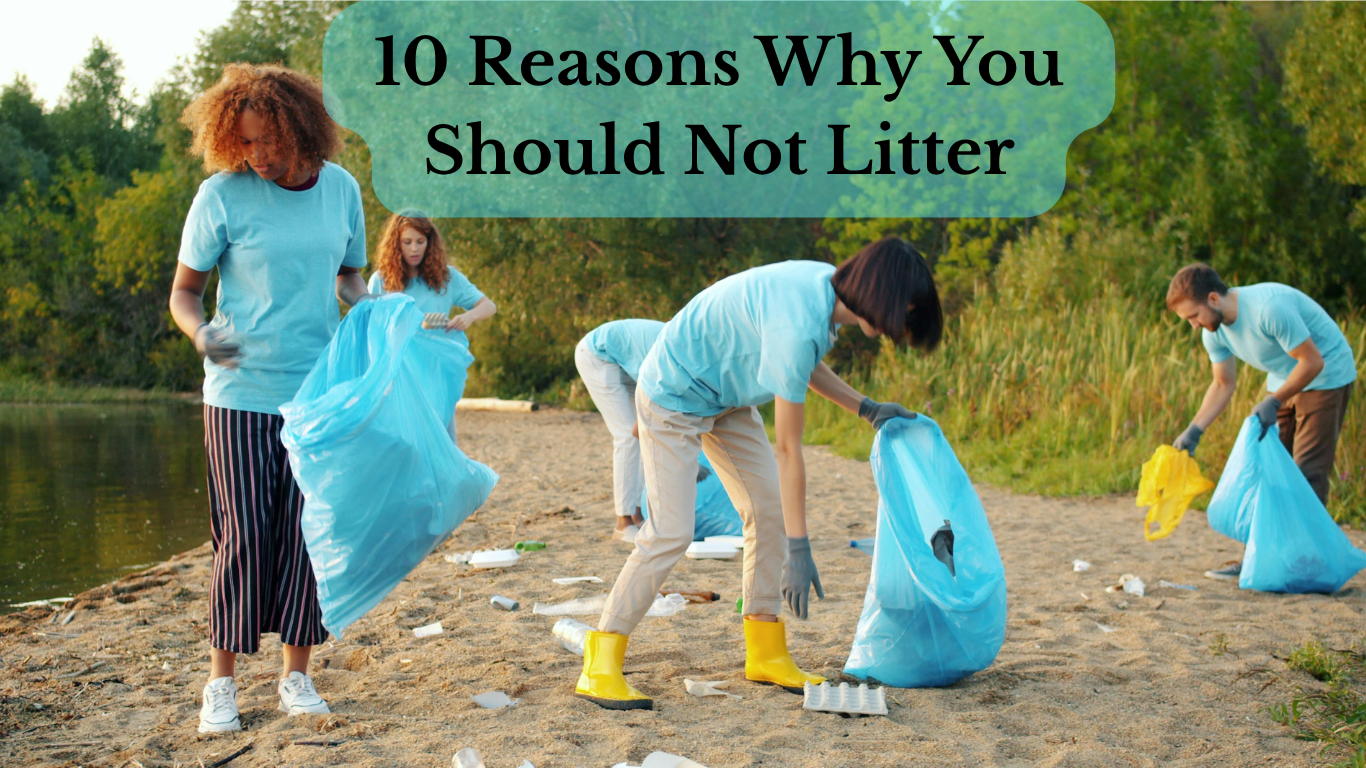
Have you ever walked through a park, along a beach, or down a street that was genuinely beautiful except for the specific, avoidable degradation of discarded rubbish — the plastic bottle in the hedgerow, the fast food packaging in the stream, the cigarette ends scattered across what should have been a pleasant public space — and felt the specific combination of aesthetic disappointment and mild moral frustration that litter consistently produces in people who notice it? Littering is one of the most universally condemned and most persistently practised behaviours in human public life — condemned because its consequences are genuinely real and genuinely harmful, practised because the specific friction of finding a bin is, in the moment, apparently sufficient to override the understanding of those consequences. This blog examines 10 genuine, evidence-informed reasons why littering is harmful — covering the environmental, ecological, economic, public health, and social dimensions of a behaviour whose costs significantly exceed what any convenience justification can support.
Table of Contents
1. Litter Causes Serious and Lasting Harm to Wildlife
The first and most visually striking reason not to litter is the specific, documented, and genuinely serious harm that discarded waste causes to wildlife — whose interactions with human litter produce outcomes ranging from injury to entanglement to death.
Per wildlife research and environmental conservation data, the specific mechanisms through which litter harms wildlife are numerous and well-documented. Marine and freshwater animals ingest plastic waste — mistaking it for food or consuming it inadvertently while feeding — with specific and serious consequences, including intestinal blockage; starvation despite full stomachs; and the accumulation of toxic chemicals in body tissues. Sea turtles mistake floating plastic bags for jellyfish — one of their primary food sources — with frequently fatal consequences. Seabirds feed plastic fragments to their chicks, whose starvation, despite full stomachs, is documented in studies of albatross populations on remote Pacific islands whose entire diet is supplemented with plastic carried thousands of miles by their parents.
Entanglement in discarded fishing line, plastic packaging rings, and other flexible waste kills or injures hundreds of thousands of marine animals annually — including seals, dolphins, sea turtles, and seabirds whose freedom of movement, ability to breathe, and survival are directly compromised by entanglement in waste whose origin was a human decision not to dispose of it properly.
Per research on terrestrial wildlife and litter, land animals, including hedgehogs, foxes, and small mammals, regularly become trapped in discarded food containers and packaging whose access they sought for food remnants and from which they cannot extract themselves. The hedgehog that enters a discarded fast food cup in search of food and becomes trapped is a specific, documented consequence of a specific, avoidable decision.
The honest acknowledgement is that the wildlife harm of litter is not abstract or statistical — it is specific, physical, and individually experienced by specific animals whose suffering is a direct and foreseeable consequence of the choice to discard waste in the environment rather than in appropriate receptacles.
2. Plastic Litter Contributes to the Microplastic Crisis
The second reason not to litter is the specific contribution of discarded plastic waste to the microplastic contamination of the environment — whose scale, persistence, and long-term consequences represent one of the most significant emerging environmental concerns of the contemporary period.
Per environmental research on plastic degradation and microplastic formation, plastic waste that enters the environment does not biodegrade in the way that organic waste does — it breaks down through photodegradation and mechanical fragmentation into progressively smaller particles whose ultimate form is microplastics — particles smaller than 5 millimetres — and nanoplastics — particles smaller than 1 micrometre — that persist in the environment indefinitely.
Microplastics have been documented in virtually every environmental compartment that researchers have examined — ocean surface waters, deep ocean sediments, freshwater rivers and lakes, soil, polar ice, mountain air, and the bodies of animals, including fish, birds, marine mammals, and most recently humans. Per research on microplastic contamination in human tissues, microplastics have been identified in human blood, lungs, placentas, and breast milk — with the long-term health implications of this tissue accumulation currently under active research whose findings are not yet fully established but whose initial direction warrants genuine concern.
The specific contribution of individual littering decisions to the aggregate microplastic crisis is the connection between the plastic wrapper discarded on a pavement and its eventual fragmentation into the microplastic particles that enter watercourses, ocean food chains, and ultimately the bodies of wildlife and people. The individual piece of litter is the starting point of a degradation pathway whose endpoint is the diffuse, persistent, essentially irremovable contamination of the global environment.
3. Litter Pollutes Waterways and Threatens Water Quality
The third reason not to litter is the specific pathway from discarded land-based waste to waterway contamination — the well-documented process through which litter that enters the environment progressively migrates to streams, rivers, and ultimately oceans, contributing to the water pollution that affects both ecological health and human water resource availability.
Per environmental hydrology research on litter transport, discarded waste on pavements, in parks, and in public spaces is transported by rainfall, wind, and surface runoff into storm drains, gutters, and watercourses — a process whose efficiency means that a significant proportion of land-based litter eventually reaches watercourses regardless of whether it was discarded near a water body. The storm drain system that manages surface water runoff in most urban areas connects directly to local watercourses – and it is not a filter; it is a conduit.
Per research on river plastic pollution, rivers serve as the primary transport mechanism for plastic waste from land to ocean — a journey that carries not only the plastic itself but also the chemicals it has absorbed and the biological contaminants it has accumulated into marine ecosystems whose food chains distribute these contaminants through the full range of marine life.
The specific water quality implications extend to human water resources — per research on microplastic contamination in drinking water sources, watercourses that serve as raw water sources for drinking water treatment contain measurable microplastic concentrations whose complete removal by conventional water treatment processes is not guaranteed. The litter that enters a catchment watercourse is potentially entering the water treatment pathway for a downstream community’s drinking water supply.
4. Litter Is a Significant Economic Burden on Public Resources
The fourth reason not to litter is the specific and substantial economic cost of litter collection and management — whose burden falls on public resources, ultimately representing a tax on every member of the community that could be entirely avoided if litter were disposed of properly in the first place.
Per research on litter management costs in the United States, the annual cost of litter cleanup is estimated at approximately $11.5 billion — a figure that includes the direct costs of municipal street cleaning, park maintenance, roadside litter collection, and the management of the infrastructure, storm drain clearing, and waterway cleanup made necessary by litter entering environmental systems. In the United Kingdom, local authorities spend approximately £1 billion annually on street cleaning, whose largest component is litter management.
These costs are not abstract — they represent the specific allocation of public resources to the management of a problem that would not exist if the specific decisions that created it had been made differently. The funds spent on litter collection are funds not spent on education, healthcare, infrastructure improvement, or any of the other public investments that communities require. The economic argument against littering is the argument that avoidable choices with real costs should be made differently — not because the cost to any individual is significant but because the aggregate cost to the community is genuinely substantial.
Per economic research on litter and property values, the presence of litter in residential and commercial areas is associated with measurably reduced property values — the litter that degrades the visual environment of a neighbourhood reduces the economic value of every property in it in a way that imposes a direct financial cost on property owners who made no decision to create the litter whose consequences they bear.
5. Litter Creates Specific Public Health Risks
The fifth reason not to litter is the specific public health risks associated with certain categories of discarded waste, whose presence in public spaces creates direct health hazards for people who encounter them.
Per public health research on litter and health risk, the specific categories of litter whose public health implications are most significant include discarded sharp objects — broken glass, hypodermic needles, and other sharps whose accidental contact produces injury and infection risk, particularly for children who play in areas where this waste has been discarded. Per NHS and CDC guidance on sharps disposal, discarded needles represent a specific bloodborne pathogen transmission risk — including Hepatitis B, Hepatitis C, and HIV — whose management requires the specific disposal infrastructure that discarding in public spaces circumvents.
Food waste litter — discarded packaging with food residue, discarded food items, and organic waste — attracts vermin including rats and mice whose presence in residential and commercial areas creates specific disease transmission risks. Per research on urban rat populations and food waste availability, the food availability created by litter is a primary driver of urban rodent population density, whose public health implications include the specific diseases associated with rodent contact and contamination of food supplies.
Standing water in discarded containers — bottles, cups, and other receptacles that collect rainwater — creates breeding habitat for mosquitoes whose public health implications include the transmission of mosquito-borne diseases that are geographically expanding as climate change alters the range of disease-carrying mosquito species.
6. Litter Damages Biodiversity and Ecosystem Function
The sixth reason not to litter is the broader ecological damage that litter causes to biodiversity and ecosystem function — beyond the direct harm to individual animals described above.
Per ecological research on litter and habitat quality, the accumulation of litter in natural and semi-natural habitats degrades habitat quality for the full range of species that inhabit them – through the physical alteration of habitat structure by large waste items; the chemical contamination of soil and water by leaching waste; the introduction of invasive species carried on contaminated waste; and the smothering of soil surface communities – invertebrates, mosses, fungi – by accumulated waste that prevents light and moisture penetration.
Per research on plastic contamination and soil ecosystems, microplastics in agricultural and natural soils alter the physical and chemical properties of soil in ways that affect soil invertebrate communities, reduce the water-holding capacity of soil, and interfere with the microbial communities whose function is essential to nutrient cycling and soil fertility. The agricultural implications of this contamination — whose long-term effects on crop productivity are under active investigation — represent a food security dimension of plastic litter pollution that extends far beyond its immediate aesthetic impacts.
Per conservation research on the relationship between litter and biodiversity, areas with high litter burdens consistently demonstrate reduced biodiversity compared to equivalent areas with low litter burdens—reflecting the cumulative ecological effect of habitat degradation, chemical contamination, and the physical disturbance associated with littered environments.
7. Litter Degrades the Quality of Public Spaces and Community Wellbeing
The seventh reason not to litter is the specific and documented effect of litter on the quality of public spaces — and through that degradation, on the wellbeing, mental health, and sense of community of the people who inhabit those spaces.
Per research on the psychology of environment and wellbeing, the quality of the physical environment — including its cleanliness and freedom from litter — is a consistent and significant predictor of reported wellbeing in urban and rural populations. The environments that people describe as restorative — the parks, the green spaces, the public spaces where genuine relaxation and mental refreshment are possible — are environments that are clean, well-maintained, and free of the visual pollution of litter. The environments that produce stress, discomfort, and the specific psychological effect of “environmental load” — the mental effort of processing a degraded environment — are consistently the littered ones.
Per research on the broken windows theory and urban environment, the presence of litter and environmental degradation in public spaces is associated with reduced social trust, increased perceived crime risk, reduced civic participation, and the progressive normalisation of further environmental degradation – whose cumulative social effect is the erosion of the specific quality of public space that makes urban life genuinely liveable.
The specific community dimension is the shared ownership of public space – whose degradation by littering is the specific imposition of one person’s convenience on the collective experience of everyone who uses that space. The park visitor who litters is making a decision that imposes its consequences on every subsequent visitor, who had no role in the decision whose outcomes they inherit.
8. Litter Contributes to Greenhouse Gas Emissions and Climate Change
The eighth reason not to litter addresses a dimension of litter’s environmental impact that is less commonly considered — the specific contribution of improperly disposed waste to greenhouse gas emissions whose climate implications represent a genuinely significant and genuinely avoidable environmental cost.
Per waste management research on greenhouse gas emissions, organic waste that decomposes in unmanaged environments – including littered food waste – produces methane, a greenhouse gas approximately 80 times more potent than carbon dioxide over a 20-year period, through the anaerobic decomposition that occurs in oxygen-limited environments, including buried or accumulated waste. The managed decomposition of organic waste in a properly designed landfill with methane capture, or through composting, produces substantially lower greenhouse gas emissions than the unmanaged decomposition of littered organic waste.
Per research on plastic waste and climate, the incineration of plastic waste in unmanaged or informal waste disposal situations — including the burning of litter and waste in areas without formal waste management infrastructure — produces carbon dioxide and toxic air pollutants whose combined climate and health impacts are significant. The full lifecycle greenhouse gas cost of plastic production, use, and disposal makes the proper management of plastic waste — including the prevention of littering, whose endpoint is often unmanaged environmental persistence — a genuine climate consideration.
9. Litter Harms Tourism and Local Economies
The ninth reason not to litter is the specific economic harm that littered environments cause to tourism and the local economies that depend on environmental quality as a fundamental asset.
Per tourism research on environmental quality and visitor behaviour, the cleanliness and visual quality of destinations is consistently among the most significant predictors of visitor satisfaction, return visit intention, and the word-of-mouth recommendations whose cumulative effect determines the reputation and economic performance of tourism-dependent communities. The beach resort whose shoreline is compromised by litter, the national park whose trails are marked by discarded waste, and the historic town whose streetscape is degraded by accumulated litter are all suffering specific, measurable economic costs from the specific decisions of people who chose not to dispose of their waste properly.
Per research on coastal community economics and marine litter, the economic cost of marine litter to fishing communities and coastal tourism economies is documented and substantial — including the specific costs of beach cleaning, whose frequency is determined by litter inputs; the reduction in visitor numbers associated with littered beaches; and the specific harm to fishing equipment and catches associated with marine debris.
10. Littering Reflects and Reinforces a Social Norm Whose Collective Consequences Are Significant
The tenth and most socially significant reason not to litter is the specific role of individual littering decisions in both reflecting and reinforcing the social norms that determine the collective quality of the shared environment — and whose individual insignificance is compounded by the aggregate significance of the behaviour they represent.
Per research on social norms and littering behaviour, the decision to litter is strongly influenced by the perceived norm of the environment — people are more likely to litter in already-littered environments and less likely to litter in clean environments, in a self-reinforcing dynamic that means individual decisions aggregate into normative environments whose quality reflects the collective decisions of everyone who uses them. The single piece of litter that breaks the cleanliness of a previously clean space is the piece most likely to attract the next piece — whose presence makes the next one more likely still.
Per social psychology research on descriptive and injunctive norms in environmental behaviour, the most effective interventions against littering operate by establishing or reinforcing the norm of non-littering through the combination of environmental cleanliness maintenance — which signals that the norm is non-littering — and visible social disapproval of littering behaviour — which reinforces the norm explicitly.
The individual decision not to litter is therefore not merely the management of one piece of waste — it is a contribution to the normative environment of the shared space, a signal that the standard of the space is worth maintaining, and a small but genuine contribution to the collective decision that determines whether the shared environment is the littered kind or the clean kind.
Key Takeaways
The ten reasons examined in this blog — wildlife harm, microplastic contamination, waterway pollution, economic cost, public health risk, biodiversity damage, community wellbeing degradation, greenhouse gas contribution, tourism and economic harm, and social norm maintenance — together make a comprehensive and genuinely evidence-supported case that littering is harmful in ways whose aggregate significance vastly exceeds the individual convenience it provides.
Per the consistent finding of environmental psychology research, the gap between people’s stated opposition to littering and the actual incidence of littering behaviour reflects not a genuine difference in values but a specific failure of the connection between values and behaviour in the specific moment of decision — the moment when the bin is a few steps away and the pocket is full and the small friction of proper disposal is sufficient to override the understanding of why it matters.
The understanding of why it matters — specifically, concretely, in terms of the wildlife it harms, the water it contaminates, the money it costs, and the environment it degrades — is the most reliable available bridge between the values most people hold and the specific behaviour that those values support.
Find the bin. Walk the extra steps. Keep the wrapper in your pocket until you reach it. The specific piece of waste you dispose of properly is not going to save the ocean by itself — but it is your contribution to the normative environment that determines whether the shared spaces we all inhabit are the kind worth inhabiting.